Nuffield Department of Clinical Neurosciences, John Radcliffe Hospital, University of Oxford, Oxford.
Ann Neurol. 2013 Sep;74(3):449-57. doi: 10.1002/ana.23951. Epub 2013 Jul 12.
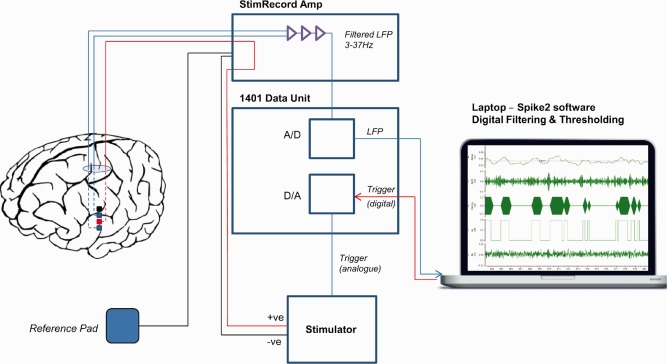
Brain-computer interfaces (BCIs) could potentially be used to interact with pathological brain signals to intervene and ameliorate their effects in disease states. Here, we provide proof-of-principle of this approach by using a BCI to interpret pathological brain activity in patients with advanced Parkinson disease (PD) and to use this feedback to control when therapeutic deep brain stimulation (DBS) is delivered. Our goal was to demonstrate that by personalizing and optimizing stimulation in real time, we could improve on both the efficacy and efficiency of conventional continuous DBS.
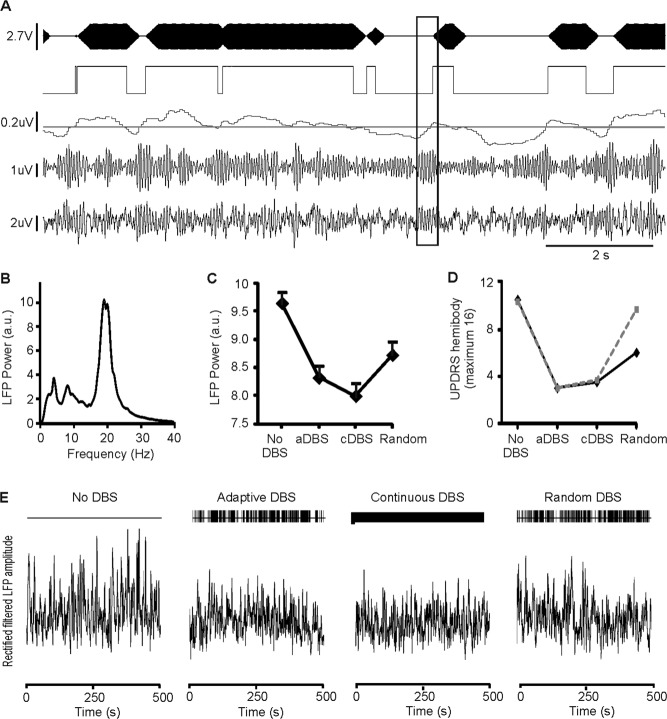
We tested BCI-controlled adaptive DBS (aDBS) of the subthalamic nucleus in 8 PD patients. Feedback was provided by processing of the local field potentials recorded directly from the stimulation electrodes. The results were compared to no stimulation, conventional continuous stimulation (cDBS), and random intermittent stimulation. Both unblinded and blinded clinical assessments of motor effect were performed using the Unified Parkinson's Disease Rating Scale.
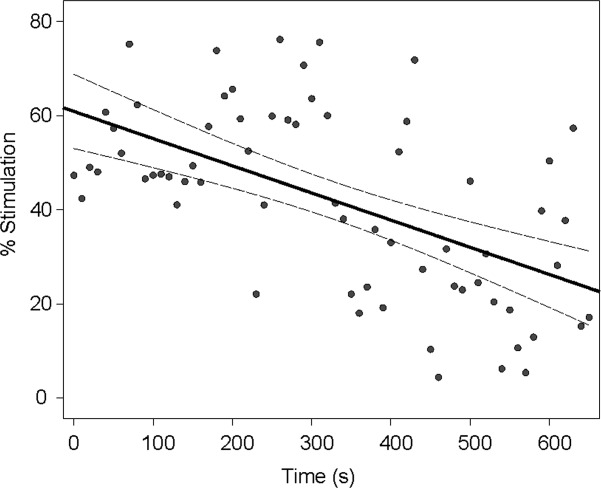
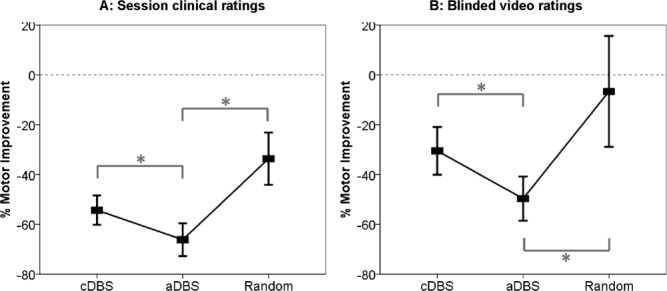
Motor scores improved by 66% (unblinded) and 50% (blinded) during aDBS, which were 29% (p = 0.03) and 27% (p = 0.005) better than cDBS, respectively. These improvements were achieved with a 56% reduction in stimulation time compared to cDBS, and a corresponding reduction in energy requirements (p < 0.001). aDBS was also more effective than no stimulation and random intermittent stimulation.
BCI-controlled DBS is tractable and can be more efficient and efficacious than conventional continuous neuromodulation for PD.
脑-机接口(BCI)可用于与病理性脑信号相互作用,以干预和改善疾病状态下的信号影响。在此,我们通过使用 BCI 来解释晚期帕金森病(PD)患者的病理性脑活动,并利用这种反馈来控制何时进行治疗性深部脑刺激(DBS),为这种方法提供了原理验证。我们的目标是证明通过实时个性化和优化刺激,可以提高常规连续 DBS 的疗效和效率。
我们在 8 名 PD 患者中测试了基于 BCI 的适应性 DBS(aDBS)。通过对直接从刺激电极记录的局部场电位进行处理,提供反馈。将结果与无刺激、常规连续刺激(cDBS)和随机间歇刺激进行比较。使用统一帕金森病评定量表(Unified Parkinson's Disease Rating Scale)进行了盲法和非盲法运动效果评估。
aDBS 时运动评分提高了 66%(非盲法)和 50%(盲法),分别比 cDBS 好 29%(p=0.03)和 27%(p=0.005)。与 cDBS 相比,刺激时间减少了 56%,能量需求相应减少(p<0.001)。aDBS 也比无刺激和随机间歇刺激更有效。
BCI 控制的 DBS 是可行的,对于 PD 来说,它比传统的连续神经调节更有效率和疗效。