Shang Yilun
Institute for Cyber Security, University of Texas at San Antonio, San Antonio, TX 78249, USA.
J Biol Phys. 2013 Jun;39(3):489-500. doi: 10.1007/s10867-013-9318-8. Epub 2013 May 3.
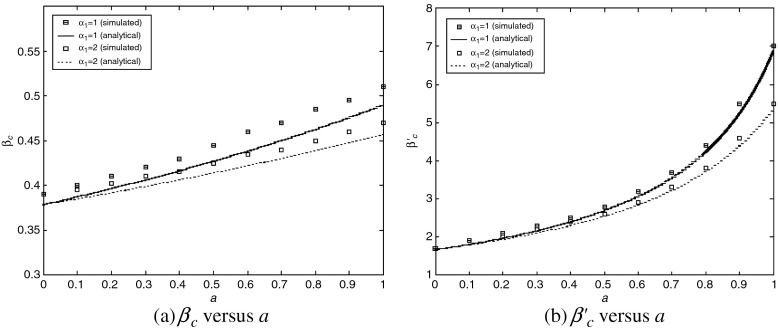
During an epidemic outbreak in a human population, susceptibility to infection can be reduced by raising awareness of the disease. In this paper, we investigate the effects of three forms of awareness (i.e., contact, local, and global) on the spread of a disease in a random network. Connectivity-correlated transmission rates are assumed. By using the mean-field theory and numerical simulation, we show that both local and contact awareness can raise the epidemic thresholds while the global awareness cannot, which mirrors the recent results of Wu et al. The obtained results point out that individual behaviors in the presence of an infectious disease has a great influence on the epidemic dynamics. Our method enriches mean-field analysis in epidemic models.
在人群中爆发流行病期间,通过提高对该疾病的认知可以降低感染易感性。在本文中,我们研究了三种形式的认知(即接触性、局部性和全局性)对随机网络中疾病传播的影响。假设传播率与连通性相关。通过使用平均场理论和数值模拟,我们表明局部认知和接触性认知都可以提高流行阈值,而全局性认知则不能,这与Wu等人最近的结果一致。所得结果指出,传染病存在时的个体行为对疫情动态有很大影响。我们的方法丰富了流行病模型中的平均场分析。