Department of Oral Biology, Faculty of Odontology, Malmö University, Malmö SE-20506, Sweden.
BMC Oral Health. 2013 Jul 16;13:32. doi: 10.1186/1472-6831-13-32.
Titanium implants in the oral cavity are covered with a saliva-derived pellicle to which early colonizing microorganisms such as Streptococcus oralis can bind. The protein profiles of salivary pellicles on titanium have not been well characterized and the proteins of importance for binding are thus unknown. Biofilm bacteria exhibit different phenotypes from their planktonic counterparts and contact with salivary proteins may be one factor contributing to the induction of changes in physiology. We have characterized salivary pellicles from titanium surfaces and investigated how contact with uncoated and saliva-coated titanium surfaces affects metabolic activity in adherent cells of S. oralis.
Salivary pellicles on smooth titanium surfaces were desorbed and these, as well as purified human saliva, were subjected to two-dimensional gel electrophoresis and mass spectroscopy. A parallel plate flow-cell model was used to study binding of a fresh isolate of S. oralis to uncoated and saliva-coated titanium surfaces. Metabolic activity was assessed using the BacLight CTC Vitality Kit and confocal scanning laser microscopy. Experiments were carried out in triplicate and the results analyzed using Student's t-test or ANOVA.
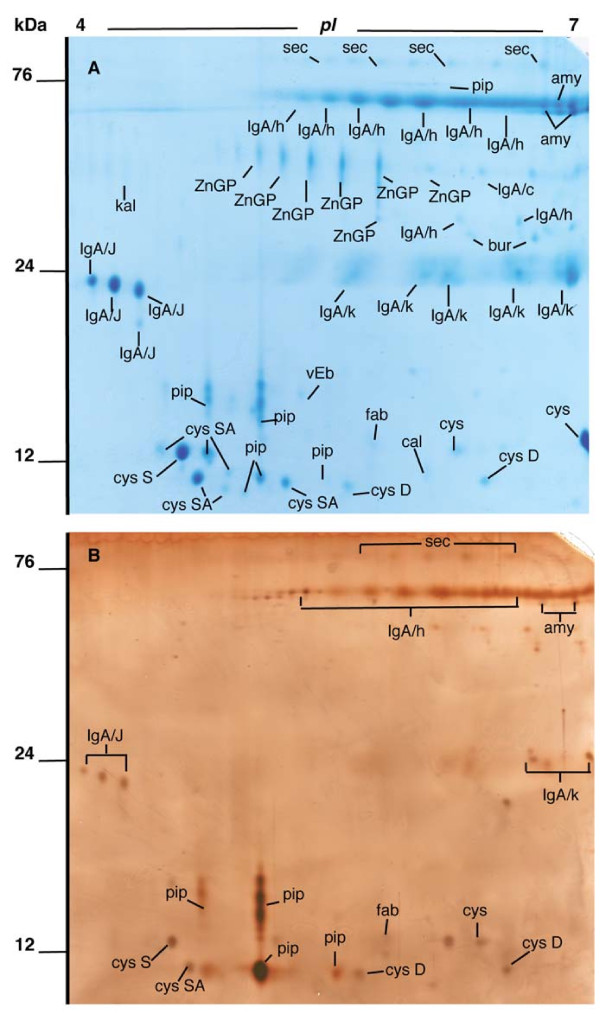
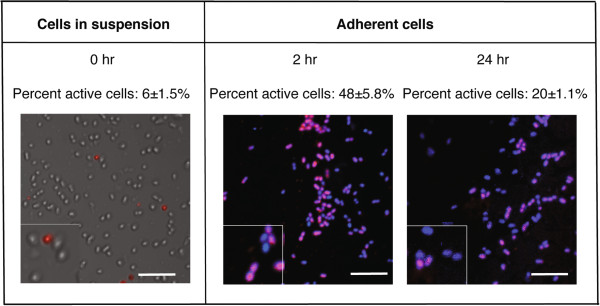
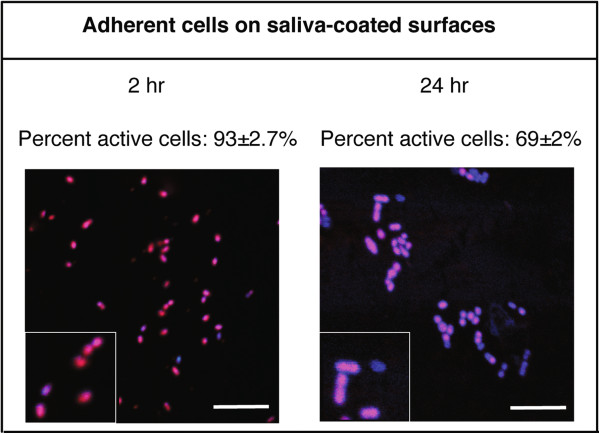
Secretory IgA, α-amylase and cystatins were identified as dominant proteins in the salivary pellicles. Selective adsorption of proteins was demonstrated by the enrichment of prolactin-inducible protein and absence of zinc-α₂-glycoprotein relative to saliva. Adherence of S. oralis to titanium led to an up-regulation of metabolic activity in the population after 2 hours. In the presence of a salivary pellicle, this effect was enhanced and sustained over the following 22 hour period.
We have shown that adherence to smooth titanium surfaces under flow causes an up-regulation of metabolic activity in the early oral colonizer S. oralis, most likely as part of an adaptation to the biofilm mode of life. The effect was enhanced by a salivary pellicle containing sIgA, α-amylase, cystatins and prolactin-inducible protein which was, for the first time, identified as an abundant component of salivary pellicles on titanium. Further studies are needed to clarify the mechanisms underlying the effect of surface contact on metabolic activity as well as to identify the salivary proteins responsible for enhancing the effect.
口腔中的钛植入物被唾液衍生的黏膜所覆盖,早期定植微生物如口腔链球菌可以黏附在黏膜上。唾液黏膜在钛上的蛋白质谱尚未得到很好的描述,因此,对于结合至关重要的蛋白质尚不清楚。生物膜细菌表现出与其浮游物不同的表型,与唾液蛋白的接触可能是导致生理变化的一个因素。我们已经对钛表面的唾液黏膜进行了表征,并研究了与未涂层和唾液涂层钛表面的接触如何影响口腔链球菌黏附细胞的代谢活性。
从光滑钛表面洗脱唾液黏膜,对这些黏膜以及纯化的人唾液进行二维凝胶电泳和质谱分析。使用平行板流动池模型研究新鲜分离的口腔链球菌对未涂层和唾液涂层钛表面的结合。使用 BacLight CTC 活力试剂盒和共聚焦扫描激光显微镜评估代谢活性。实验重复进行了 3 次,使用学生 t 检验或 ANOVA 对结果进行分析。
分泌型免疫球蛋白 A、α-淀粉酶和半胱氨酸蛋白酶抑制剂被鉴定为唾液黏膜中的主要蛋白质。通过富集催乳素诱导蛋白和缺乏锌-α₂-糖蛋白,证明了蛋白质的选择性吸附。口腔链球菌黏附在钛上会导致在 2 小时后种群的代谢活性上调。在存在唾液黏膜的情况下,这种效应在接下来的 22 小时内得到增强和持续。
我们已经表明,在流动条件下黏附在光滑的钛表面会导致早期口腔定植菌口腔链球菌的代谢活性上调,这很可能是其适应生物膜生活方式的一部分。唾液中含有 sIgA、α-淀粉酶、半胱氨酸蛋白酶抑制剂和催乳素诱导蛋白的黏膜增强了这种效应,这些蛋白质首次被鉴定为钛表面唾液黏膜的丰富成分。需要进一步研究以阐明表面接触对代谢活性的影响机制,以及确定负责增强这种效应的唾液蛋白。