• 文献检索
  • 文档翻译
  • 深度研究
  • 学术资讯
  • Suppr Zotero 插件Zotero 插件
  • 邀请有礼
  • 套餐&价格
  • 历史记录
应用&插件
Suppr Zotero 插件Zotero 插件浏览器插件Mac 客户端Windows 客户端微信小程序
定价
高级版会员购买积分包购买API积分包
服务
文献检索文档翻译深度研究API 文档MCP 服务
关于我们
关于 Suppr公司介绍联系我们用户协议隐私条款
关注我们

Suppr 超能文献

核心技术专利:CN118964589B侵权必究
粤ICP备2023148730 号-1Suppr @ 2026

文献检索

告别复杂PubMed语法,用中文像聊天一样搜索,搜遍4000万医学文献。AI智能推荐,让科研检索更轻松。

立即免费搜索

文件翻译

保留排版,准确专业,支持PDF/Word/PPT等文件格式,支持 12+语言互译。

免费翻译文档

深度研究

AI帮你快速写综述,25分钟生成高质量综述,智能提取关键信息,辅助科研写作。

立即免费体验

全食物频率问卷与三天非称重食物记录在年轻波兰成年女性中的比较:对膳食评估的影响。

Comparison of a full food-frequency questionnaire with the three-day unweighted food records in young Polish adult women: implications for dietary assessment.

机构信息

Department of Human Nutrition, University of Warmia and Mazury, Słoneczna 44a, Olsztyn 10-718, Poland.

出版信息

Nutrients. 2013 Jul 19;5(7):2747-76. doi: 10.3390/nu5072747.

DOI:10.3390/nu5072747
PMID:23877089
原文链接:https://pmc.ncbi.nlm.nih.gov/articles/PMC3738998/
Abstract

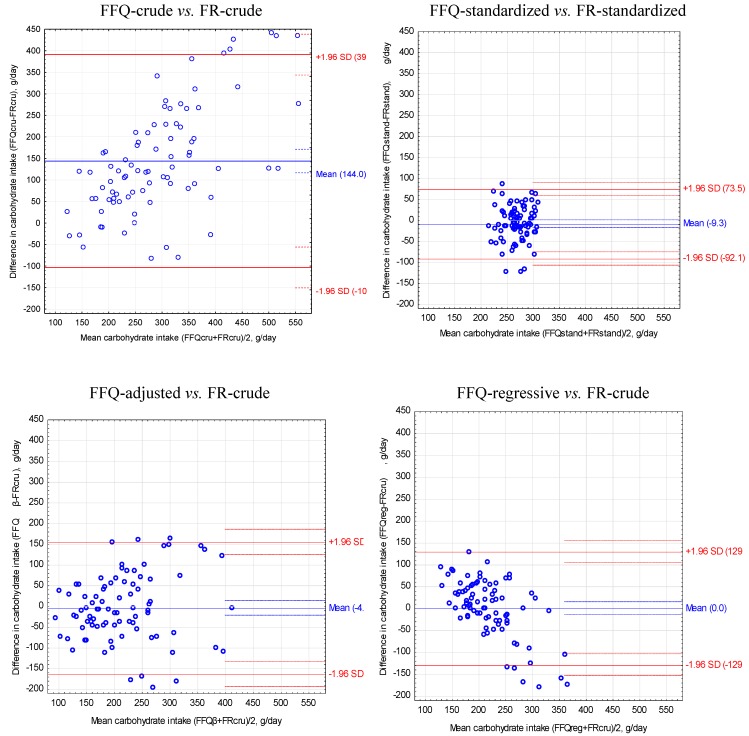
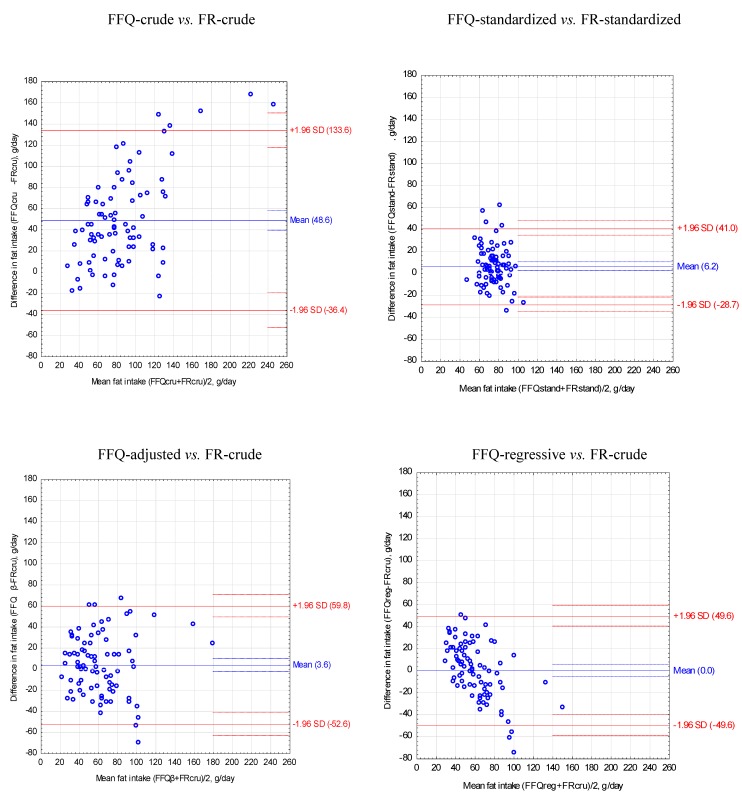
The food frequency questionnaire (FFQ) and the food record (FR) are among the most common methods used in dietary research. It is important to know that is it possible to use both methods simultaneously in dietary assessment and prepare a single, comprehensive interpretation. The aim of this study was to compare the energy and nutritional value of diets, determined by the FFQ and by the three-day food records of young women. The study involved 84 female students aged 21-26 years (mean of 22.2 ± 0.8 years). Completing the FFQ was preceded by obtaining unweighted food records covering three consecutive days. Energy and nutritional value of diets was assessed for both methods (FFQ-crude, FR-crude). Data obtained for FFQ-crude were adjusted with beta-coefficient equaling 0.5915 (FFQ-adjusted) and regression analysis (FFQ-regressive). The FFQ-adjusted was calculated as FR-crude/FFQ-crude ratio of mean daily energy intake. FFQ-regressive was calculated for energy and each nutrient separately using regression equation, including FFQ-crude and FR-crude as covariates. For FR-crude and FFQ-crude the energy value of diets was standardized to 2000 kcal (FR-standardized, FFQ-standardized). Methods of statistical comparison included a dependent samples t-test, a chi-square test, and the Bland-Altman method. The mean energy intake in FFQ-crude was significantly higher than FR-crude (2740.5 kcal vs. 1621.0 kcal, respectively). For FR-standardized and FFQ-standardized, significance differences were found in the mean intake of 18 out of 31 nutrients, for FR-crude and FFQ-adjusted in 13 out of 31 nutrients and FR-crude and FFQ-regressive in 11 out of 31 nutrients. The Bland-Altman method showed an overestimation of energy and nutrient intake by FFQ-crude in comparison to FR-crude, e.g., total protein was overestimated by 34.7 g/day (95% Confidence Interval, CI: -29.6, 99.0 g/day) and fat by 48.6 g/day (95% CI: -36.4, 133.6 g/day). After regressive transformation of FFQ, the absolute difference between FFQ-regressive and FR-crude equaled 0.0 g/day and 95% CI were much better (e.g., for total protein 95% CI: -32.7, 32.7 g/day, for fat 95% CI: -49.6, 49.6 g/day). In conclusion, differences in nutritional value of diets resulted from overestimating energy intake by the FFQ in comparison to the three-day unweighted food records. Adjustment of energy and nutrient intake applied for the FFQ using various methods, particularly regression equations, significantly improved the agreement between results obtained by both methods and dietary assessment. To obtain the most accurate results in future studies using this FFQ, energy and nutrient intake should be adjusted by the regression equations presented in this paper.

摘要

食物频率问卷 (FFQ) 和食物记录 (FR) 是膳食研究中最常用的方法。重要的是要知道,在膳食评估中同时使用这两种方法并编制一份单一的综合解释是有可能的。本研究旨在比较通过 FFQ 和年轻女性的三天食物记录确定的饮食的能量和营养值。研究对象为 84 名年龄在 21-26 岁的女性学生(平均年龄 22.2 ± 0.8 岁)。在获得连续三天的未加权食物记录之前,先完成 FFQ。使用两种方法(FFQ-粗值、FR-粗值)评估饮食的能量和营养值。FFQ-粗值的数据用等于 0.5915 的β系数进行调整(FFQ-调整)和回归分析(FFQ-回归)。FFQ-调整值是通过 FR-粗值/FFQ-粗值的平均每日能量摄入比计算得出的。使用回归方程分别为能量和每种营养素计算 FFQ-回归,其中包括 FFQ-粗值和 FR-粗值作为协变量。对于 FR-粗值和 FFQ-粗值,将饮食的能量值标准化为 2000 千卡(FR-标准化,FFQ-标准化)。统计比较方法包括配对样本 t 检验、卡方检验和 Bland-Altman 方法。FFQ-粗值的平均能量摄入量明显高于 FR-粗值(分别为 2740.5 千卡和 1621.0 千卡)。对于 FR-标准化和 FFQ-标准化,在 31 种营养素中的 18 种营养素中发现了摄入量的显著差异,对于 FR-粗值和 FFQ-调整,在 31 种营养素中的 13 种营养素中发现了差异,对于 FR-粗值和 FFQ-回归,在 31 种营养素中的 11 种营养素中发现了差异。Bland-Altman 方法显示,与 FR-粗值相比,FFQ-粗值高估了能量和营养素的摄入量,例如,总蛋白高估了 34.7 克/天(95%置信区间,CI:-29.6,99.0 克/天),脂肪高估了 48.6 克/天(95% CI:-36.4,133.6 克/天)。在 FFQ 回归转换后,FFQ-回归和 FR-粗值之间的绝对差异为 0.0 克/天,95%CI 要好得多(例如,总蛋白 95%CI:-32.7,32.7 克/天,脂肪 95%CI:-49.6,49.6 克/天)。总之,与三天未加权食物记录相比,FFQ 高估了能量摄入,导致饮食的营养值存在差异。使用各种方法(特别是回归方程)对 FFQ 的能量和营养素摄入量进行调整,显著提高了两种方法之间的结果一致性和膳食评估。为了在未来使用该 FFQ 的研究中获得最准确的结果,应使用本文提出的回归方程对能量和营养素摄入量进行调整。

https://cdn.ncbi.nlm.nih.gov/pmc/blobs/621b/3738998/8f4a613e481d/nutrients-05-02747-g003.jpg
https://cdn.ncbi.nlm.nih.gov/pmc/blobs/621b/3738998/faaf476c8543/nutrients-05-02747-g001.jpg
https://cdn.ncbi.nlm.nih.gov/pmc/blobs/621b/3738998/9ebffe052e56/nutrients-05-02747-g002.jpg
https://cdn.ncbi.nlm.nih.gov/pmc/blobs/621b/3738998/8f4a613e481d/nutrients-05-02747-g003.jpg
https://cdn.ncbi.nlm.nih.gov/pmc/blobs/621b/3738998/faaf476c8543/nutrients-05-02747-g001.jpg
https://cdn.ncbi.nlm.nih.gov/pmc/blobs/621b/3738998/9ebffe052e56/nutrients-05-02747-g002.jpg
https://cdn.ncbi.nlm.nih.gov/pmc/blobs/621b/3738998/8f4a613e481d/nutrients-05-02747-g003.jpg

相似文献

1
Comparison of a full food-frequency questionnaire with the three-day unweighted food records in young Polish adult women: implications for dietary assessment.全食物频率问卷与三天非称重食物记录在年轻波兰成年女性中的比较:对膳食评估的影响。
Nutrients. 2013 Jul 19;5(7):2747-76. doi: 10.3390/nu5072747.
2
Online dietary intake estimation: reproducibility and validity of the Food4Me food frequency questionnaire against a 4-day weighed food record.在线膳食摄入量估计:Food4Me食物频率问卷相对于4天称重食物记录的可重复性和有效性。
J Med Internet Res. 2014 Aug 11;16(8):e190. doi: 10.2196/jmir.3355.
3
The 72-Item Semi-Quantitative Food Frequency Questionnaire (72-Item SQ-FFQ) for Polish Young Adults: Reproducibility and Relative Validity.波兰青年 72 项半定量食物频率问卷(72-Item SQ-FFQ)的再现性和相对有效性。
Nutrients. 2022 Jun 29;14(13):2696. doi: 10.3390/nu14132696.
4
Development, validation and reproducibility of a food frequency questionnaire to measure flavonoid intake in older Australian adults.开发、验证和重现性:一种用于测量老年澳大利亚成年人黄酮类化合物摄入量的食物频率问卷。
Nutr Diet. 2018 Feb;75(1):106-116. doi: 10.1111/1747-0080.12371. Epub 2017 Aug 10.
5
Underreporting of energy intake in Brazilian women varies according to dietary assessment: a cross-sectional study using doubly labeled water.巴西女性能量摄入报告不足情况因膳食评估方法而异:一项使用双标水法的横断面研究
J Am Diet Assoc. 2008 Dec;108(12):2031-40. doi: 10.1016/j.jada.2008.09.012.
6
Online dietary intake estimation: the Food4Me food frequency questionnaire.在线膳食摄入量评估:Food4Me食物频率问卷
J Med Internet Res. 2014 Jun 9;16(6):e150. doi: 10.2196/jmir.3105.
7
Validation of Nutrient Intake Estimates Derived Using a Semi-Quantitative FFQ against 3 Day Diet Records in the Baltimore Longitudinal Study of Aging.在巴尔的摩纵向衰老研究中,使用半定量食物频率问卷得出的营养素摄入量估计值与3天饮食记录的验证。
J Nutr Health Aging. 2015 Dec;19(10):994-1002. doi: 10.1007/s12603-015-0518-8.
8
Development and validation of an electronic FFQ to assess food intake in the Slovene population.用于评估斯洛文尼亚人群食物摄入量的电子食物频率问卷的开发与验证
Public Health Nutr. 2014 Aug;17(8):1729-37. doi: 10.1017/S1368980013002577. Epub 2013 Oct 8.
9
A validation study comparing energy and nutrient intake between a web-based food frequency questionnaire and a 4-d dietary record.一项基于网络的食物频率问卷和 4 天饮食记录的能量和营养素摄入量比较的验证研究。
Nutrition. 2024 Apr;120:112332. doi: 10.1016/j.nut.2023.112332. Epub 2023 Dec 20.
10
Web-Based Dietary Intake Estimation to Assess the Reproducibility and Relative Validity of the EatWellQ8 Food Frequency Questionnaire: Validation Study.基于网络的膳食摄入量估计,以评估EatWellQ8食物频率问卷的可重复性和相对有效性:验证研究。
JMIR Form Res. 2021 Mar 2;5(3):e13591. doi: 10.2196/13591.

引用本文的文献

1
Energy and Nutrient Intakes of Public Health Concern by Rural and Urban Ghanaian Mothers Assessed by Weighed Food Compared to Recommended Intakes.通过称重食物评估的加纳农村和城市母亲的能量和营养素摄入量与推荐摄入量相比存在公共卫生问题。
Nutrients. 2025 Aug 7;17(15):2567. doi: 10.3390/nu17152567.
2
Development, Validity, and Reliability of a Food Frequency Questionnaire for Omani Adults.阿曼成年人食物频率问卷的开发、效度和信度
Nutrients. 2025 Jul 4;17(13):2220. doi: 10.3390/nu17132220.
3
Risk Factors of Primary Dysmenorrhea in Female Adolescent Basketball Players Related to Dietary, Hormonal, and Immuno-Metabolic Factors and Disordered Eating Attitudes.

本文引用的文献

1
Development, reproducibility and validity of the food frequency questionnaire in the Poland arm of the Prospective Urban and Rural Epidemiological (PURE) study.《前瞻性城乡流行病学(PURE)研究波兰分中心食物频率问卷的编制、可重复性和有效性》
J Hum Nutr Diet. 2012 Jun;25(3):225-32. doi: 10.1111/j.1365-277X.2012.01240.x. Epub 2012 Mar 6.
2
A food frequency questionnaire for the assessment of calcium, vitamin D and vitamin K: a pilot validation study.用于评估钙、维生素 D 和维生素 K 的食物频率问卷:一项初步验证研究。
Nutrients. 2010 Aug;2(8):805-19. doi: 10.3390/nu2080805. Epub 2010 Jul 28.
3
Evaluation of dietary assessment tools used to assess the diet of adults participating in the Communities Advancing the Studies of Tribal Nations Across the Lifespan cohort.
女性青少年篮球运动员原发性痛经的危险因素与饮食、激素、免疫代谢因素及饮食态度紊乱有关。
Nutrients. 2025 Mar 28;17(7):1190. doi: 10.3390/nu17071190.
4
Associations with Taste, Diet, and Health in an Italian Population.意大利人群中味觉、饮食与健康的关联。
Nutrients. 2025 Jan 17;17(2):329. doi: 10.3390/nu17020329.
5
Determinants of Fish Intake and Complying with Fish Consumption Recommendations-A Nationwide Cross-Sectional Study among Secondary School Students in Poland.鱼类摄入量的决定因素及对鱼类消费建议的遵守情况:波兰全国中学生的一项横断面研究。
Nutrients. 2024 Mar 15;16(6):853. doi: 10.3390/nu16060853.
6
The Mediterranean Diet Scale (MDS): Translation and validation of the Arabic version.地中海饮食量表(MDS):阿拉伯语版本的翻译和验证。
PLoS One. 2023 Aug 24;18(8):e0287497. doi: 10.1371/journal.pone.0287497. eCollection 2023.
7
Associations between Serum Saturated Fatty Acids Content and Mortality in Dialysis Patients.透析患者血清饱和脂肪酸含量与死亡率之间的关联
J Clin Med. 2022 Aug 28;11(17):5051. doi: 10.3390/jcm11175051.
8
Validating Accuracy of an Internet-Based Application against USDA Computerized Nutrition Data System for Research on Essential Nutrients among Social-Ethnic Diets for the E-Health Era.验证互联网应用程序在研究电子健康时代社会民族饮食中的基本营养素方面与美国农业部计算机营养数据系统的准确性。
Nutrients. 2022 Jul 31;14(15):3168. doi: 10.3390/nu14153168.
9
Rice-based breakfast improves fasting glucose and HOMA-IR in Korean adolescents who skip breakfast, but breakfast skipping increases aromatic amino acids associated with diabetes prediction in Korean adolescents who skip breakfast: a randomized, parallel-group, controlled trial.对于不吃早餐的韩国青少年,以米饭为主的早餐可改善空腹血糖和胰岛素抵抗指数(HOMA-IR),但不吃早餐会增加与韩国青少年糖尿病预测相关的芳香族氨基酸:一项随机、平行组、对照试验。
Nutr Res Pract. 2022 Aug;16(4):450-463. doi: 10.4162/nrp.2022.16.4.450. Epub 2021 Oct 25.
10
The 72-Item Semi-Quantitative Food Frequency Questionnaire (72-Item SQ-FFQ) for Polish Young Adults: Reproducibility and Relative Validity.波兰青年 72 项半定量食物频率问卷(72-Item SQ-FFQ)的再现性和相对有效性。
Nutrients. 2022 Jun 29;14(13):2696. doi: 10.3390/nu14132696.
对用于评估参与“促进部落民族全生命周期研究社区”队列研究的成年人饮食的膳食评估工具的评价。
J Am Diet Assoc. 2010 Jan;110(1):65-73. doi: 10.1016/j.jada.2009.10.012.
4
Misreporting of energy and micronutrient intake estimated by food records and 24 hour recalls, control and adjustment methods in practice.通过食物记录和24小时回顾法估算的能量和微量营养素摄入量的误报情况及实际中的控制与调整方法。
Br J Nutr. 2009 Jul;101 Suppl 2:S73-85. doi: 10.1017/S0007114509990602.
5
The effect of personal characteristics on the validity of nutrient intake estimates using a food-frequency questionnaire.个人特征对使用食物频率问卷进行营养素摄入量估计有效性的影响。
Public Health Nutr. 2006 May;9(3):394-402. doi: 10.1079/phn2006839.
6
Reproducibility and validity of a Chinese food frequency questionnaire used in Taiwan.台湾使用的一份中国食物频率问卷的可重复性和有效性。
Asia Pac J Clin Nutr. 2006;15(2):161-9.
7
Relative validity of a short food frequency questionnaire for assessing nutrient intake versus three-day weighed diet records in middle-aged Japanese.一份简短食物频率问卷在评估中年日本人营养摄入量方面相对于三日称重饮食记录的相对有效性。
J Epidemiol. 2005 Jul;15(4):135-45. doi: 10.2188/jea.15.135.
8
Validity and reproducibility of an interviewer-administered food frequency questionnaire for healthy French-Canadian men and women.针对健康法裔加拿大男性和女性的访谈式食物频率问卷的有效性和可重复性。
Nutr J. 2004 Sep 13;3:13. doi: 10.1186/1475-2891-3-13.
9
Comparison of an Australian food-frequency questionnaire with diet records: implications for nutrition surveillance.澳大利亚食物频率问卷与饮食记录的比较:对营养监测的启示
Public Health Nutr. 2003 Jun;6(4):415-22. doi: 10.1079/PHN2002434.
10
Development, validation and utilisation of food-frequency questionnaires - a review.食物频率问卷的开发、验证与应用——综述
Public Health Nutr. 2002 Aug;5(4):567-87. doi: 10.1079/PHN2001318.