Sayers Stephen P, Gibson Kyle
Department of Physical Therapy, University of Missouri, Columbia, Missouri.
J Strength Cond Res. 2014 Mar;28(3):616-21. doi: 10.1519/JSC.0b013e3182a361b8.
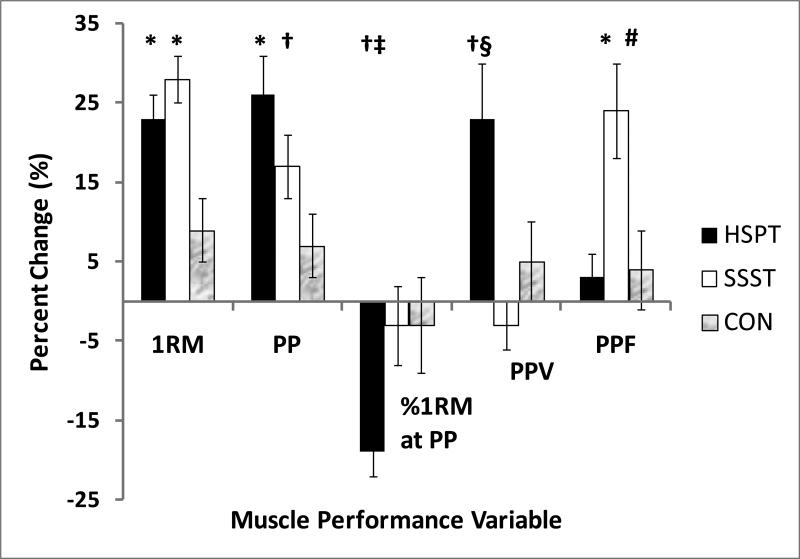
Studies have shown that power training increases peak power (PP) in older adults. Evaluating the external resistance (% 1 repetition maximum [1RM]) at which PP is developed is critical given that changes in the components of PP (force and velocity) are dependent on the %1RM at which PP occurs. The purpose of this study was to compare the changes in PP (and the external resistance at which PP occurred) after 12 weeks of high-speed power training (HSPT) vs. traditional slow-speed strength training (SSST). Seventy-two older men and women were randomized to HSPT at 40% of the 1RM (HSPT: n = 24 [70.8 ± 6.8 years]); traditional resistance training at 80% 1RM (SSST: n = 22 [68.6 ± 7.8 years]); or control (CON: n = 18 [71.5 ± 6.1 years]). Measures of muscle performance were obtained at baseline and after the 12-week training intervention. Changes in muscle power and 1RM strength improved similarly with both HSPT and SSST, but HSPT shifted the external resistance at which PP was produced to a lower external resistance (from 67% 1RM to 52% 1RM) compared with SSST (from 65% 1RM to 62% 1RM) (p ≤ 0.05), thus increasing the velocity component of PP (change: HSPT = 0.18 ± 0.21 m·s; SSST = -0.03 ± 0.15 m·s) (p ≤ 0.05). Because sufficient speed of the lower limb is necessary for functional tasks related to safety (crossing a busy intersection, fall prevention), HSPT should be implemented in older adults to improve power at lower external resistances, thus increasing the velocity component of power and making older adults safer in their environment. These data provide clinicians with the necessary information to tailor exercise programs to the individual needs of the older adult, affecting the components of power.
研究表明,力量训练可提高老年人的峰值功率(PP)。鉴于PP的组成部分(力量和速度)的变化取决于产生PP时的1次重复最大值百分比(%1RM),评估产生PP时的外部阻力(%1RM)至关重要。本研究的目的是比较高速力量训练(HSPT)与传统低速力量训练(SSST)12周后PP(以及产生PP时的外部阻力)的变化。72名老年男性和女性被随机分为接受1RM的40%的HSPT组(HSPT:n = 24 [70.8 ± 6.8岁]);接受80% 1RM的传统阻力训练组(SSST:n = 22 [68.6 ± 7.8岁]);或对照组(CON:n = 18 [71.5 ± 6.1岁])。在基线和12周训练干预后获取肌肉性能指标。HSPT和SSST均使肌肉力量和1RM力量有类似改善,但与SSST(从65% 1RM到62% 1RM)相比,HSPT将产生PP时的外部阻力转移到了更低的外部阻力(从67% 1RM到52% 1RM)(p≤0.05),从而增加了PP的速度组成部分(变化:HSPT = 0.18 ± 0.21米·秒;SSST = -0.03 ± 0.15米·秒)(p≤0.05)。由于与安全相关的功能性任务(穿过繁忙的十字路口、预防跌倒)需要下肢有足够的速度,因此应在老年人中实施HSPT,以提高较低外部阻力下的力量,从而增加力量的速度组成部分,并使老年人在其环境中更安全。这些数据为临床医生提供了必要信息,以便根据老年人的个体需求调整运动计划,影响力量的组成部分。