Bernstein Center for Computational Neuroscience Göttingen, Germany ; Max Planck Institute for Dynamics and Self-Organization Göttingen, Germany.
Front Comput Neurosci. 2013 Jul 24;7:87. doi: 10.3389/fncom.2013.00087. eCollection 2013.
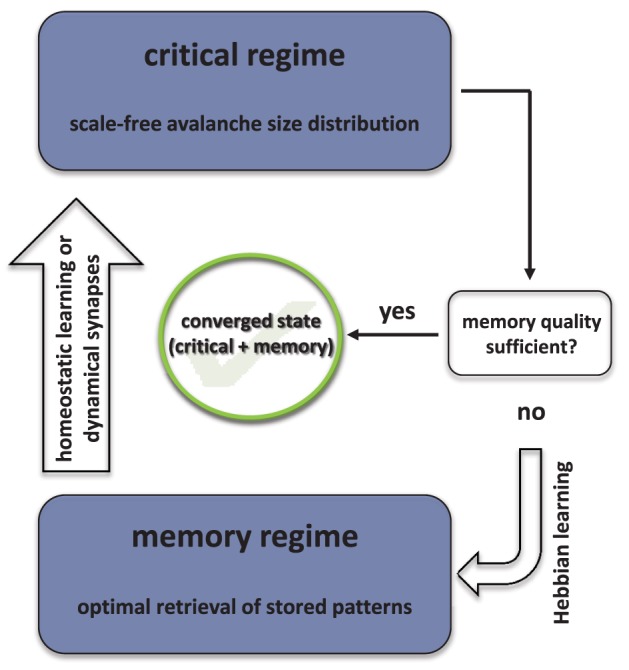
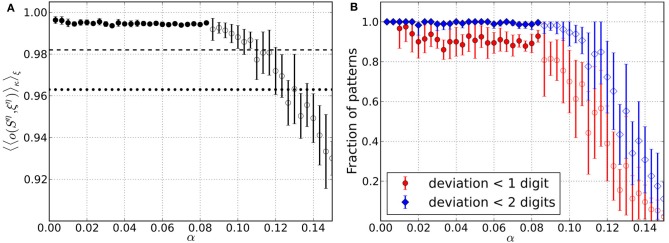
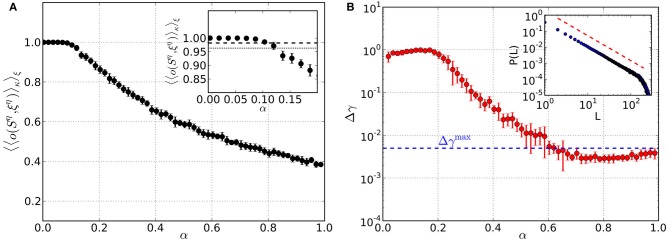
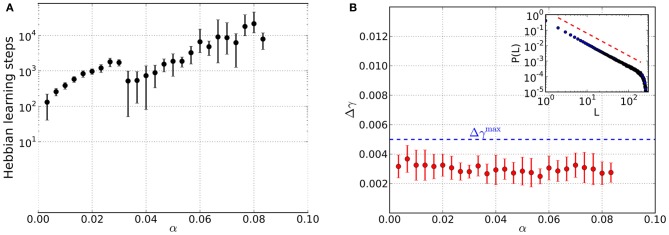
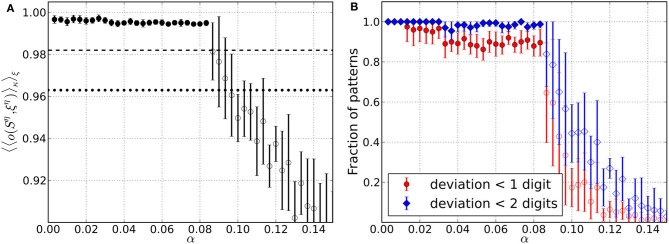
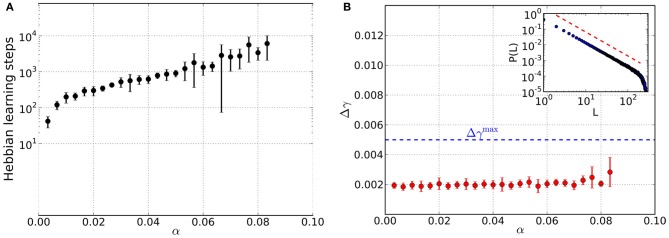
Critical behavior in neural networks is characterized by scale-free avalanche size distributions and can be explained by self-regulatory mechanisms. Theoretical and experimental evidence indicates that information storage capacity reaches its maximum in the critical regime. We study the effect of structural connectivity formed by Hebbian learning on the criticality of network dynamics. The network only endowed with Hebbian learning does not allow for simultaneous information storage and criticality. However, the critical regime can be stabilized by short-term synaptic dynamics in the form of synaptic depression and facilitation or, alternatively, by homeostatic adaptation of the synaptic weights. We show that a heterogeneous distribution of maximal synaptic strengths does not preclude criticality if the Hebbian learning is alternated with periods of critical dynamics recovery. We discuss the relevance of these findings for the flexibility of memory in aging and with respect to the recent theory of synaptic plasticity.
神经网络中的临界行为的特征是无标度的雪崩大小分布,可以用自我调节机制来解释。理论和实验证据表明,信息存储容量在临界状态下达到最大值。我们研究了赫布学习形成的结构连接对网络动力学临界性的影响。仅具有赫布学习的网络不允许同时进行信息存储和临界性。然而,通过短期突触动力学(如突触抑制和易化)或通过突触权重的动态平衡适应,可以稳定临界状态。我们表明,如果赫布学习与临界动力学恢复期交替进行,则最大突触强度的异质分布不会排除临界性。我们讨论了这些发现对衰老时记忆灵活性以及最近的突触可塑性理论的相关性。