Department of Gastroenterology and Hepatology, Osaka Red Cross Hospital, Osaka, Japan.
J Cancer. 2013 Jul 11;4(6):473-80. doi: 10.7150/jca.6609. Print 2013.
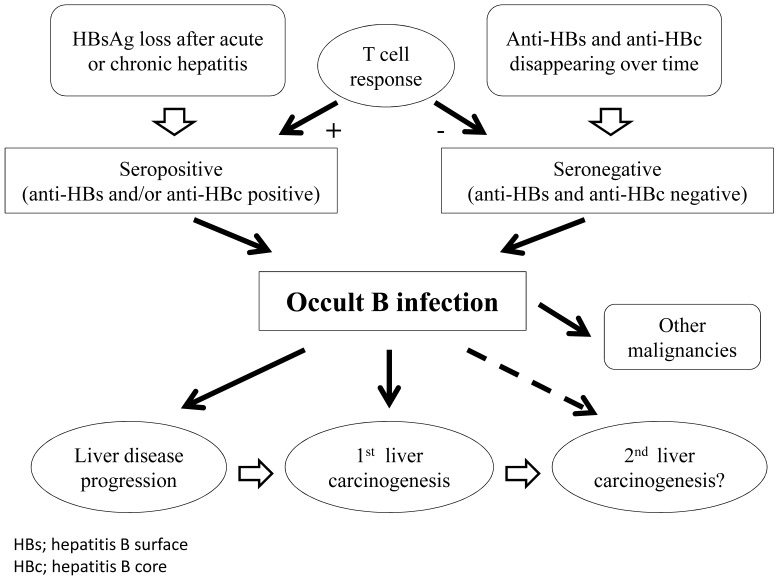
Occult hepatitis B infection (OBI) is defined as long-lasting persistence of hepatitis B virus (HBV) DNA in the liver of patients with hepatitis B surface antigen (HBsAg)-negative status, with or without serological markers of previous exposure (antibodies to HBsAg and/or to hepatitis B core antigen). Over the past two decades, significant progress has been made in understanding OBI and its clinical implications. OBI as a cause of chronic liver disease in patients with HBsAg-negative status is becoming an important disease entity. In conditions of immunocompetence, OBI is inoffensive in itself and detection of HBV DNA in the liver does not always indicate active hepatitis. However, when other factors that cause liver damage, such as hepatitis C virus infection, obesity and alcohol abuse are present, the minimal lesions produced by the immunological response to OBI might worsen the clinical course of the underlying liver disease. Several lines of evidence suggest that OBI is associated with progression of liver fibrosis and the development of hepatocellular carcinoma in patients with chronic liver disease. The major interest in OBI is primarily associated with the growing, widely discussed evidence of its clinical impact. The aim of this review is to highlight recent data for OBI, with a major focus on disease progression or carcinogenesis in patients with chronic liver disease.
隐匿性乙型肝炎病毒感染(OBI)定义为乙型肝炎表面抗原(HBsAg)阴性状态患者肝脏中乙型肝炎病毒(HBV)DNA 的长期持续存在,无论是否存在先前接触的血清学标志物(抗 HBsAg 和/或抗乙型肝炎核心抗原抗体)。在过去的二十年中,人们对 OBI 及其临床意义有了更深入的了解。OBI 作为 HBsAg 阴性状态患者慢性肝病的病因,正成为一种重要的疾病实体。在免疫功能正常的情况下,OBI 本身并无危害,肝脏中检测到 HBV DNA 并不总是表明存在活动性肝炎。然而,当存在其他导致肝损伤的因素,如丙型肝炎病毒感染、肥胖和酗酒时,对 OBI 的免疫反应产生的微小病变可能会使潜在肝病的临床病程恶化。有几条证据表明,OBI 与慢性肝病患者的肝纤维化进展和肝细胞癌的发生有关。人们对 OBI 的主要兴趣主要与日益增多的、广泛讨论的其临床影响的证据有关。本综述的目的是强调 OBI 的最新数据,主要关注慢性肝病患者的疾病进展或癌变。