Laboratório de Epidemiologia e Sistemática Molecular, Instituto Oswaldo Cruz - Fiocruz, Rio de Janeiro, Brazil.
PLoS One. 2013 Aug 5;8(8):e70974. doi: 10.1371/journal.pone.0070974. Print 2013.
Triatoma dimidiata is among the main vectors of Chagas disease in Latin America. However, and despite important advances, there is no consensus about the taxonomic status of phenotypically divergent T. dimidiata populations, which in most recent papers are regarded as subspecies.
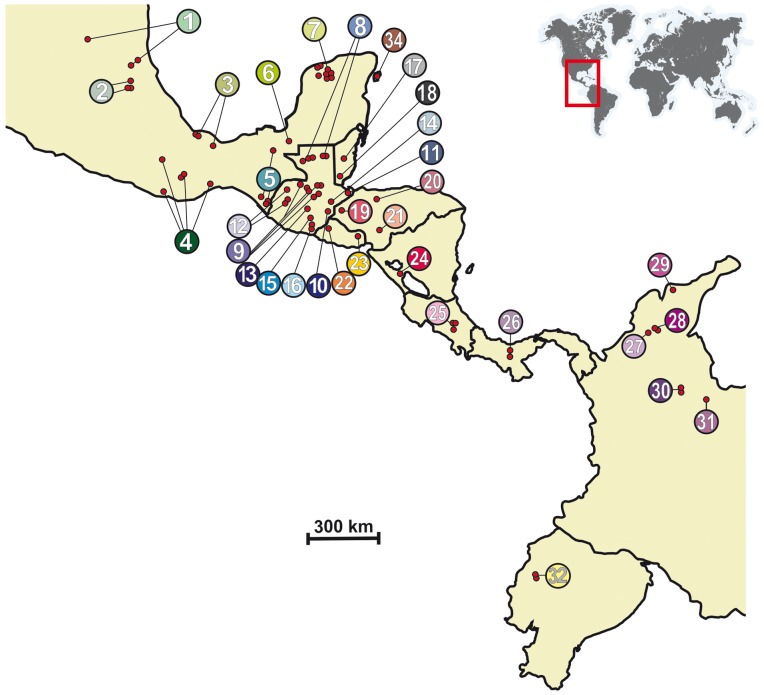
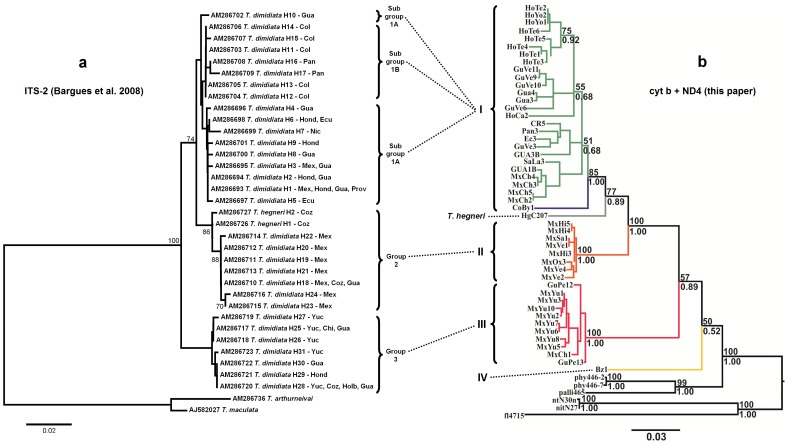
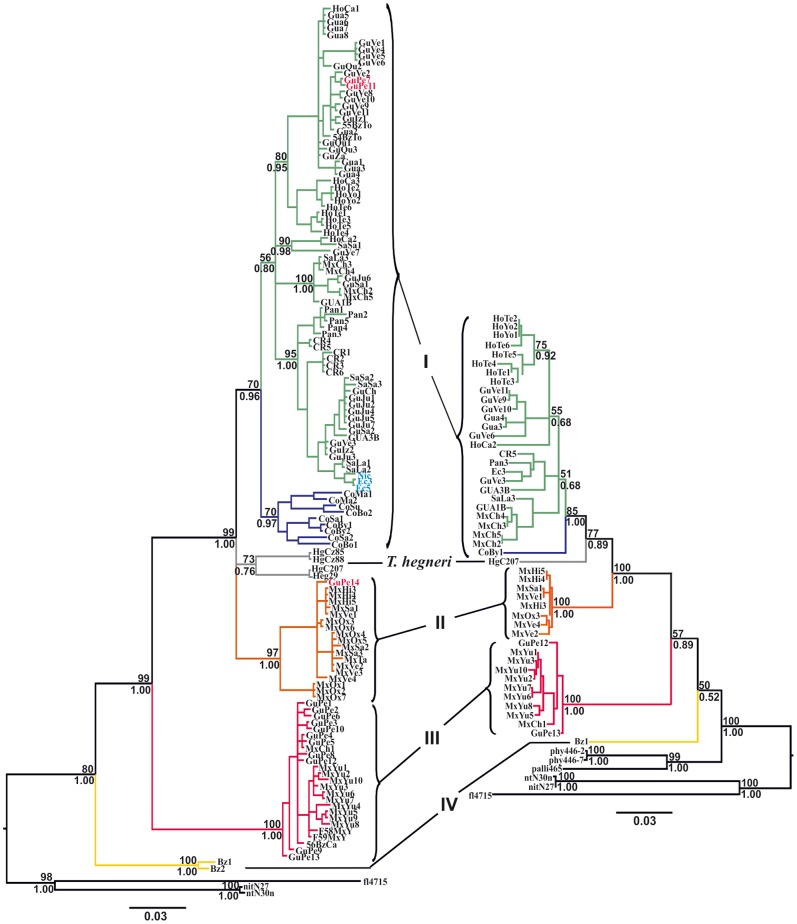
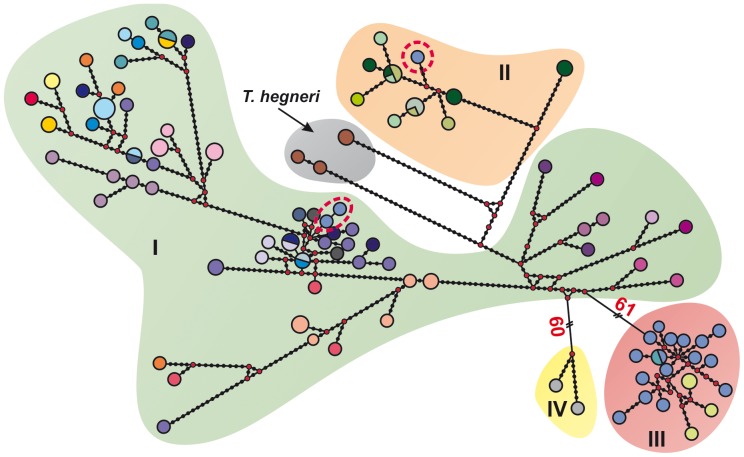
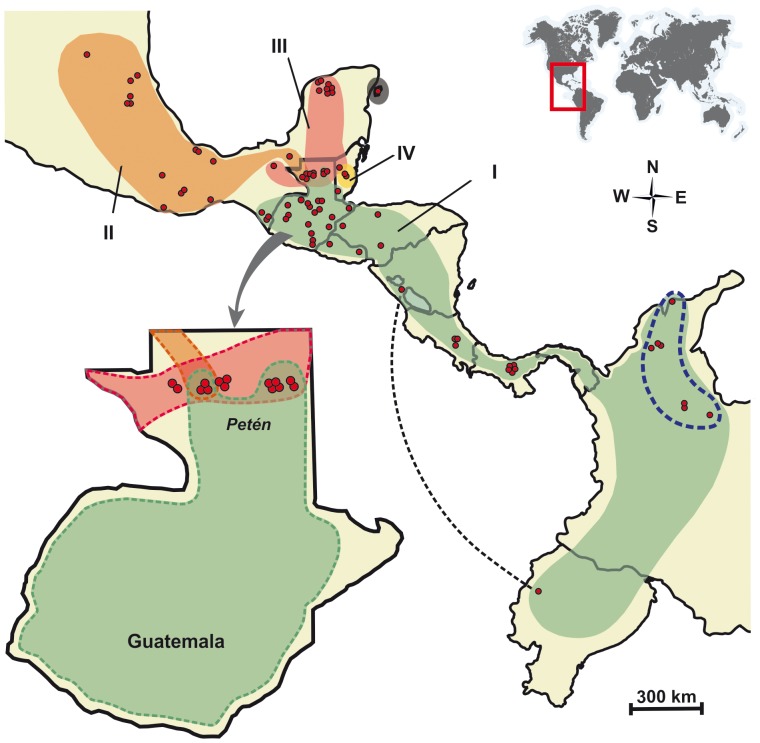
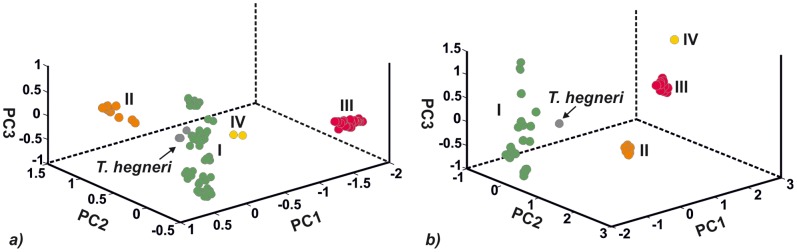
A total of 126 cyt b sequences (621 bp long) were produced for specimens from across the species range. Forty-seven selected specimens representing the main cyt b clades observed (after a preliminary phylogenetic analysis) were also sequenced for an ND4 fragment (554 bp long) and concatenated with their respective cyt b sequences to produce a combined data set totalling 1175 bp/individual. Bayesian and Maximum-Likelihood phylogenetic analyses of both data sets (cyt b, and cyt b+ND4) disclosed four strongly divergent (all pairwise Kimura 2-parameter distances >0.08), monophyletic groups: Group I occurs from Southern Mexico through Central America into Colombia, with Ecuadorian specimens resembling Nicaraguan material; Group II includes samples from Western-Southwestern Mexico; Group III comprises specimens from the Yucatán peninsula; and Group IV consists of sylvatic samples from Belize. The closely-related, yet formally recognized species T. hegneri from the island of Cozumel falls within the divergence range of the T. dimidiata populations studied.
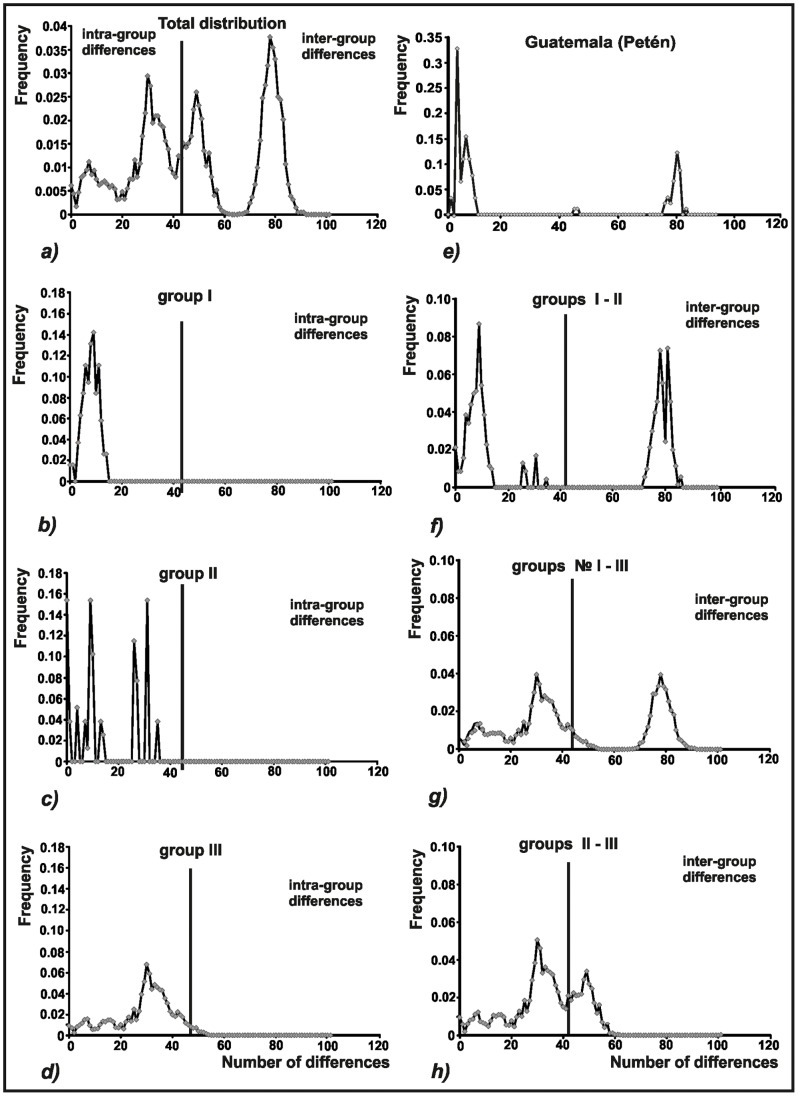
We propose that Groups I-IV, as well as T. hegneri, should be regarded as separate species. In the Petén of Guatemala, representatives of Groups I, II, and III occur in sympatry; the absence of haplotypes with intermediate genetic distances, as shown by multimodal mismatch distribution plots, clearly indicates that reproductive barriers actively promote within-group cohesion. Some sylvatic specimens from Belize belong to a different species - likely the basal lineage of the T. dimidiata complex, originated ~8.25 Mya. The evidence presented here strongly supports the proposition that T. dimidiata is a complex of five cryptic species (Groups I-IV plus T. hegneri) that play different roles as vectors of Chagas disease in the region.
三带喙库蚊是拉丁美洲恰加斯病的主要传播媒介之一。然而,尽管取得了重要进展,但在形态上有差异的三带喙库蚊种群的分类地位仍存在分歧,在最近的大多数论文中,这些种群被视为亚种。
共为来自该物种分布范围的标本生成了 126 条 cyt b 序列(621bp 长)。为了代表初步系统发育分析中观察到的主要 cyt b 支系(47 个选定的标本),还对 47 个选定的标本进行了 ND4 片段(554bp 长)的测序,并将其与各自的 cyt b 序列拼接,生成一个包含 1175bp/个体的组合数据集。对这两个数据集(cyt b 和 cyt b+ND4)进行贝叶斯和最大似然系统发育分析,揭示了四个高度分化的(所有两两 Kimura 2-参数距离>0.08)单系群:I 组从墨西哥南部经中美洲延伸至哥伦比亚,厄瓜多尔标本与尼加拉瓜材料相似;II 组包括来自墨西哥西南部的样本;III 组包括来自尤卡坦半岛的样本;而 IV 组由来自伯利兹的森林样本组成。与该研究中三带喙库蚊种群密切相关但已被正式承认的物种 T. hegneri 来自科苏梅尔岛,位于三带喙库蚊种群的分化范围内。
我们建议将 I-IV 组以及 T. hegneri 视为独立的物种。在危地马拉的佩滕地区,I、II 和 III 组的代表在同域共存;多峰不匹配分布图显示不存在遗传距离中等的单倍型,这清楚地表明生殖障碍积极促进了组内的凝聚力。来自伯利兹的一些森林标本属于不同的物种-可能是三带喙库蚊复合体的基础谱系,起源于约 825 万年前。这里提出的证据强烈支持三带喙库蚊是一个由五个隐种(I-IV 组加 T. hegneri)组成的复合体的观点,这些隐种在该地区扮演着不同的恰加斯病传播媒介角色。