Centre for Interdisciplinary Computational and Dynamical Analysis (CICADA), School of Mathematics, The University of Manchester, Manchester, UK.
J Math Neurosci. 2013 Aug 14;3(1):17. doi: 10.1186/2190-8567-3-17.
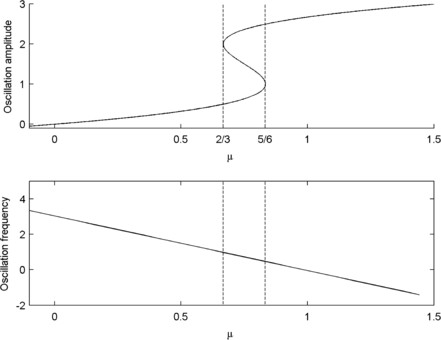
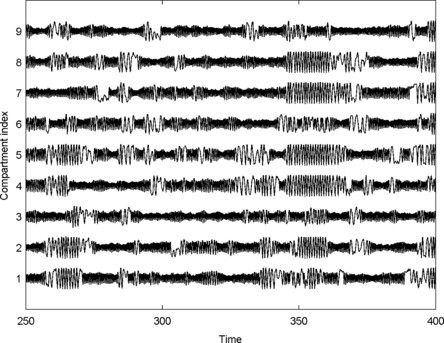
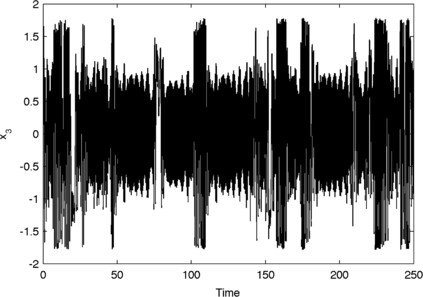
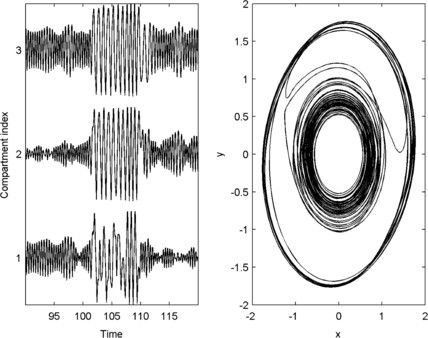
We investigate the dynamic mechanisms underlying intermittent state transitions in a recently proposed neural mass model of epilepsy. A low dimensional model is constructed, which preserves two key features of the neural mass model, namely (i) coupling between oscillators and (ii) heterogeneous proximity of these oscillators to a bifurcation between distinct limit cycles. We demonstrate that state transitions due to intermittency occur in the abstract model. This suggests that there is a general bifurcation mechanism responsible for this behaviour and that this is independent of the precise form of the evolution equations. Such abstractions of neural mass models allow a deeper insight into underlying dynamic and physiological mechanisms, and also allow the more efficient exploration of large scale brain dynamics in disease.
我们研究了最近提出的癫痫神经群体模型中间歇性状态转变的动力学机制。构建了一个低维模型,保留了神经群体模型的两个关键特征,即(i)振荡器之间的耦合和(ii)这些振荡器与不同极限环之间的分岔之间的异质接近性。我们证明了由于间歇性而导致的状态转变在抽象模型中发生。这表明存在一个负责这种行为的一般分岔机制,并且与演化方程的精确形式无关。这种对神经群体模型的抽象可以更深入地了解潜在的动态和生理机制,并允许更有效地探索疾病中的大规模脑动力学。