Department of Epidemiology, School of Public Health and Tropical Medicine, Tulane University, New Orleans, LA.
Diabetes. 2014 Jan;63(1):354-62. doi: 10.2337/db13-0744. Epub 2013 Aug 15.
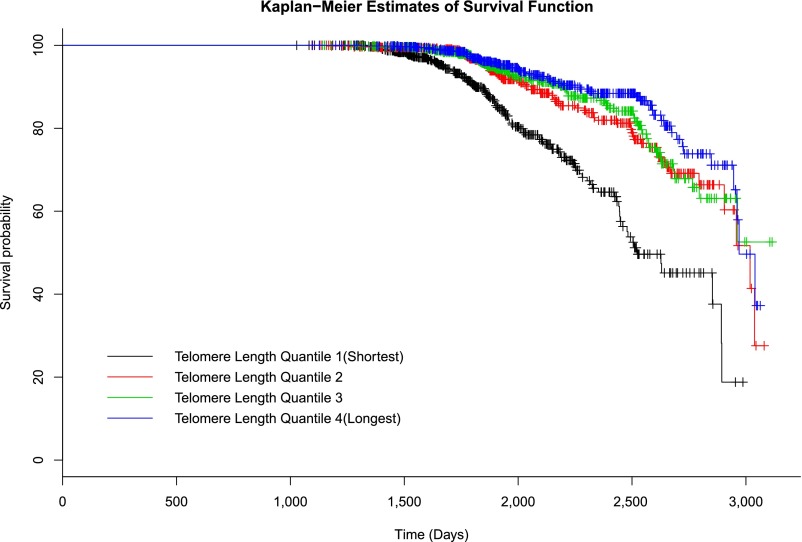
Telomeres play a central role in cellular aging, and shorter telomere length has been associated with age-related disorders including diabetes. However, a causal link between telomere shortening and diabetes risk has not been established. In a well-characterized longitudinal cohort of American Indians participating in the Strong Heart Family Study, we examined whether leukocyte telomere length (LTL) at baseline predicts incident diabetes independent of known diabetes risk factors. Among 2,328 participants free of diabetes at baseline, 292 subjects developed diabetes during an average 5.5 years of follow-up. Compared with subjects in the highest quartile (longest) of LTL, those in the lowest quartile (shortest) had an almost twofold increased risk of incident diabetes (hazard ratio [HR] 1.83 [95% CI 1.26-2.66]), whereas the risk for those in the second (HR 0.87 [95% CI 0.59-1.29]) and the third (HR 0.95 [95% CI 0.65-1.38]) quartiles was statistically nonsignificant. These findings suggest a nonlinear association between LTL and incident diabetes and indicate that LTL could serve as a predictive marker for diabetes development in American Indians, who suffer from disproportionately high rates of diabetes.
端粒在细胞衰老中起着核心作用,端粒较短与包括糖尿病在内的与年龄相关的疾病有关。然而,端粒缩短与糖尿病风险之间的因果关系尚未建立。在一项针对美国印第安人的特征明确的纵向队列研究——“强壮心脏家族研究”中,我们研究了白细胞端粒长度(LTL)在基线时是否可以独立于已知的糖尿病危险因素预测糖尿病的发生。在基线时无糖尿病的 2328 名参与者中,有 292 名在平均 5.5 年的随访中发生了糖尿病。与 LTL 最高四分位数(最长)的参与者相比,最低四分位数(最短)的参与者发生糖尿病的风险几乎增加了两倍(风险比[HR]1.83[95%CI1.26-2.66]),而第二(HR0.87[95%CI0.59-1.29])和第三(HR0.95[95%CI0.65-1.38])四分位数的风险则无统计学意义。这些发现表明 LTL 与糖尿病的发生之间存在非线性关联,并表明 LTL 可以作为美国印第安人发生糖尿病的预测标志物,而美国印第安人患有糖尿病的比例过高。