From the Howard Hughes Medical Institute and the Department of Molecular Biology and Genetics, Johns Hopkins University School of Medicine, Baltimore, Maryland 21205.
J Biol Chem. 2013 Oct 11;288(41):29530-8. doi: 10.1074/jbc.M113.487090. Epub 2013 Aug 20.
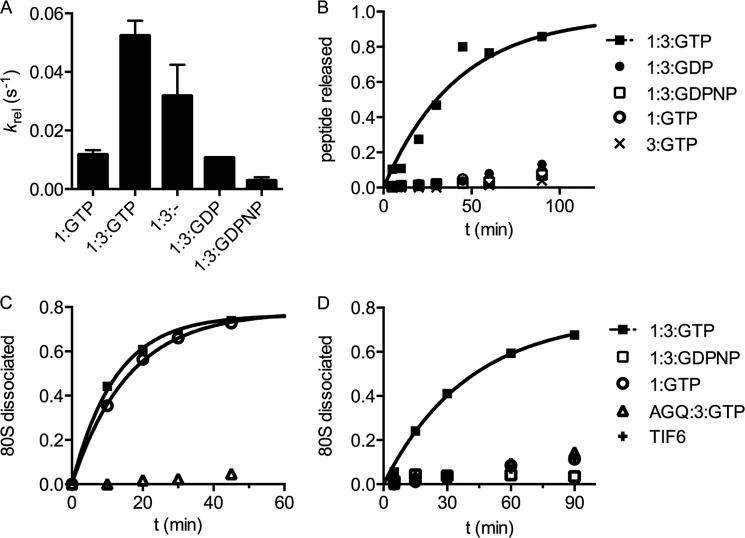
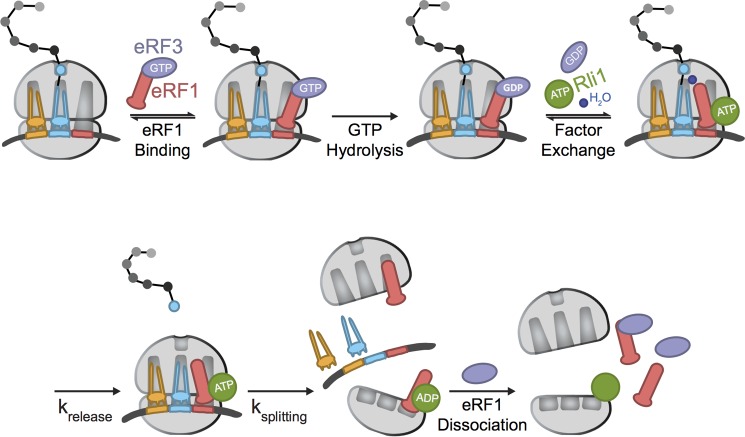
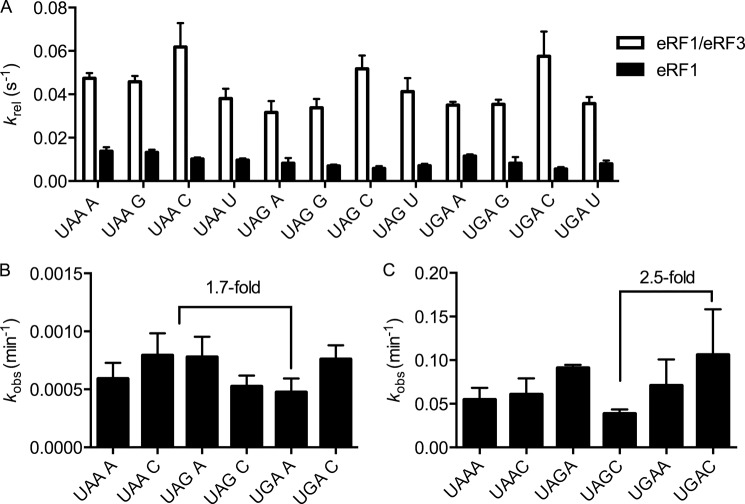
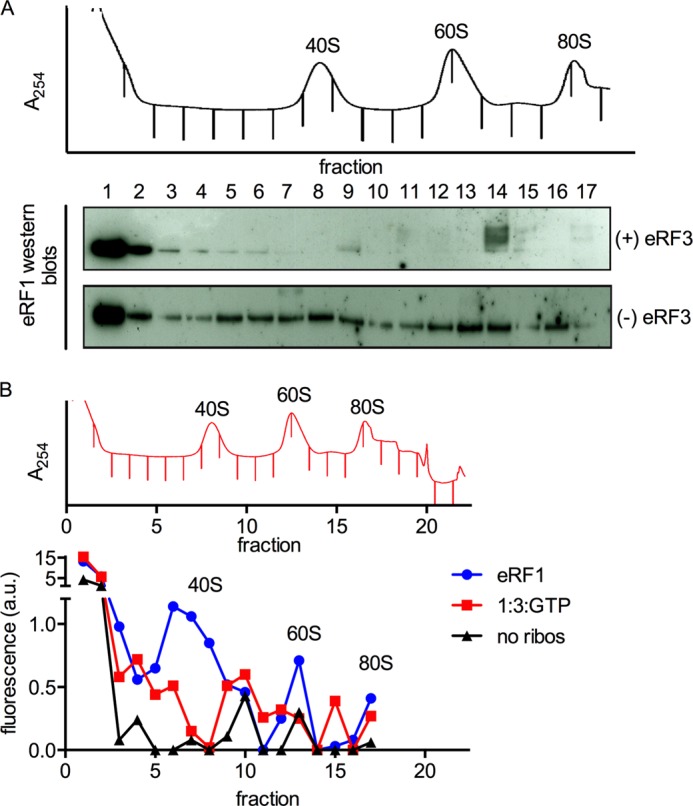
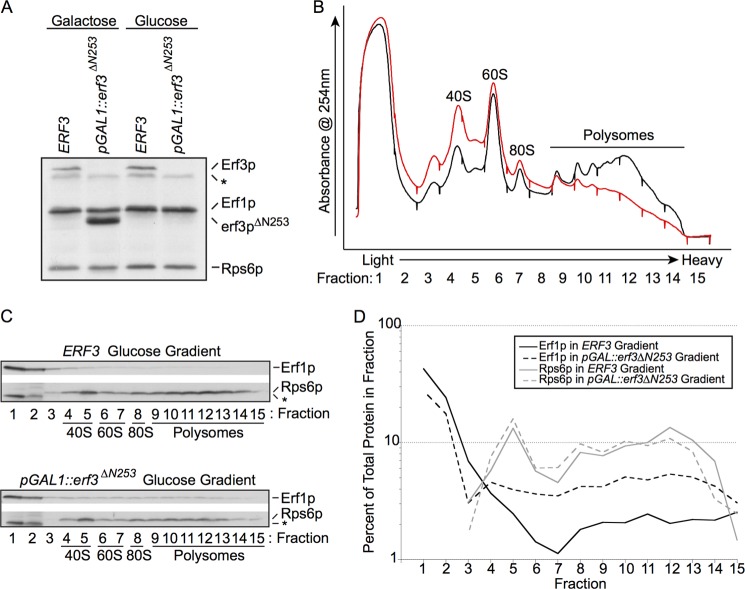
Eukaryotic peptide release factor 3 (eRF3) is a conserved, essential gene in eukaryotes implicated in translation termination. We have systematically measured the contribution of eRF3 to the rates of peptide release with both saturating and limiting levels of eukaryotic release factor 1 (eRF1). Although eRF3 modestly stimulates the absolute rate of peptide release (∼5-fold), it strongly increases the rate of peptide release when eRF1 is limiting (>20-fold). This effect was generalizable across all stop codons and in a variety of contexts. Further investigation revealed that eRF1 remains associated with ribosomal complexes after peptide release and subunit dissociation and that eRF3 promotes the dissociation of eRF1 from these post-termination complexes. These data are consistent with models where eRF3 principally affects binding interactions between eRF1 and the ribosome, either prior to or subsequent to peptide release. A role for eRF3 as an escort for eRF1 into its fully accommodated state is easily reconciled with its close sequence similarity to the translational GTPase EFTu.
真核肽释放因子 3(eRF3)是真核生物中一种保守的必需基因,参与翻译终止。我们已经系统地测量了 eRF3 对肽释放速率的贡献,使用了饱和和限制水平的真核释放因子 1(eRF1)。尽管 eRF3 适度地刺激肽释放的绝对速率(约 5 倍),但当 eRF1 受到限制时,它会强烈地增加肽释放的速率(>20 倍)。这种效应在所有终止密码子和各种情况下都是普遍的。进一步的研究表明,eRF1 在肽释放和亚基解离后仍然与核糖体复合物结合,并且 eRF3 促进 eRF1 从这些终止后复合物中解离。这些数据与 eRF3 主要影响 eRF1 与核糖体之间的结合相互作用的模型是一致的,无论是在肽释放之前还是之后。eRF3 作为 eRF1 进入其完全适应状态的伴侣的作用,很容易与它与翻译 GTP 酶 EFTu 的密切序列相似性相协调。