Department of Immunology, Medical University of Bialystok, Bialystok, Poland.
Int J Oral Sci. 2013 Sep;5(3):141-5. doi: 10.1038/ijos.2013.59. Epub 2013 Aug 23.
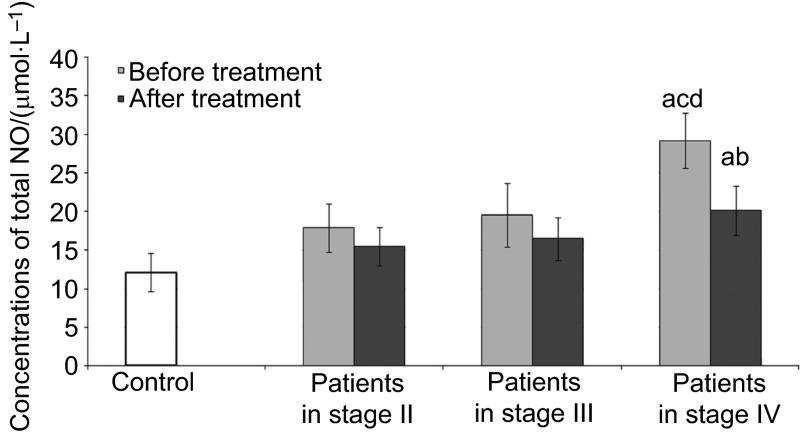
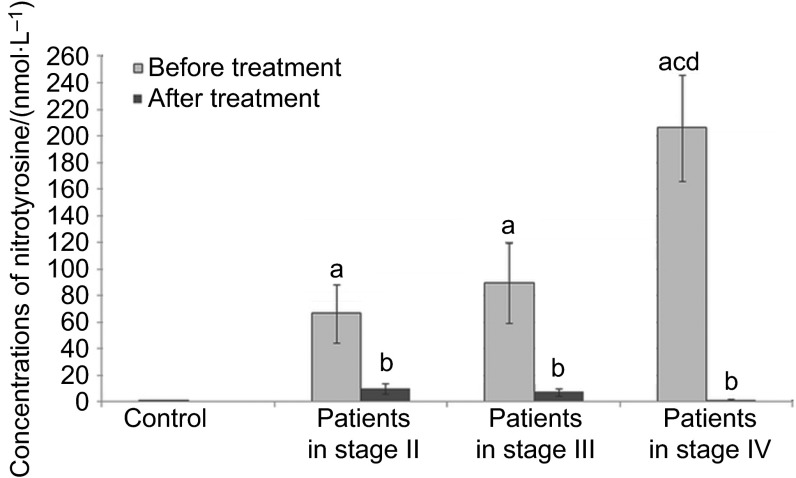
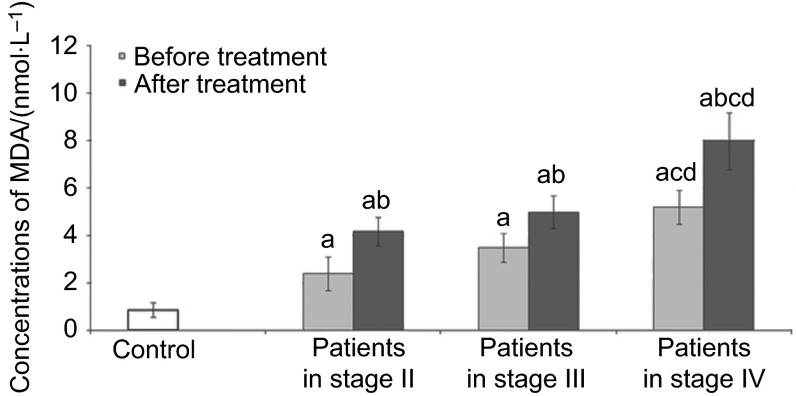
The aim of the study was a determination of the levels of nitric oxide (NO) and its biological markers such as malonyldialdehyde (MDA) and nitrotyrosine in the serum of patients with squamous cell carcinoma (SCC) of the oral cavity and identification of the relationships between NO and those markers. These studies were performed on patients with SCC of the oral cavity before and after treatment. Griess reaction was used for the estimation of the total concentration of NO in serum. The nitrotyrosine level in serum was assessed with an enzyme-linked immunosorbent assay (ELISA) kit, and MDA level using a spectrophotometric assay. Higher concentrations of NO in blood serum were determined in patients with stage IV of the disease before treatment in comparison to the control group and patients with stages II and III of the disease. Moreover, higher concentrations of MDA and nitrotyrosine were determined in the serum of patients in all stages of the disease in comparison to healthy people. After treatment, lower concentrations of NO in the serum of patients with stage IV of the disease were observed in comparison to the amounts obtained prior to treatment. In addition, lower levels of nitrotyrosine in the serum of patients with all stages of the disease were recorded, whereas higher concentrations of MDA were determined in these patients in comparison to results obtained before treatment. The compounds formed with the contribution of NO, such as MDA and nitrotyrosine, may lead to cancer progression in patients with SCC of the oral cavity, and contribute to formation of resistance to therapy in these patients as well. Moreover, the lack of a relationship between concentrations of NO and MDA, and between NO and nitrotyrosine in serum suggests that the process of lipid peroxidation and nitration in patients with SCC does not just depend on NO.
本研究旨在测定口腔鳞状细胞癌(SCC)患者血清中一氧化氮(NO)及其生物标志物如丙二醛(MDA)和硝基酪氨酸的水平,并确定 NO 与这些标志物之间的关系。这些研究是在口腔 SCC 患者治疗前后进行的。Griess 反应用于估计血清中总 NO 浓度。使用酶联免疫吸附测定(ELISA)试剂盒评估血清中硝基酪氨酸的水平,使用分光光度法测定 MDA 水平。与对照组和 II 期和 III 期疾病患者相比,治疗前 IV 期疾病患者的血清中 NO 浓度较高。此外,与健康人相比,所有疾病阶段的患者血清中 MDA 和硝基酪氨酸的浓度均较高。治疗后,与治疗前相比,IV 期疾病患者的血清中 NO 浓度较低。此外,所有疾病阶段的患者血清中硝基酪氨酸的水平较低,而这些患者的 MDA 浓度较高,与治疗前的结果相比。在口腔 SCC 患者中,NO 参与形成的化合物,如 MDA 和硝基酪氨酸,可能导致癌症进展,并导致这些患者对治疗产生耐药性。此外,血清中 NO 与 MDA 之间以及 NO 与硝基酪氨酸之间浓度缺乏关系表明,SCC 患者的脂质过氧化和硝化过程不仅依赖于 NO。