Department of Population and Health, University of Cape Coast, Cape Coast, Ghana.
Arch Public Health. 2013 Aug 23;71(1):22. doi: 10.1186/2049-3258-71-22.
Available evidence in Ghana shows the implementation of tuberculosis (TB) control activities efforts since the beginning of the 1900s. In spite of that, TB continues to be one of the common diseases in the country. In 1994, local and international policy windows opened for renewed strategies for the control of TB. This paper explores some of the approaches which have been in place since 1994 and their implications for treatment outcomes.
The study combines quantitative and qualitative data. The quantitative data consist of treatment outcome from 1997-2010 and the qualitative data are derived from in-depth interviews with some staff of the TB control programme. Poisson regression and inductive coding were applied to the quantitative and qualitative data respectively.
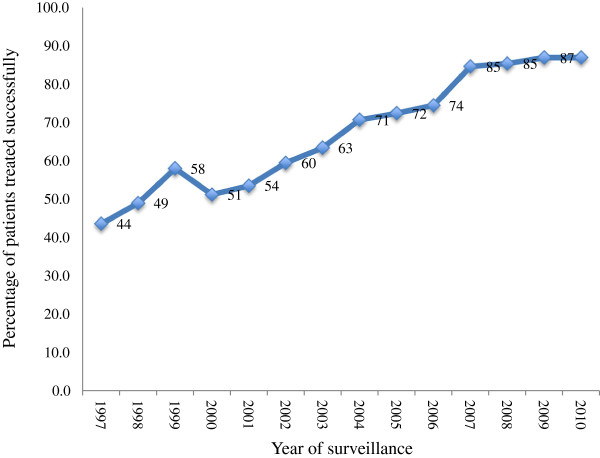
Reported cure rates increased from 43.6% to 87.7% between 1997 and 2010. The data from the in-depth interviews (IDIs) suggested that improvements in diagnosis, community TB care, stigma reduction among community and health workers towards TB patients, the public-private partnership, and the enablers' package contributed to the improved better treatment outcomes, particularly from 2008.
Lessons learnt include the achievement of objectives with varying strategies and stakeholder interventions. Further studies would be needed to quantify the contributions of the various interventions to help determine those that are cost effective as well as efficient and effective for TB control.
加纳现有的证据表明,自 20 世纪初以来,结核病(TB)控制活动一直在开展。尽管如此,结核病仍然是该国常见疾病之一。1994 年,当地和国际政策窗口为结核病控制的新战略打开了大门。本文探讨了自 1994 年以来实施的一些方法及其对治疗结果的影响。
本研究结合了定量和定性数据。定量数据包括 1997-2010 年的治疗结果,定性数据来自于对结核病控制项目的一些工作人员的深入访谈。泊松回归和归纳编码分别应用于定量和定性数据。
报告的治愈率从 1997 年到 2010 年从 43.6%增加到 87.7%。深入访谈(IDIs)的数据表明,诊断、社区结核病护理、社区和卫生工作者对结核病患者的耻辱感减少、公私伙伴关系以及辅助工具包的改善,有助于提高更好的治疗结果,特别是自 2008 年以来。
所吸取的经验教训包括通过不同的战略和利益攸关方干预实现目标。需要进一步研究以量化各种干预措施的贡献,以帮助确定那些在结核病控制方面具有成本效益、高效和有效的措施。