Department of Medical and Health Sciences, Faculty of Health Sciences, Linköping University , Linköping , Sweden.
Ups J Med Sci. 2013 Nov;118(4):247-55. doi: 10.3109/03009734.2013.825348. Epub 2013 Aug 27.
The improvement of insulin sensitivity by exercise has been shown to be inhibited by supplementation of vitamins acting as antioxidants.
To examine effects of exercise with or without blueberries, containing natural antioxidants, on cardio-metabolic risk factors.
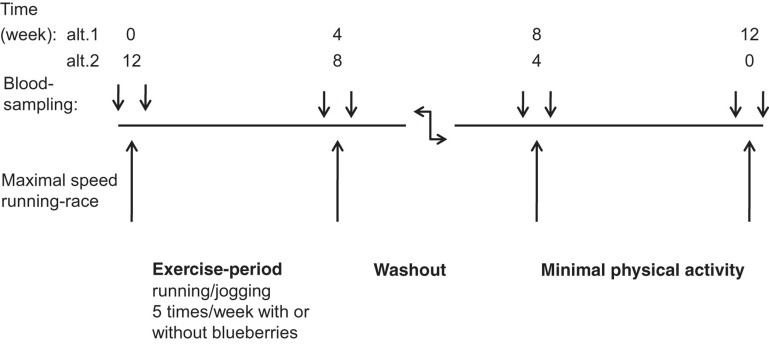
Fifteen healthy men and 17 women, 27.6 ± 6.5 years old, were recruited, and 26 completed a randomized cross-over trial with 4 weeks of exercise by running/jogging 5 km five times/week and 4 weeks of minimal physical activity. Participants were also randomized to consume 150 g of blueberries, or not, on exercise days. Laboratory variables were measured before and after a 5 km running-race at maximal speed at the beginning and end of each period, i.e. there were four maximal running-races and eight samplings in total for each participant.
Insulin and triglyceride levels were reduced while HDL-cholesterol increased by exercise compared with minimal physical activity. Participants randomized to consume blueberries showed an increase in fasting glucose levels compared with controls, during the exercise period (blueberries: from 5.12 ± 0.49 mmol/l to 5.32 ± 0.29 mmol/l; controls: from 5.24 ± 0.27 mmol/l to 5.17 ± 0.23 mmol/l, P = 0.04 for difference in change). Triglyceride levels fell in the control group (from 1.1 ± 0.49 mmol/l to 0.93 ± 0.31 mmol/l, P = 0.02), while HDL-cholesterol increased in the blueberry group (from 1.51 ± 0.29 mmol/l to 1.64 ± 0.33 mmol/l, P = 0.006).
Ingestion of blueberries induced differential effects on cardio-metabolic risk factors, including increased levels of both fasting glucose and HDL-cholesterol. However, since it is possible that indirect effects on food intake were induced, other than consumption of blueberries, further studies are needed to confirm the findings.
运动提高胰岛素敏感性会受到作为抗氧化剂的维生素补充的抑制。
研究运动结合或不结合蓝莓(含有天然抗氧化剂)对心脏代谢风险因素的影响。
招募了 15 名健康男性和 17 名女性,年龄 27.6±6.5 岁,并进行了一项随机交叉试验,为期 4 周的运动方案为每周 5 次跑步/慢跑 5 公里,4 周的最低体力活动。参与者还被随机分配在运动日食用 150 克蓝莓或不食用蓝莓。在每个周期的开始和结束时,通过最大速度进行 5 公里跑步比赛,测量实验室变量,因此每个参与者总共进行了 4 次最大跑步比赛和 8 次采样。
与最低体力活动相比,运动可降低胰岛素和甘油三酯水平,增加高密度脂蛋白胆固醇。与对照组相比,在运动期间,摄入蓝莓的参与者的空腹血糖水平升高(蓝莓组:从 5.12±0.49mmol/L 增加到 5.32±0.29mmol/L;对照组:从 5.24±0.27mmol/L 增加到 5.17±0.23mmol/L,P=0.04 差值变化)。对照组的甘油三酯水平下降(从 1.1±0.49mmol/L 降至 0.93±0.31mmol/L,P=0.02),而蓝莓组的高密度脂蛋白胆固醇升高(从 1.51±0.29mmol/L 增加到 1.64±0.33mmol/L,P=0.006)。
摄入蓝莓对心脏代谢风险因素产生了不同的影响,包括空腹血糖和高密度脂蛋白胆固醇水平的升高。然而,由于可能除了蓝莓的摄入外,还引起了对食物摄入的间接影响,因此需要进一步的研究来证实这些发现。