Foek Dave Lie Sam, Yetkiner Enver, Ozcan Mutlu
Department of Orthodontics, University Medical Center Groningen, University of Groningen, Groningen, The Netherlands.
Korean J Orthod. 2013 Aug;43(4):186-92. doi: 10.4041/kjod.2013.43.4.186. Epub 2013 Aug 22.
To analyze the fatigue resistance, debonding force, and failure type of fiber-reinforced composite, polyethylene ribbon-reinforced, and braided stainless steel wire lingual retainers in vitro.
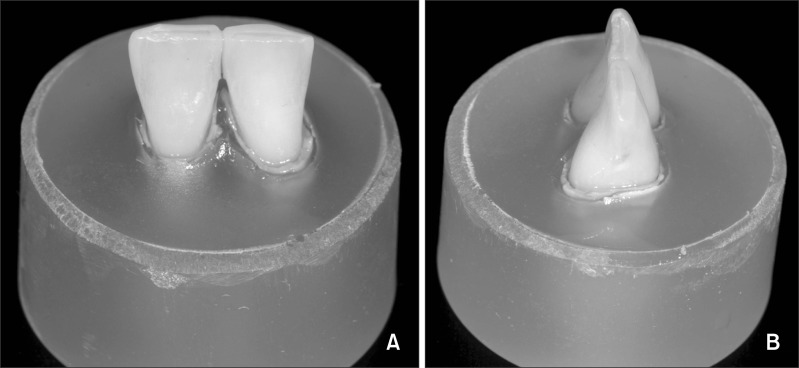
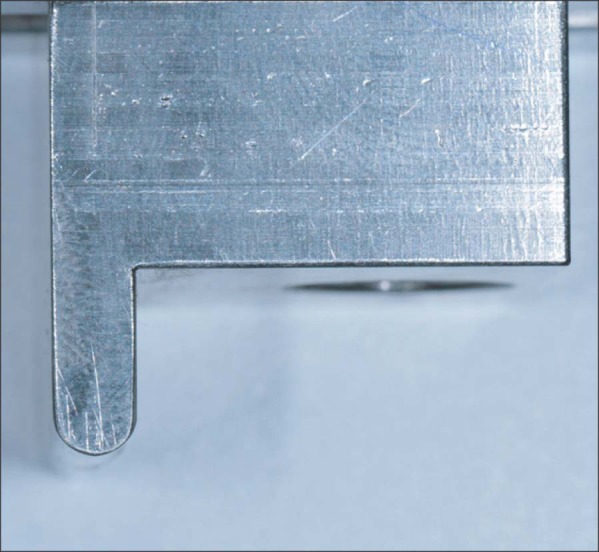
Roots of human mandibular central incisors were covered with silicone, mimicking the periodontal ligament, and embedded in polymethylmethacrylate. The specimens (N = 50), with two teeth each, were randomly divided into five groups (n = 10/group) according to the retainer materials: (1) Interlig (E-glass), (2) everStick Ortho (E-glass), (3) DentaPreg Splint (S2-glass), (4) Ribbond (polyethylene), and (5) Quad Cat wire (stainless steel). After the recommended adhesive procedures, the retainers were bonded to the teeth by using flowable composite resin (Tetric Flow). The teeth were subjected to 10,00,000 cyclic loads (8 Hz, 3 - 100 N, 45° angle, under 37 ± 3℃ water) at their incisoproximal contact, and debonding forces were measured with a universal testing machine (1 mm/min crosshead speed). Failure sites were examined under a stereomicroscope (×40 magnification). Data were analyzed by one-way analysis of variance.
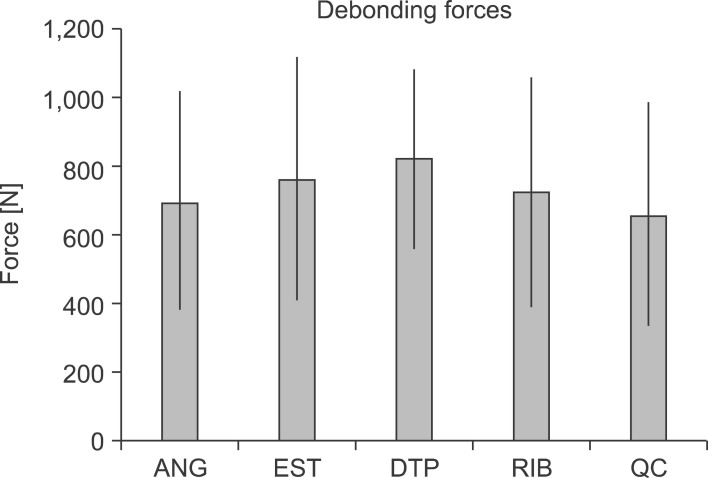
All the specimens survived the cyclic loading. Their mean debonding forces were not significantly different (p > 0.05). The DentaPreg Splint group (80%) showed the highest incidence of complete adhesive debonding, followed by the Interlig group (60%). The everStick Ortho group (80%) presented predominantly partial adhesive debonding. The Quad Cat wire group (50%) presented overlying composite detachment.
Cyclic loading did not cause debonding. The retainers presented similar debonding forces but different failure types. Braided stainless steel wire retainers presented the most repairable failure type.
在体外分析纤维增强复合材料、聚乙烯带增强和编织不锈钢丝舌侧保持器的抗疲劳性、脱粘力及失效类型。
用人下颌中切牙的牙根覆盖硅胶模拟牙周韧带,然后嵌入聚甲基丙烯酸甲酯中。将标本(共50个,每个标本含两颗牙)根据保持器材料随机分为五组(每组n = 10):(1)Interlig(E玻璃纤维),(2)everStick Ortho(E玻璃纤维),(3)DentaPreg Splint(S2玻璃纤维),(4)Ribbond(聚乙烯),(5)Quad Cat wire(不锈钢)。按照推荐的粘结步骤,使用流动复合树脂(Tetric Flow)将保持器粘结到牙齿上。在牙齿的切近中接触点施加1000000次循环载荷(8赫兹,3 - 100牛,45°角,在37 ± 3℃水中),并用万能试验机(十字头速度1毫米/分钟)测量脱粘力。在立体显微镜(放大40倍)下检查失效部位。数据采用单因素方差分析。
所有标本在循环加载后均未脱粘。它们的平均脱粘力无显著差异(p > 0.05)。DentaPreg Splint组(80%)完全粘结脱粘的发生率最高,其次是Interlig组(60%)。everStick Ortho组(80%)主要表现为部分粘结脱粘。Quad Cat wire组(50%)表现为覆盖的复合材料分离。
循环加载未导致脱粘。保持器具有相似的脱粘力但失效类型不同。编织不锈钢丝保持器呈现出最易于修复的失效类型。