Department of Life Sciences, National Chung Hsing University, Taichung, Taiwan.
Biotechnol Biofuels. 2013 Sep 11;6(1):130. doi: 10.1186/1754-6834-6-130.
Though n-butanol has been proposed as a potential transportation biofuel, its toxicity often causes oxidative stress in the host microorganism and is considered one of the bottlenecks preventing its efficient mass production.
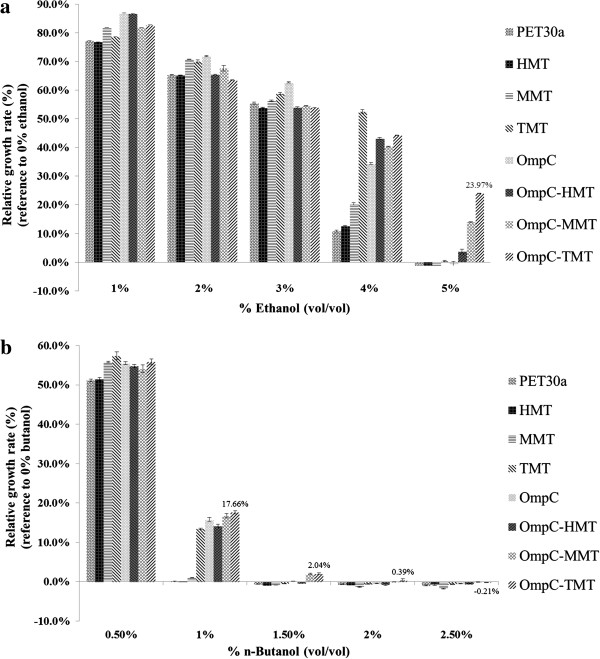
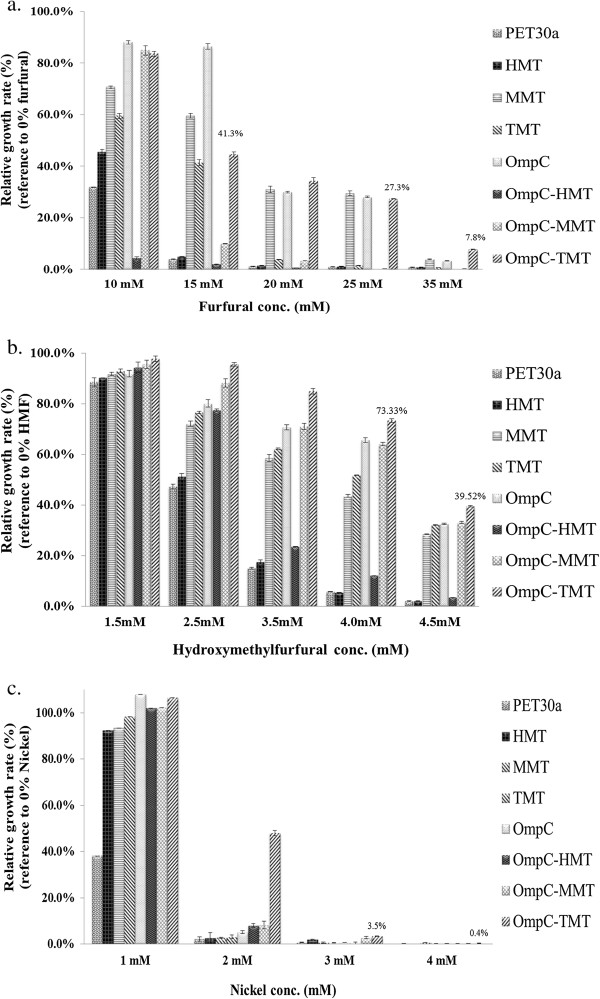
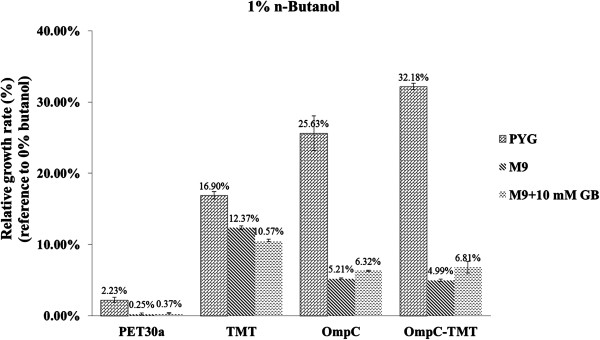
To relieve the oxidative stress in the host cell, metallothioneins (MTs), which are known as scavengers for reactive oxygen species (ROS), were engineered in E. coli hosts for both cytosolic and outer-membrane-targeted (osmoregulatory membrane protein OmpC fused) expression. Metallothioneins from human (HMT), mouse (MMT), and tilapia fish (TMT) were tested. The host strain expressing membrane-targeted TMT showed the greatest ability to reduce oxidative stresses induced by n-butanol, ethanol, furfural, hydroxymethylfurfural, and nickel. The same strain also allowed for an increased growth rate of recombinant E. coli under n-butanol stress. Further experiments indicated that the TMT-fused OmpC protein could not only function in ROS scavenging but also regulate either glycine betaine (GB) or glucose uptake via osmosis, and the dual functional fusion protein could contribute in an enhancement of the host microorganism's growth rate.
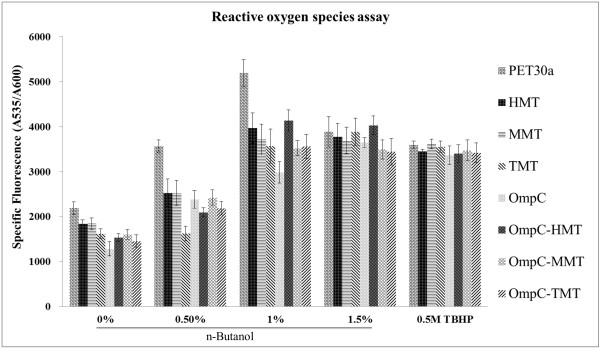
The abilities of scavenging intracellular or extracellular ROS by these engineering E. coli were examined, and TMT show the best ability among three MTs. Additionally, the membrane-targeted fusion protein, OmpC-TMT, improved host tolerance up to 1.5% n-butanol above that of TMT which is only 1%. These results presented indicate potential novel approaches for engineering stress tolerant microorganism strains.
尽管正丁醇已被提议作为一种有潜力的运输生物燃料,但它的毒性常常导致宿主微生物产生氧化应激,被认为是阻止其高效大规模生产的瓶颈之一。
为了减轻宿主细胞中的氧化应激,金属硫蛋白(MTs)被设计在大肠杆菌宿主中表达,包括细胞质和外膜靶向(与渗透压调节膜蛋白 OmpC 融合)表达。测试了来自人类(HMT)、小鼠(MMT)和罗非鱼(TMT)的金属硫蛋白。表达膜靶向 TMT 的宿主菌株表现出最大的能力来减轻正丁醇、乙醇、糠醛、羟甲基糠醛和镍诱导的氧化应激。同一菌株还允许在正丁醇胁迫下提高重组大肠杆菌的生长速率。进一步的实验表明,TMT 融合的 OmpC 蛋白不仅可以在 ROS 清除中发挥作用,还可以通过渗透调节甘氨酸甜菜碱(GB)或葡萄糖的摄取,并且这种双重功能融合蛋白可以促进宿主微生物的生长速率。
研究了这些工程大肠杆菌清除细胞内或细胞外 ROS 的能力,TMT 在三种 MT 中表现出最好的能力。此外,膜靶向融合蛋白 OmpC-TMT 将宿主的耐受能力提高到 1.5%的正丁醇,而 TMT 仅为 1%。这些结果表明,对于工程抗应激微生物菌株,存在潜在的新方法。