Shanghai Mental Health Center, Shanghai Jiaotong University School of Medicine, Shanghai, China.
PLoS One. 2013 Sep 2;8(9):e74258. doi: 10.1371/journal.pone.0074258. eCollection 2013.
Cognitive impairment in patients with schizophrenia is a core symptom of this disease. The computerized CogState Battery (CSB) has been used to detect seven of the most common cognitive domains in schizophrenia. The aim of this study was to examine the reliability and validity of the Chinese version of the CSB (CSB-C), in Chinese patients with schizophrenia.
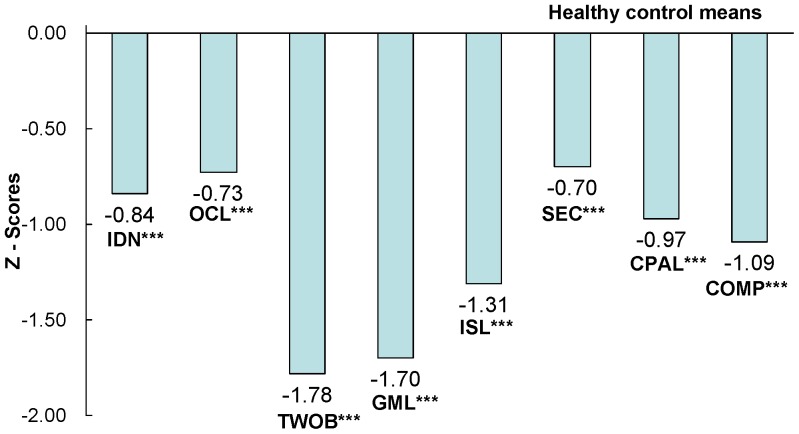
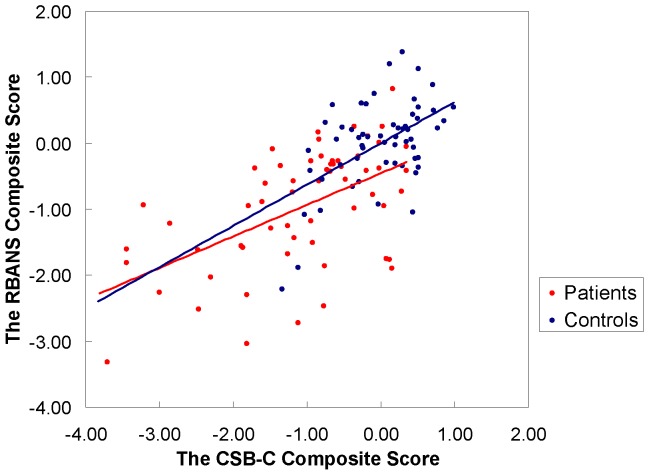
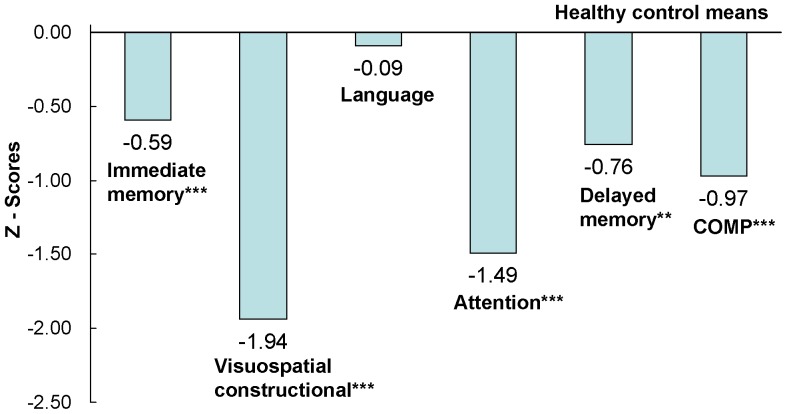
METHODOLOGY/PRINCIPAL FINDINGS: Sixty Chinese patients with schizophrenia and 58 age, sex, and education matched healthy controls were enrolled. All subjects completed the CSB-C and the Repeated Battery for the Assessment of Neuropsychological Status (RBANS). To examine the test-retest reliability of CSB-C, we tested 33 healthy controls twice, at a one month interval. The Cronbach α value of CSB-C in patients was 0.81. The test-retest correlation coefficients of the Two Back Task, Gronton Maze Learning Task, Social Emotional Cognition Task, and Continuous Paired Association Learning Task were between 0.39 and 0.62 (p<0.01) in healthy controls. The composite scores and all subscores for the CSB-C in patients were significantly (p<0.01) lower than those of healthy controls. Furthermore, composite scores for patients on the RBANS were also significantly lower than those of healthy controls. Interestingly, there was a positive correlation (r = 0.544, p<0.001) between the composite scores on CSB-C and RBANS for patients. Additionally, in the attention and memory cognitive domains, corresponding subsets from the two batteries correlated significantly (p<0.05). Moreover, factor analysis showed a two-factor model, consisting of speed, memory and reasoning.
CONCLUSIONS/SIGNIFICANCE: The CSB-C shows good reliability and validity in measuring the broad cognitive domains of schizophrenia in affected Chinese patients. Therefore, the CSB-C can be used as a cognitive battery, to assess the therapeutic effects of potential cognitive-enhancing agents in this cohort.
精神分裂症患者的认知障碍是该病的核心症状。计算机化的 CogState 电池 (CSB) 已用于检测精神分裂症中最常见的七个认知领域。本研究旨在检验中文版 CSB(CSB-C)在精神分裂症中国患者中的信度和效度。
方法/主要发现:纳入 60 例精神分裂症中国患者和 58 名年龄、性别和教育程度匹配的健康对照者。所有受试者均完成 CSB-C 和重复神经心理状态评估测试(RBANS)。为了检验 CSB-C 的重测信度,我们对 33 名健康对照者进行了两次测试,间隔一个月。患者 CSB-C 的 Cronbach α 值为 0.81。健康对照组的二项任务、格朗恩迷宫学习任务、社会情感认知任务和连续配对联想学习任务的重测相关系数在 0.39 到 0.62 之间(p<0.01)。患者 CSB-C 的综合评分和所有子评分均明显低于健康对照组(p<0.01)。此外,患者的 RBANS 综合评分也明显低于健康对照组。有趣的是,患者 CSB-C 与 RBANS 的综合评分之间呈正相关(r = 0.544,p<0.001)。此外,在注意力和记忆认知领域,两个电池的相应子集之间存在显著相关性(p<0.05)。此外,因子分析显示出一个由速度、记忆和推理组成的双因素模型。
结论/意义:CSB-C 在中国精神分裂症患者中能可靠、有效地测量广泛的认知领域。因此,CSB-C 可以作为一种认知电池,用于评估这一队列中潜在的认知增强剂的治疗效果。