Departamento de Microbiologia, Universidade Federal de Viçosa , Viçosa, MG , Brasil.
Braz J Microbiol. 2012 Oct;43(4):1508-15. doi: 10.1590/S1517-838220120004000035. Epub 2012 Jun 1.
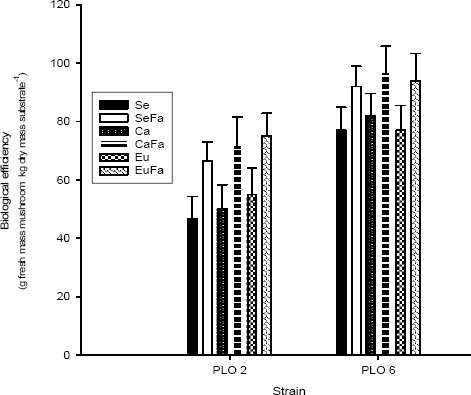
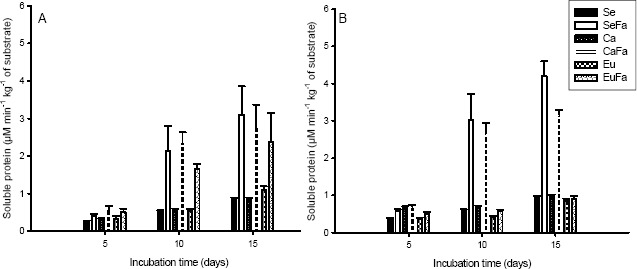
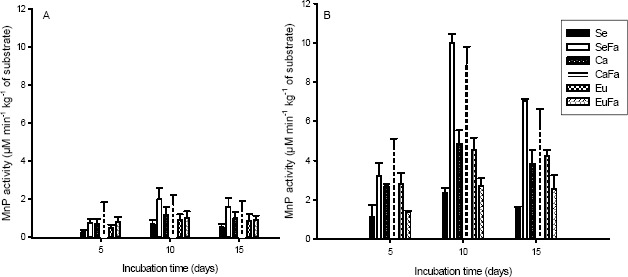
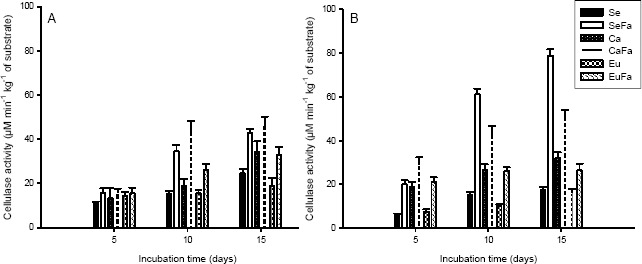
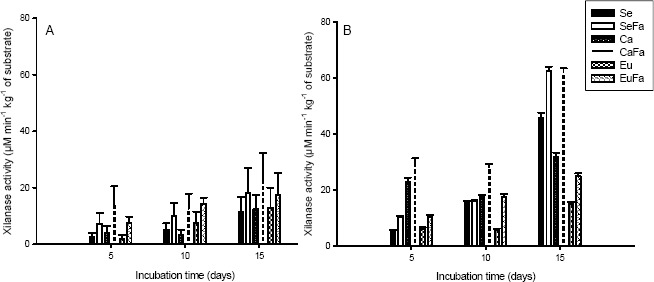
The mushroom Pleurotus ostreatus has nutritional and medicinal characteristics that depend on the growth substrate. In nature, this fungus grows on dead wood, but it can be artificially cultivated on agricultural wastes (coffee husks, eucalyptus sawdust, corncobs and sugar cane bagasse). The degradation of agricultural wastes involves some enzyme complexes made up of oxidative (laccase, manganese peroxidase and lignin peroxidase) and hydrolytic enzymes (cellulases, xylanases and tanases). Understanding how these enzymes work will help to improve the productivity of mushroom cultures and decrease the potential pollution that can be caused by inadequate discharge of the agroindustrial residues. The objective of this work was to assess the activity of the lignocellulolytic enzymes produced by two P. ostreatus strains (PLO 2 and PLO 6). These strains were used to inoculate samples of coffee husks, eucalyptus sawdust or eucalyptus bark add with or without 20 % rice bran. Every five days after substrate inoculation, the enzyme activity and soluble protein concentration were evaluated. The maximum activity of oxidative enzymes was observed at day 10 after inoculation, and the activity of the hydrolytic enzymes increased during the entire period of the experiment. The results show that substrate composition and colonization time influenced the activity of the lignocellulolytic enzymes.
糙皮侧耳(Pleurotus ostreatus)具有营养和药用特性,这些特性取决于生长基质。在自然界中,这种真菌生长在枯木上,但可以在农业废料(咖啡壳、桉树锯末、玉米芯和甘蔗渣)上进行人工栽培。农业废料的降解涉及一些由氧化酶(漆酶、锰过氧化物酶和木质素过氧化物酶)和水解酶(纤维素酶、木聚糖酶和单宁酶)组成的酶复合物。了解这些酶的作用方式将有助于提高蘑菇培养物的生产力,并减少因农业工业废物排放不当而可能造成的潜在污染。本工作的目的是评估两种糙皮侧耳(PLO 2 和 PLO 6)菌株产生的木质纤维素酶的活性。使用这些菌株接种咖啡壳、桉树锯末或桉树皮样本,并添加或不添加 20%的米糠。接种后每五天评估一次酶活性和可溶性蛋白浓度。接种后第 10 天观察到氧化酶的最大活性,水解酶的活性在整个实验期间增加。结果表明,基质组成和定植时间影响木质纤维素酶的活性。