Departments of Cell Biology and Biochemistry; Duke University Medical Center; Durham, NC USA.
Adipocyte. 2013 Oct 1;2(4):289-93. doi: 10.4161/adip.26082. Epub 2013 Aug 19.
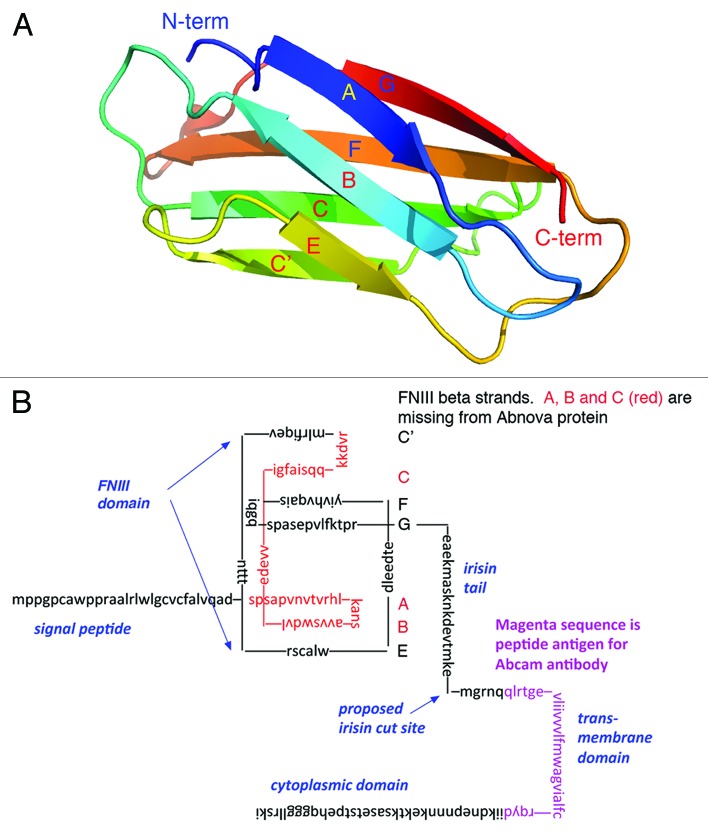
FNDC5 (fibronectin domain-containing [protein] 5) was initially discovered and characterized by two groups in 2002. In 2011 FNDC5 burst into prominence as the parent of irisin, a small protein containing the fibronectin type III domain. Irisin was proposed to be secreted by skeletal muscle cells in response to exercise, and to circulate to fat tissue where it induced a transition to brown fat. Since brown fat results in dissipation of energy, this pathway is of considerable interest for metabolism and obesity. Here I review the original discoveries of FNDC5 and the more recent discovery of irisin. I note in particular three problems in the characterization of irisin: the antibodies used to detect irisin in plasma lack validity; the recombinant protein used to demonstrate activity in cell culture was severely truncated; and the degree of shedding of soluble irisin from the cell surface has not been quantitated. The original discovery proposing that FNDC5 may be a transmembrane receptor may deserve a new look.
FNDC5(富含纤维连接蛋白结构域的 [蛋白质] 5)最初是在 2002 年由两个研究小组发现并进行了特征描述。2011 年,FNDC5 一鸣惊人,成为鸢尾素的母体,这是一种含有纤维连接蛋白 III 结构域的小蛋白。鸢尾素被认为是骨骼肌细胞在运动时分泌的物质,并在循环中进入脂肪组织,在那里诱导其向棕色脂肪转化。由于棕色脂肪会消耗能量,因此这条通路与代谢和肥胖密切相关。本文回顾了 FNDC5 的最初发现和最近发现的鸢尾素。我特别注意到在鸢尾素特征描述方面存在三个问题:用于检测血浆中鸢尾素的抗体缺乏有效性;用于在细胞培养中证明其活性的重组蛋白严重缺失;以及细胞表面可溶性鸢尾素的脱落程度尚未被定量。最初的发现提出 FNDC5 可能是一种跨膜受体,这可能值得重新审视。