Colorado State University, Department of Bioagricultural Sciences and Pest Management, Fort Collins, Colorado, United States of America.
PLoS One. 2013 Sep 12;8(9):e72572. doi: 10.1371/journal.pone.0072572. eCollection 2013.
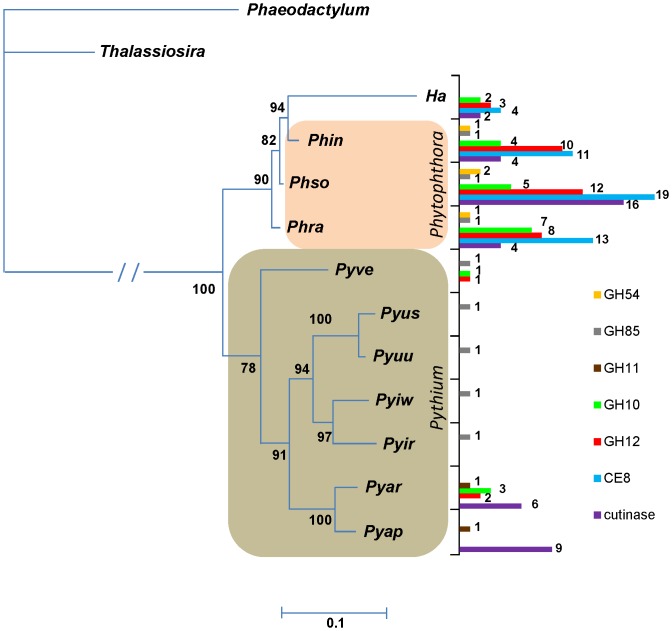
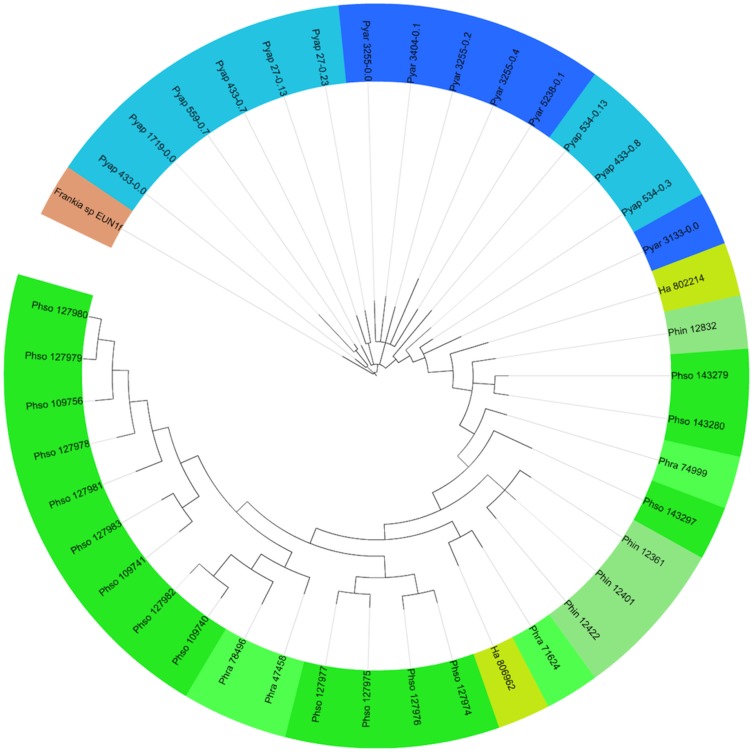
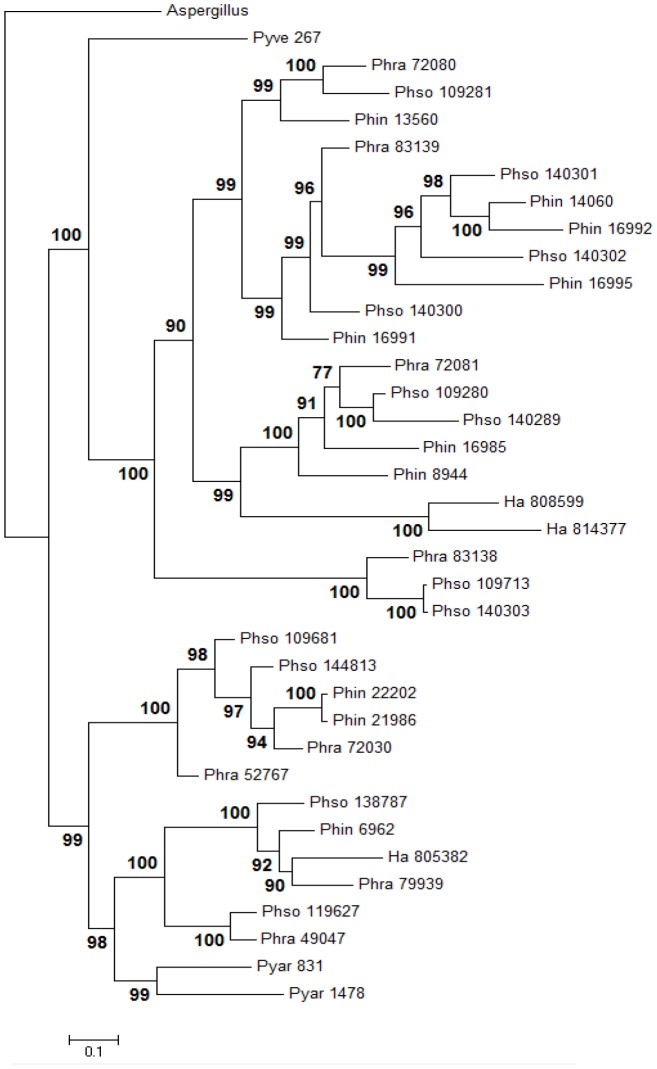
Carbohydrate-active enzymes (CAZymes) are involved in the metabolism of glycoconjugates, oligosaccharides, and polysaccharides and, in the case of plant pathogens, in the degradation of the host cell wall and storage compounds. We performed an in silico analysis of CAZymes predicted from the genomes of seven Pythium species (Py. aphanidermatum, Py. arrhenomanes, Py. irregulare, Py. iwayamai, Py. ultimum var. ultimum, Py. ultimum var. sporangiiferum and Py. vexans) using the "CAZymes Analysis Toolkit" and "Database for Automated Carbohydrate-active Enzyme Annotation" and compared them to previously published oomycete genomes. Growth of Pythium spp. was assessed in a minimal medium containing selected carbon sources that are usually present in plants. The in silico analyses, coupled with our in vitro growth assays, suggest that most of the predicted CAZymes are involved in the metabolism of the oomycete cell wall with starch and sucrose serving as the main carbohydrate sources for growth of these plant pathogens. The genomes of Pythium spp. also encode pectinases and cellulases that facilitate degradation of the plant cell wall and are important in hyphal penetration; however, the species examined in this study lack the requisite genes for the complete saccharification of these carbohydrates for use as a carbon source. Genes encoding for xylan, xyloglucan, (galacto)(gluco)mannan and cutin degradation were absent or infrequent in Pythium spp.. Comparative analyses of predicted CAZymes in oomycetes indicated distinct evolutionary histories. Furthermore, CAZyme gene families among Pythium spp. were not uniformly distributed in the genomes, suggesting independent gene loss events, reflective of the polyphyletic relationships among some of the species.
碳水化合物活性酶(CAZymes)参与糖缀合物、寡糖和多糖的代谢,在植物病原体的情况下,还参与宿主细胞壁和储存化合物的降解。我们使用“CAZymes 分析工具包”和“用于自动化碳水化合物活性酶注释的数据库”对来自 7 种疫霉属物种(Py. aphanidermatum、Py. arrhenomanes、Py. irregulare、Py. iwayamai、Py. ultimum var. ultimum、Py. ultimum var. sporangiiferum 和 Py. vexans)的基因组进行了 CAZymes 的计算机分析,并将其与之前发表的卵菌基因组进行了比较。在含有通常存在于植物中的选定碳源的最小培养基中评估了疫霉属 spp. 的生长情况。计算机分析,加上我们的体外生长测定,表明大多数预测的 CAZymes 参与了卵菌细胞壁的代谢,淀粉和蔗糖作为这些植物病原体生长的主要碳水化合物来源。疫霉属 spp. 的基因组还编码果胶酶和纤维素酶,有助于植物细胞壁的降解,并且在菌丝穿透中很重要;然而,本研究中检查的物种缺乏完整糖化这些碳水化合物以用作碳源的必需基因。编码木聚糖、木葡聚糖、(半乳糖)(葡糖)甘露聚糖和角质降解的基因在疫霉属 spp. 中缺失或罕见。对卵菌中预测的 CAZymes 的比较分析表明它们具有不同的进化历史。此外,疫霉属 spp. 中的 CAZyme 基因家族在基因组中分布不均,表明存在独立的基因丢失事件,反映了其中一些物种的多系关系。