Zhang Wande, Soman Pranav, Meggs Kyle, Qu Xin, Chen Shaochen
Department of NanoEngineering University of California San Diego, 9500 Gilman Drive, Atkinson Hall, MC-0448, La Jolla, CA 92093, USA.
Adv Funct Mater. 2013 Jul 5;23(25). doi: 10.1002/adfm.201202666.
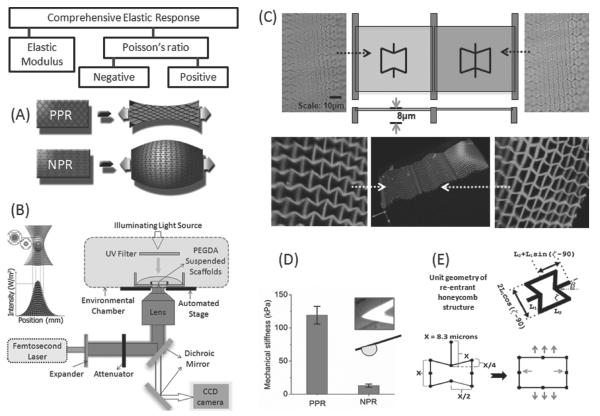
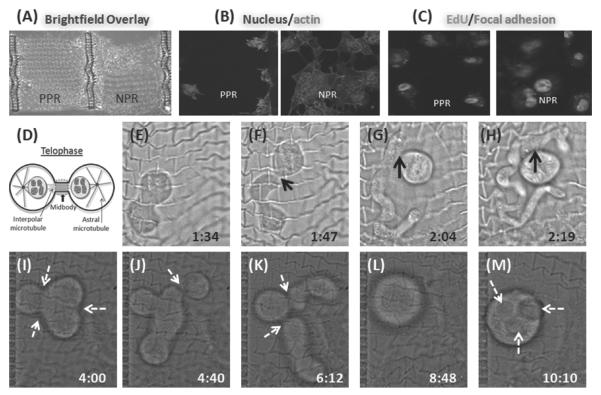
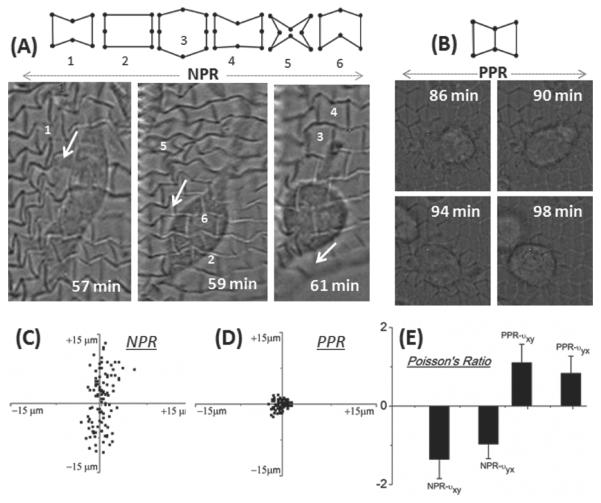
Cells sense and respond to mechanical forces, regardless of whether the source is from a normal tissue matrix, an adjacent cell or a synthetic substrate. In recent years, cell response to surface rigidity has been extensively studied by modulating the elastic modulus of poly(ethylene glycol) (PEG)-based hydrogels. In the context of biomaterials, Poisson's ratio, another fundamental material property parameter has not been explored, primarily because of challenges involved in tuning the Poisson's ratio in biological scaffolds. Two-photon polymerization is used to fabricate suspended web structures that exhibit positive and negative Poisson's ratio (NPR), based on analytical models. NPR webs demonstrate biaxial expansion/compression behavior, as one or multiple cells apply local forces and move the structures. Unusual cell division on NPR structures is also demonstrated. This methodology can be used to tune the Poisson's ratio of several photocurable biomaterials and could have potential implications in the field of mechanobiology.
细胞能够感知并对机械力做出反应,无论这种力的来源是正常组织基质、相邻细胞还是合成底物。近年来,通过调节基于聚乙二醇(PEG)的水凝胶的弹性模量,对细胞对表面刚度的反应进行了广泛研究。在生物材料领域,泊松比作为另一个基本的材料特性参数尚未得到探索,主要是因为在生物支架中调节泊松比存在挑战。基于分析模型,利用双光子聚合制造出具有正泊松比和负泊松比(NPR)的悬浮网状结构。当一个或多个细胞施加局部力并移动结构时,NPR网表现出双轴膨胀/压缩行为。还证明了NPR结构上存在异常的细胞分裂。这种方法可用于调节几种光固化生物材料的泊松比,并可能在力学生物学领域具有潜在意义。