The Key Laboratory of Industrial Biotechnology, Ministry of Education, School of Biotechnology, Jiangnan University, Wuxi, Jiangsu Province, China.
PLoS One. 2013 Oct 2;8(10):e76149. doi: 10.1371/journal.pone.0076149. eCollection 2013.
Previously, a safe strain, Bacillus amyloliquefaciens B10-127 was identified as an excellent candidate for industrial-scale microbial fermentation of 2,3-butanediol (2,3-BD). However, B. amyloliquefaciens fermentation yields large quantities of acetoin, lactate and succinate as by-products, and the 2,3-BD yield remains prohibitively low for commercial production.
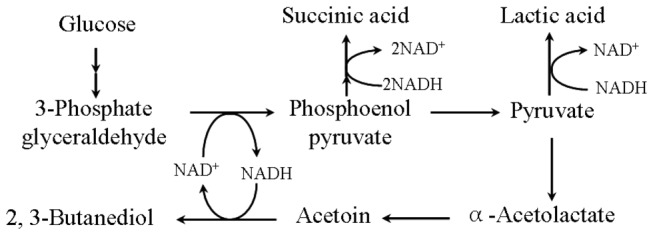
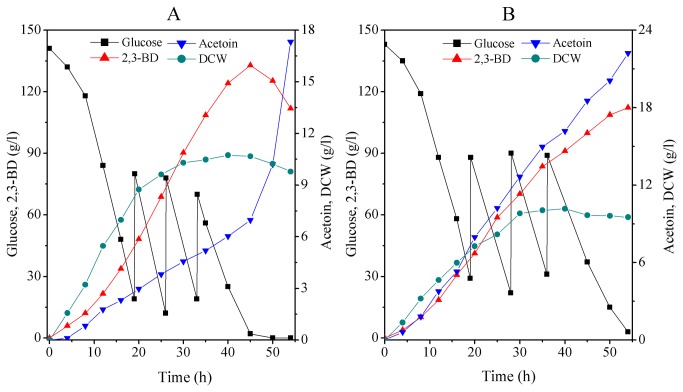
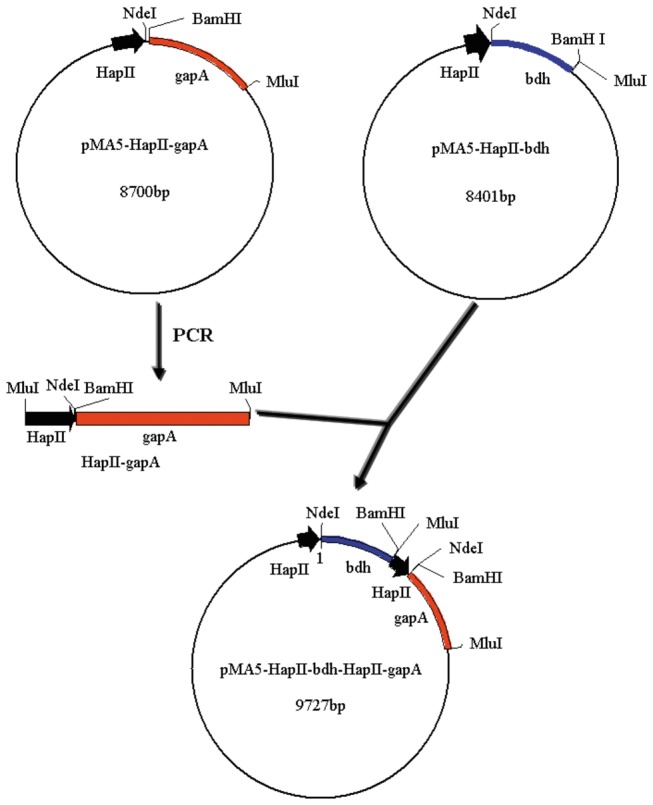
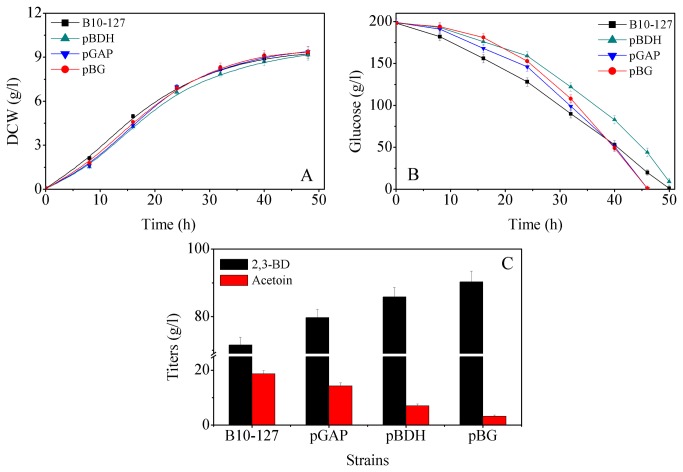
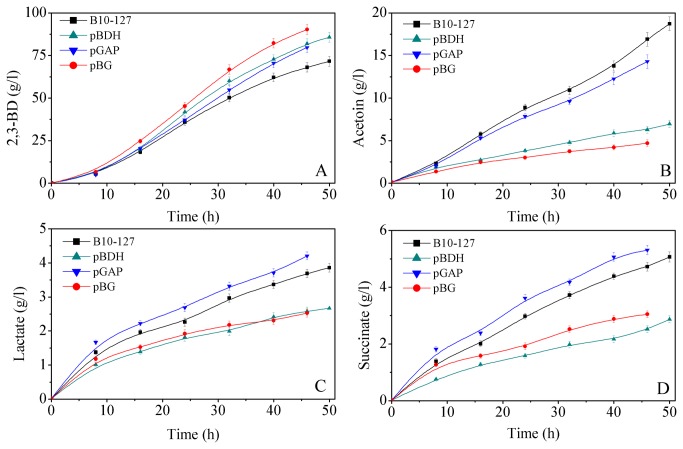
METHODOLOGY/PRINCIPAL FINDINGS: In the 2,3-butanediol metabolic pathway, glyceraldehyde-3-phosphate dehydrogenase (GAPDH) catalyzes the conversion of 3-phosphate glyceraldehyde to 1,3-bisphosphoglycerate, with concomitant reduction of NAD(+) to NADH. In the same pathway, 2,3-BD dehydrogenase (BDH) catalyzes the conversion of acetoin to 2,3-BD with concomitant oxidation of NADH to NAD(+). In this study, to improve 2,3-BD production, we first over-produced NAD(+)-dependent GAPDH and NADH-dependent BDH in B. amyloliquefaciens. Excess GAPDH reduced the fermentation time, increased the 2,3-BD yield by 12.7%, and decreased the acetoin titer by 44.3%. However, the process also enhanced lactate and succinate production. Excess BDH increased the 2,3-BD yield by 16.6% while decreasing acetoin, lactate and succinate production, but prolonged the fermentation time. When BDH and GAPDH were co-overproduced in B. amyloliquefaciens, the fermentation time was reduced. Furthermore, in the NADH-dependent pathways, the molar yield of 2,3-BD was increased by 22.7%, while those of acetoin, lactate and succinate were reduced by 80.8%, 33.3% and 39.5%, relative to the parent strain. In fed-batch fermentations, the 2,3-BD concentration was maximized at 132.9 g/l after 45 h, with a productivity of 2.95 g/l·h.
CONCLUSIONS/SIGNIFICANCE: Co-overexpression of bdh and gapA genes proved an effective method for enhancing 2,3-BD production and inhibiting the accumulation of unwanted by-products (acetoin, lactate and succinate). To our knowledge, we have attained the highest 2,3-BD fermentation yield thus far reported for safe microorganisms.
此前,一种安全的菌株——解淀粉芽孢杆菌 B10-127 被鉴定为工业规模发酵 2,3-丁二醇(2,3-BD)的优秀候选菌株。然而,解淀粉芽孢杆菌发酵会产生大量的乙酰 3-羟基丁酮、乳酸和琥珀酸等副产物,2,3-BD 的产量仍然远远低于商业生产的要求。
方法/主要发现:在 2,3-丁二醇代谢途径中,甘油醛-3-磷酸脱氢酶(GAPDH)催化 3-磷酸甘油醛转化为 1,3-双磷酸甘油酸,同时将 NAD(+)还原为 NADH。在同一途径中,2,3-BD 脱氢酶(BDH)催化乙酰 3-羟基丁酮转化为 2,3-BD,同时将 NADH 氧化为 NAD(+)。在这项研究中,为了提高 2,3-BD 的产量,我们首先在解淀粉芽孢杆菌中过量生产 NAD(+)-依赖性 GAPDH 和 NADH-依赖性 BDH。过量的 GAPDH 缩短了发酵时间,将 2,3-BD 的产量提高了 12.7%,同时将乙酰 3-羟基丁酮的浓度降低了 44.3%。然而,这一过程也增加了乳酸和琥珀酸的产量。过量的 BDH 将 2,3-BD 的产量提高了 16.6%,同时降低了乙酰 3-羟基丁酮、乳酸和琥珀酸的产量,但延长了发酵时间。当 BDH 和 GAPDH 在解淀粉芽孢杆菌中共过表达时,发酵时间缩短。此外,在 NADH 依赖途径中,2,3-BD 的理论摩尔收率提高了 22.7%,而乙酰 3-羟基丁酮、乳酸和琥珀酸的收率分别降低了 80.8%、33.3%和 39.5%。在分批补料发酵中,经过 45 小时后,2,3-BD 的浓度最大达到 132.9 g/l,生产速率为 2.95 g/l·h。
结论/意义:BDH 和 gapA 基因的共表达被证明是一种有效的方法,可以提高 2,3-BD 的产量,抑制不必要副产物(乙酰 3-羟基丁酮、乳酸和琥珀酸)的积累。据我们所知,我们已经达到了迄今为止安全微生物报道的最高 2,3-BD 发酵产率。