School of Physical Education and Sport, University of Sao Paulo, São Paulo, Brazil.
PLoS One. 2013 Oct 3;8(10):e76301. doi: 10.1371/journal.pone.0076301. eCollection 2013.
To assess the effects of creatine supplementation, associated or not with strength training, upon emotional and cognitive measures in older woman.
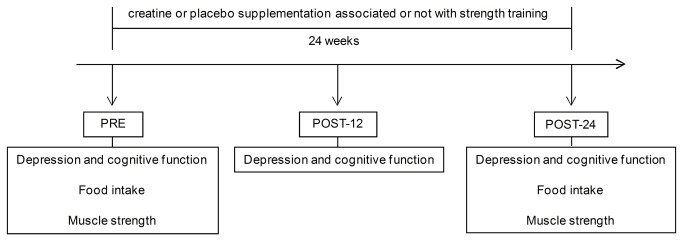
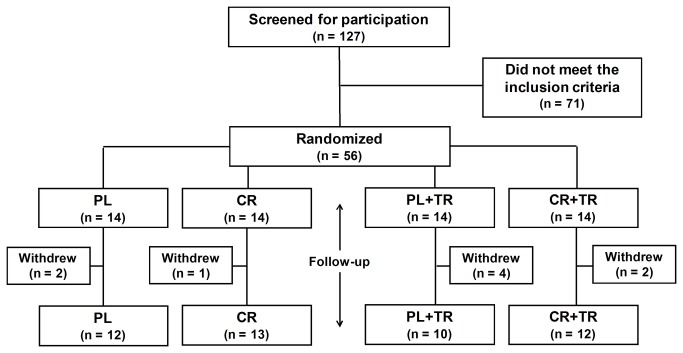
This is a 24-week, parallel-group, double-blind, randomized, placebo-controlled trial. The individuals were randomly allocated into one of the following groups (n=14 each): 1) placebo, 2) creatine supplementation, 3) placebo associated with strength training or 4) creatine supplementation associated with strength training. According to their allocation, the participants were given creatine (4 x 5 g/d for 5 days followed by 5 g/d) or placebo (dextrose at the same dosage) and were strength trained or not. Cognitive function, assessed by a comprehensive battery of tests involving memory, selective attention, and inhibitory control, and emotional measures, assessed by the Geriatric Depression Scale, were evaluated at baseline, after 12 and 24 weeks of the intervention. Muscle strength and food intake were evaluated at baseline and after 24 weeks.
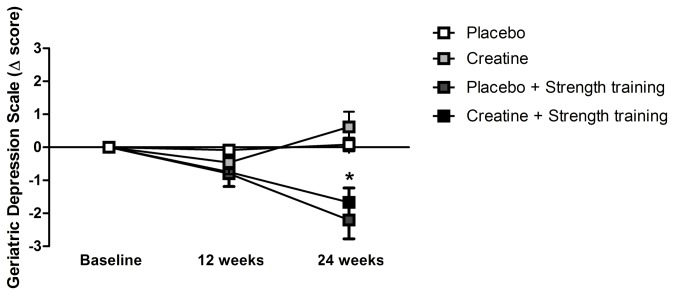
After the 24-week intervention, both training groups (ingesting creatine supplementation and placebo) had significant reductions on the Geriatric Depression Scale scores when compared with the non-trained placebo group (p = 0.001 and p = 0.01, respectively) and the non-trained creatine group (p < 0.001 for both comparison). However, no significant differences were observed between the non-trained placebo and creatine (p = 0.60) groups, or between the trained placebo and creatine groups (p = 0.83). Both trained groups, irrespective of creatine supplementation, had better muscle strength performance than the non-trained groups. Neither strength training nor creatine supplementation altered any parameter of cognitive performance. Food intake remained unchanged.
Creatine supplementation did not promote any significant change in cognitive function and emotional parameters in apparently healthy older individuals. In addition, strength training per se improved emotional state and muscle strength, but not cognition, with no additive effects of creatine supplementation.
Clinicaltrials.gov NCT01164020.
评估在老年女性中,补充肌酸与力量训练相结合或不结合对情绪和认知测量的影响。
这是一项 24 周、平行组、双盲、随机、安慰剂对照试验。个体被随机分配到以下四个组中的一个(每组 14 人):1)安慰剂组、2)肌酸补充组、3)安慰剂联合力量训练组或 4)肌酸补充联合力量训练组。根据他们的分组,参与者给予肌酸(5 天内每天 4 次,每次 5 克,然后每天 5 克)或安慰剂(相同剂量的葡萄糖),并进行力量训练或不进行。认知功能通过包括记忆、选择性注意和抑制控制在内的综合测试套件进行评估,情绪测量通过老年抑郁量表进行评估,在干预开始时、12 周和 24 周后进行评估。肌肉力量和食物摄入量在基线和 24 周后进行评估。
经过 24 周的干预,与非训练安慰剂组相比(p = 0.001 和 p = 0.01,分别)和非训练肌酸组(两者均 p < 0.001),两组训练组(摄入肌酸补充剂和安慰剂)的老年抑郁量表评分均有显著降低。然而,非训练安慰剂和肌酸组之间(p = 0.60)或训练安慰剂和肌酸组之间(p = 0.83)未观察到显著差异。两组训练组,无论是否补充肌酸,肌肉力量表现均优于非训练组。力量训练和肌酸补充均未改变认知表现的任何参数。食物摄入量保持不变。
在看似健康的老年人中,肌酸补充并未导致认知功能和情绪参数发生任何显著变化。此外,力量训练本身可改善情绪状态和肌肉力量,但不会改善认知能力,而肌酸补充没有附加作用。
Clinicaltrials.gov NCT01164020。