Digestive Disease Research Center, Tehran University of Medical Sciences, Tehran, Iran ; Department of Epidemiology, University of Groningen, University Medical Center Groningn, Groningen, The Netherlands.
PLoS One. 2013 Sep 30;8(9):e74440. doi: 10.1371/journal.pone.0074440. eCollection 2013.
A few studies have indicated inverse relationships between serum ghrelin and gastric and esophageal cancers but those associations have been restricted to specific populations, including smokers and overweight individuals. We examined the association between ghrelin and gastroesophageal cancers and atrophic gastritis in a population-based setting.
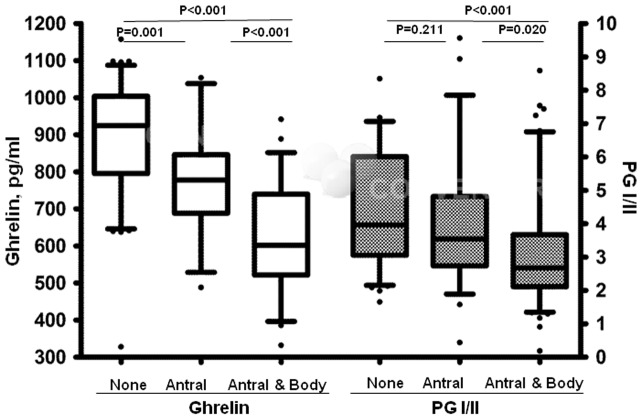
In total 220 gastroesophageal cancers, comprising non-cardia and cardia gastric cancer, esophageal adenocarcinoma, esophageal squamous cell carcinoma (SCC) and age and gender-matched controls were recruited. Serum ghrelin, pepsinogen I/II ratio (PGI/II) and anti-H.pylori IgG antibodies were measured. Relationships between ghrelin and gastroesophageal cancers, after adjustment for PGI/II ratio, H.pylori status and smoking, were tested using logistic regression. Furthermore, in 125 endoscopically normal volunteers, with and without histological atrophic gastritis, the relationship with ghrelin was compared.
Serum ghrelin (lowest vs. highest quintile) was inversely associated with gastric cancer: OR (95% CI) 8.71 (1.70-44.59) for cardia and 6.58 (1.26-34.46) for non-cardia cancer. Lower serum ghrelin was also associated with esophageal SCC: OR (95% CI) 5.69 (1.36-23.78), but not with esophageal adenocarcinoma. A similar association was observed between gastric cancer (cardia and non-cardia) and esophageal SCC when serum ghrelin was analysed as a continuous scaled variable. In endoscopically-normal volunteers, extensive atrophic gastritis was associated with low serum ghrelin [OR (95% CI) 0.25 (0.10-0.64)].
Inverse associations between ghrelin and some gastroesophageal cancers suggest a potential role for serum ghrelin as a biomarker of upper gastrointestinal cancers and atrophic gastritis. In areas with a high incidence of gastric and/or esophageal cancer, screening might be more effectively targeted to individuals with low serum ghrelin in addition to the PGI/II ratio.
有一些研究表明血清胃饥饿素与胃癌和食管癌之间呈负相关,但这些关联仅限于特定人群,包括吸烟者和超重者。我们在基于人群的环境中研究了胃饥饿素与胃食管癌症和萎缩性胃炎之间的关系。
共招募了 220 例胃食管癌症患者,包括非贲门和贲门胃癌、食管腺癌、食管鳞状细胞癌(SCC)以及年龄和性别匹配的对照。测量了血清胃饥饿素、胃蛋白酶原 I/II 比值(PGI/II)和抗 H.pylori IgG 抗体。使用逻辑回归测试了在调整 PGI/II 比值、H.pylori 状态和吸烟后胃饥饿素与胃食管癌症之间的关系。此外,在 125 例内镜正常的志愿者中,比较了伴有和不伴有组织学萎缩性胃炎的志愿者与胃饥饿素的关系。
血清胃饥饿素(最低与最高五分位数)与胃癌呈负相关:贲门癌的 OR(95%CI)为 8.71(1.70-44.59),非贲门癌为 6.58(1.26-34.46)。较低的血清胃饥饿素也与食管 SCC 相关:OR(95%CI)为 5.69(1.36-23.78),但与食管腺癌无关。当血清胃饥饿素作为连续变量进行分析时,胃食管癌症(贲门和非贲门)与食管 SCC 之间也观察到类似的关联。在内镜正常的志愿者中,广泛的萎缩性胃炎与低血清胃饥饿素相关 [OR(95%CI)0.25(0.10-0.64)]。
胃饥饿素与一些胃食管癌症之间的负相关表明血清胃饥饿素作为上消化道癌症和萎缩性胃炎的生物标志物具有潜在作用。在胃癌和/或食管癌发病率较高的地区,除了 PGI/II 比值外,还可以针对血清胃饥饿素水平较低的个体进行更有效的筛查。