Størdal Ketil, Haugen Margaretha, Brantsæter Anne Lise, Lundin Knut E A, Stene Lars C
Norwegian Institute of Public Health, Oslo, Norway; Østfold Hospital Trust, Fredrikstad, Norway.
Norwegian Institute of Public Health, Oslo, Norway.
Clin Gastroenterol Hepatol. 2014 Apr;12(4):624-31.e1-2. doi: 10.1016/j.cgh.2013.09.061. Epub 2013 Oct 7.
BACKGROUND & AIMS: The aim of our study was to determine whether the use of iron supplements during pregnancy affects the risk for celiac disease in children.
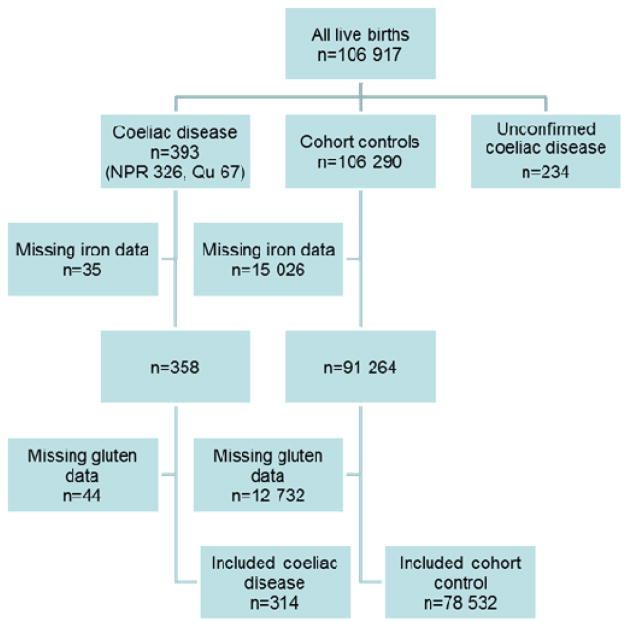
We assessed data from the prospective Norwegian Mother and Child cohort study, in which individuals with celiac disease were identified by answers on questionnaires and linkage to the Norwegian Patient Register. Complete data were available for 78,846 children (mean age 5.9 years, range 2-12 years); 314 children were identified with celiac disease. Questionnaires were given to pregnant women to collect information on use of iron-containing supplements, diet, anemia, and levels of hemoglobin.
Celiac disease was diagnosed in 4.65 of 1000 children whose mothers took iron supplements while they were pregnant, compared with 3.15 of 1000 children whose mothers did not. After adjusting for children's age, sex, and age of gluten introduction, and the presence of celiac disease in mothers, iron supplementation during pregnancy remained significantly associated with celiac disease in children (odds ratio [OR], 1.33; 95% confidence interval [CI], 1.05-1.68; P = .019). However, celiac disease was not associated with the mothers' intake of iron from foods (adjusted OR, 1.00; 95% CI, 0.97-1.03). Anemia before or during the early stages of pregnancy was not significantly associated with the risk of celiac disease in children (adjusted OR, 1.24; 95% CI, 0.84-2.00; P = .24). The use of iron supplements during pregnancy remained significantly associated with celiac disease in children after adjusting for children who were given iron supplements before 18 months of age, which itself was associated with celiac disease.
In a prospective Norwegian Mother and Child cohort study, we found an increased risk of celiac disease in children whose mothers used iron supplements during pregnancy; this association does not appear to arise from maternal anemia.
我们研究的目的是确定孕期使用铁补充剂是否会影响儿童患乳糜泻的风险。
我们评估了挪威母婴前瞻性队列研究的数据,通过问卷回答以及与挪威患者登记册的关联来识别乳糜泻患者。共有78846名儿童(平均年龄5.9岁,范围2 - 12岁)有完整数据;其中314名儿童被诊断为乳糜泻。我们向孕妇发放问卷,收集其使用含铁补充剂、饮食、贫血及血红蛋白水平等信息。
母亲孕期服用铁补充剂的儿童中,每1000名中有4.65名被诊断为乳糜泻,而母亲未服用铁补充剂的儿童中,每1000名中有3.15名被诊断为乳糜泻。在对儿童的年龄、性别、麸质引入年龄以及母亲是否患有乳糜泻进行校正后,孕期补充铁剂仍与儿童患乳糜泻显著相关(比值比[OR]为1.33;95%置信区间[CI]为1.05 - 1.68;P = 0.019)。然而,乳糜泻与母亲从食物中摄入的铁无关(校正后的OR为1.00;95% CI为0.97 - 1.03)。孕期早期或孕期贫血与儿童患乳糜泻的风险无显著关联(校正后的OR为1.24;95% CI为0.84 - 2.00;P = 0.24)。在校正18个月前接受铁补充剂的儿童(其本身与乳糜泻有关)后,孕期使用铁补充剂仍与儿童患乳糜泻显著相关。
在挪威母婴前瞻性队列研究中,我们发现母亲孕期使用铁补充剂的儿童患乳糜泻的风险增加;这种关联似乎并非由母亲贫血引起。