Division of Metabolism, Endocrinology and Diabetes, Department of Internal Medicine, University of Michigan, 24 Frank Lloyd Wright Drive, Lobby C, Suite 1300, PO Box 451, Ann Arbor, MI, 48106-0451, USA,
Qual Life Res. 2014 May;23(4):1371-6. doi: 10.1007/s11136-013-0557-8. Epub 2013 Oct 16.
To assess the impact of weight loss on health-related quality-of-life (HRQL), to describe the factors associated with improvements in HRQL after weight loss, and to assess the relationship between obesity as assessed by body mass index (BMI) and HRQL before and after weight loss.
We studied 188 obese patients with BMI ≥ 32 kg/m(2) with one or more comorbidities or ≥35 kg/m(2). All patients had baseline and follow-up assessments of BMI and HRQL using the EuroQol (EQ-5D) and its visual analog scale (VAS) before and after 6 months of medical weight loss that employed very low-calorie diets, physical activity, and intensive behavioral counseling.
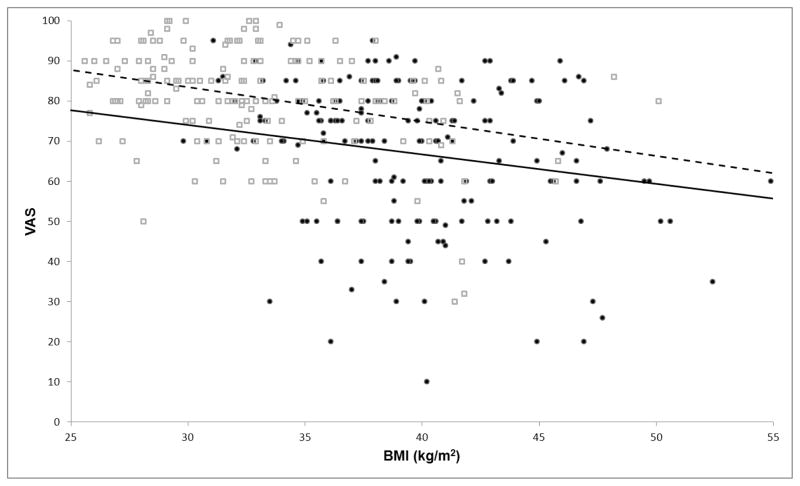
At baseline, age was 50 ± 8 years (mean ± SD), BMI was 40. 0 ± 5.0 kg/m(2), EQ-5D-derived health utility score was 0.85 ± 0.13, and VAS-reported quality-of-life was 0.67 ± 0.18. At 6-month follow-up, BMI decreased by 7.0 ± 3.2 kg/m(2), EQ-5D increased by 0.06 [interquartile range (IQR) 0.06-0.17], and VAS increased by 0.14 (IQR 0.04-0.23). In multivariate analyses, improvement in EQ-5D and VAS were associated with lower baseline BMI, greater reduction in BMI at follow-up, fewer baseline comorbidities, and lower baseline HRQL. For any given BMI category, EQ-5D and VAS tended to be higher at follow-up than at baseline.
Measured improvements in HRQL between baseline and follow-up were greater than predicted by the reduction in BMI at follow-up. If investigators use cross-sectional data to estimate changes in HRQL as a function of BMI, they will underestimate the improvement in HRQL associated with weight loss and underestimate the cost-utility of interventions for obesity treatment.
评估体重减轻对健康相关生活质量(HRQL)的影响,描述与体重减轻后 HRQL 改善相关的因素,并评估体重指数(BMI)评估的肥胖与体重减轻前后 HRQL 的关系。
我们研究了 188 名 BMI≥32kg/m²且有 1 种或多种合并症或≥35kg/m²的肥胖患者。所有患者在 6 个月的医学减重后进行了基线和随访评估,采用极低热量饮食、体力活动和强化行为咨询。在基线时,年龄为 50±8 岁(平均值±标准差),BMI 为 40.0±5.0kg/m²,EQ-5D 衍生的健康效用评分 0.85±0.13,VAS 报告的生活质量为 0.67±0.18。在 6 个月的随访中,BMI 降低了 7.0±3.2kg/m²,EQ-5D 增加了 0.06[四分位距(IQR)0.06-0.17],VAS 增加了 0.14(IQR 0.04-0.23)。在多变量分析中,EQ-5D 和 VAS 的改善与较低的基线 BMI、随访时 BMI 的更大降低、基线合并症较少以及较低的基线 HRQL 相关。对于任何给定的 BMI 类别,EQ-5D 和 VAS 在随访时往往高于基线。
在基线和随访之间测量的 HRQL 改善大于根据随访时 BMI 的降低预测的改善。如果研究人员使用横断面数据来估计 HRQL 随 BMI 变化的变化,他们将低估与体重减轻相关的 HRQL 改善,并低估肥胖治疗干预措施的成本效益。