Ameni Gobena, Tadesse Konjit, Hailu Elena, Deresse Yohannes, Medhin Girmay, Aseffa Abraham, Hewinson Glyn, Vordermeier Martin, Berg Stefan
Animal Health and Zoonotic Research Unit, Aklilu Lemma Institute of Pathobiology, Addis Ababa University, Addis Ababa, Ethiopia ; TB Research Team, Armauer Hansen Research Institute, Addis Ababa, Ethiopia.
PLoS One. 2013 Oct 10;8(10):e76891. doi: 10.1371/journal.pone.0076891. eCollection 2013.
Transmission of Mycobacterium tuberculosis (M. tuberculosis) complex could be possible between farmers and their cattle in Ethiopia.
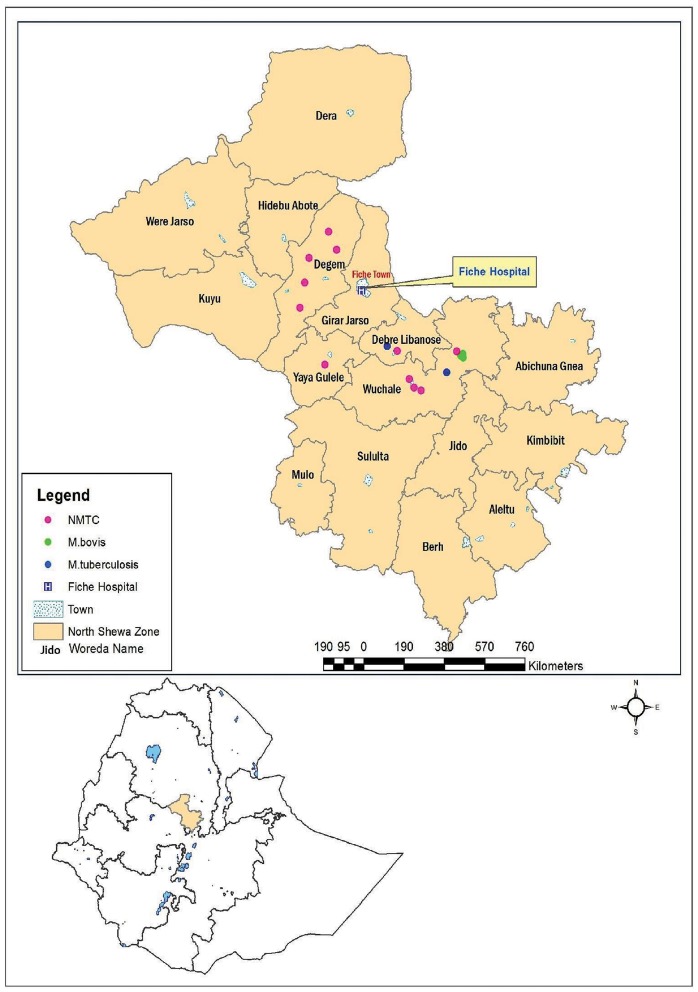
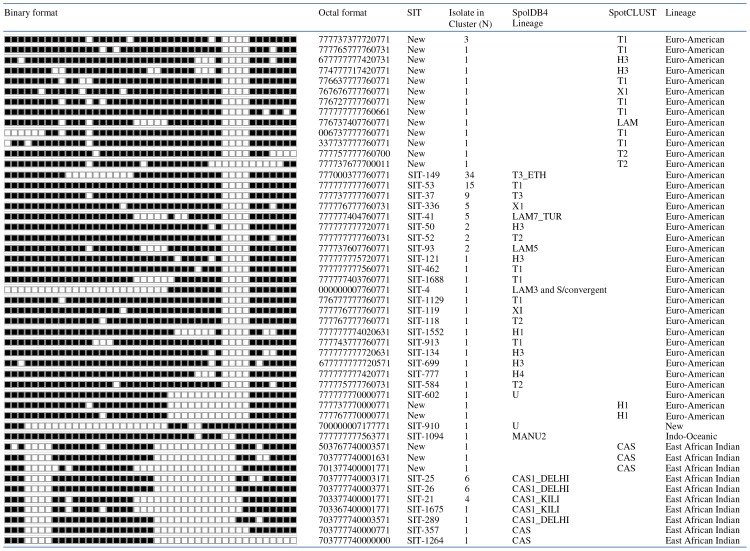
METHODOLOGY/PRINCIPAL FINDINGS: A study was conducted in mixed type multi-purposes cattle raising region of Ethiopia on 287 households (146 households with case of pulmonary tuberculosis (TB) and 141 free of TB) and 287 herds consisting of 2,033 cattle belonging to these households to evaluate transmission of TB between cattle and farmers. Interview, bacteriological examinations and molecular typing were used for human subjects while comparative intradermal tuberculin (CIDT) test, post mortem and bacteriological examinations, and molecular typing were used for animal studies. Herd prevalence of CIDT reactors was 9.4% and was higher (p<0.01) in herds owned by households with TB than in herds owned by TB free households. Animal prevalence was 1.8% and also higher (p<0.01) in cattle owned by households with TB case than in those owned by TB free households. All mycobacteria (141) isolated from farmers were M. tuberculosis, while only five of the 16 isolates from cattle were members of the M. tuberculosis complex (MTC) while the remaining 11 were members of non-tuberculosis mycobacteria (NTM). Further speciation of the five MTC isolates showed that three of the isolates were M. bovis (strain SB1176), while the remaining two were M. tuberculosis strains (SIT149 and SIT53). Pathology scoring method described by "Vordermeier et al. (2002)" was applied and the average severity of pathology in two cattle infected with M. bovis, in 11 infected with NTM and two infected with M. tuberculosis were 5.5, 2.1 and 0.5, respectively.
CONCLUSIONS/SIGNIFICANCE: The results showed that transmission of TB from farmers to cattle by the airborne route sensitizes the cows but rarely leads to TB. Similarly, low transmission of M. bovis between farmers and their cattle was found, suggesting requirement of ingestion of contaminated milk from cows with tuberculous mastitis.
在埃塞俄比亚,农民与其饲养的牛之间可能存在结核分枝杆菌复合群的传播。
方法/主要发现:在埃塞俄比亚混合型多用途养牛区对287户家庭(146户有肺结核病例,141户无肺结核)以及由这些家庭拥有的287群共2033头牛进行了一项研究,以评估牛与农民之间结核病的传播情况。对人类受试者采用访谈、细菌学检查和分子分型,而对动物研究则采用比较皮内结核菌素(CIDT)试验、尸检和细菌学检查以及分子分型。CIDT反应阳性牛群的患病率为9.4%,有结核病家庭所拥有的牛群患病率更高(p<0.01),高于无结核病家庭所拥有的牛群。动物患病率为1.8%,有结核病病例家庭所拥有的牛的患病率也更高(p<0.01),高于无结核病家庭所拥有的牛。从农民身上分离出的所有分枝杆菌(141株)均为结核分枝杆菌,而从牛身上分离出的16株菌株中只有5株是结核分枝杆菌复合群(MTC)成员,其余11株是非结核分枝杆菌(NTM)成员。对这5株MTC分离株的进一步分型显示,其中3株为牛分枝杆菌(菌株SB1176),其余2株为结核分枝杆菌菌株(SIT149和SIT53)。应用了“Vordermeier等人(2002年)”描述的病理学评分方法,感染牛分枝杆菌的2头牛、感染NTM的11头牛和感染结核分枝杆菌的2头牛的平均病理严重程度分别为5.5、2.1和0.5。
结论/意义:结果表明,结核病通过空气传播从农民传给牛会使奶牛致敏,但很少导致结核病。同样,发现牛分枝杆菌在农民及其牛之间的传播率较低,这表明需要摄入患有结核性乳腺炎奶牛的受污染牛奶。