Respiratory Medicines Development Center, GlaxoSmithKline, Research Triangle Park, North Carolina, USA.
BMJ Open. 2013 Oct 22;3(10):e003048. doi: 10.1136/bmjopen-2013-003048.
To test the reliability, validity and responsiveness of the 13-item Shortness of Breath with Daily Activities (SOBDA) questionnaire, and determine the threshold for response and minimal important difference (MID).
6 week, randomised, double-blind, placebo-controlled study.
40 centres in the USA between 29 October 2009 and 1 July 2010.
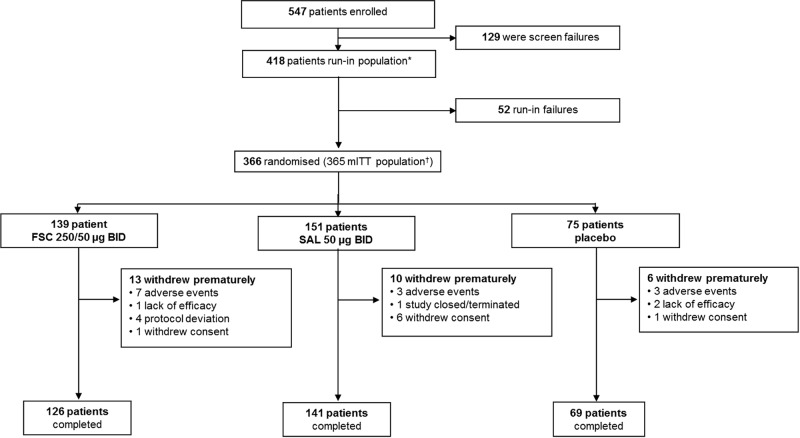
547 patients with chronic obstructive pulmonary disease (COPD) were enrolled and 418 entered the 2-week run-in period. Data from the run-in period were collected to test internal consistency, test-retest reliability, convergent validity and known-groups validity of the SOBDA. Three hundred and sixty six patients were randomised 2:2:1 to fluticasone propionate/salmeterol 250/50 µg, salmeterol 50 µg or placebo, twice daily. Results from the SOBDA questionnaire, Patient Global Assessment of Change Question, modified Medical Research Council Dyspnoea Scale (mMRC), Clinician Global Impression of Dysponea Severity (CGI-S), Clinician Global Impression of Change Question and Chronic Respiratory Disease Questionnaire self-administered standardised version (CRQ-SAS) were evaluated; spirometry and safety parameters were measured. Study endpoints were selected to investigate the cross-sectional and longitudinal validity of the SOBDA questionnaire in relation to the clinical criteria.
Internal consistency of the SOBDA questionnaire (Cronbach α) was 0.89. Test-retest reliability (intraclass correlation) was 0.94. The SOBDA weekly scores correlated with the patient-reported and clinician-reported mMRC, CGI-S and CRQ-SAS dyspnoea domain scores (0.29, 0.24, 0.24 and -0.68, respectively). The SOBDA weekly scores differentiated between the responders and the non-responders as rated by the patients and the clinicians. Anchor-based and supportive distribution-based analyses produced a range of the potential values for the threshold for the responders and MID.
The 13-item SOBDA questionnaire is reliable, valid and responsive to change in patients with COPD. On using anchor-based methods, the proposed responder threshold shows a -0.1 to -0.2 score change. A specific threshold value will be identified as more data are generated from future clinical trials.
NCT00984659; GlaxoSmithKline study number: ASQ112989.
测试 13 项日常活动呼吸困难问卷(SOBDA)的可靠性、有效性和反应度,并确定反应的阈值和最小临床重要差异(MID)。
6 周、随机、双盲、安慰剂对照研究。
2009 年 10 月 29 日至 2010 年 7 月 1 日期间,美国的 40 个中心。
547 名慢性阻塞性肺疾病(COPD)患者入组,418 名进入 2 周的预试验期。从预试验期收集的数据用于测试 SOBDA 的内部一致性、重测信度、收敛有效性和已知组有效性。366 名患者按 2:2:1 的比例随机分为氟替卡松丙酸酯/沙美特罗 250/50μg、沙美特罗 50μg 或安慰剂,每日两次。评估了 SOBDA 问卷、患者整体变化评估问题、改良的医学研究委员会呼吸困难量表(mMRC)、临床医生整体呼吸困难严重程度评估(CGI-S)、临床医生整体变化评估问题和慢性呼吸系统疾病问卷自我管理标准化版本(CRQ-SAS)的结果;测量了肺功能和安全性参数。选择研究终点以调查 SOBDA 问卷在与临床标准相关的横断面和纵向有效性。
SOBDA 问卷的内部一致性(Cronbach α)为 0.89。重测信度(组内相关)为 0.94。SOBDA 每周评分与患者报告的和临床医生报告的 mMRC、CGI-S 和 CRQ-SAS 呼吸困难域评分相关(分别为 0.29、0.24、0.24 和-0.68)。SOBDA 每周评分可区分患者和临床医生评定的应答者和非应答者。基于锚定和基于分布的分析产生了一系列潜在的应答者阈值和 MID 值。
13 项 SOBDA 问卷在 COPD 患者中可靠、有效且对变化敏感。使用基于锚定的方法,提出的应答者阈值显示-0.1 至-0.2 分的变化。随着未来临床试验产生更多数据,将确定特定的阈值值。
NCT00984659;葛兰素史克研究编号:ASQ112989。