Liu Yang, Li Honghe, Ding Ning, Wang Ningning, Wen Deliang
From the School of Public Health (YL, HL, DW); The Research Centre for Medical Education (ND), China Medical University, Shenyang; and School of Public Health (NW), Dalian Medical University, Dalian, Liaoning, China.
Medicine (Baltimore). 2016 May;95(20):e3672. doi: 10.1097/MD.0000000000003672.
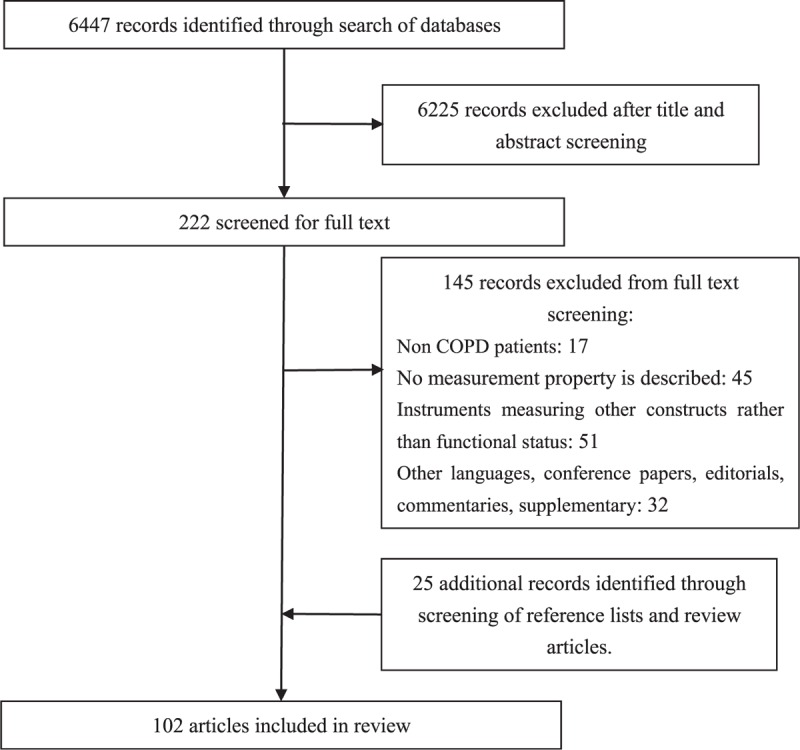
Presently, there is no recommendation on how to assess functional status of chronic obstructive pulmonary disease (COPD) patients. This study aimed to summarize and systematically evaluate these measures.Studies on measures of COPD patients' functional status published before the end of January 2015 were included using a search filters in PubMed and Web of Science, screening reference lists of all included studies, and cross-checking against some relevant reviews. After title, abstract, and main text screening, the remaining was appraised using the Consensus-based Standards for the Selection of Health Measurement Instruments (COSMIN) 4-point checklist. All measures from these studies were rated according to best-evidence synthesis and the best-rated measures were selected.A total of 6447 records were found and 102 studies were reviewed, suggesting 44 performance-based measures and 14 patient-reported measures. The majority of the studies focused on internal consistency, reliability, and hypothesis testing, but only 21% of them employed good or excellent methodology. Their common weaknesses include lack of checks for unidimensionality, inadequate sample sizes, no prior hypotheses, and improper methods. On average, patient-reported measures perform better than performance-based measures. The best-rated patient-reported measures are functional performance inventory (FPI), functional performance inventory short form (FPI-SF), living with COPD questionnaire (LCOPD), COPD activity rating scale (CARS), University of Cincinnati dyspnea questionnaire (UCDQ), shortness of breath with daily activities (SOBDA), and short-form pulmonary functional status scale (PFSS-11), and the best-rated performance-based measures are exercise testing: 6-minute walk test (6MWT), endurance treadmill test, and usual 4-meter gait speed (usual 4MGS).Further research is needed to evaluate the reliability and validity of performance-based measures since present studies failed to provide convincing evidence. FPI, FPI-SF, LCOPD, CARS, UCDQ, SOBDA, PFSS-11, 6MWT, endurance treadmill test, and usual 4MGS performed well and are preferable to assess functional status of COPD patients.
目前,对于如何评估慢性阻塞性肺疾病(COPD)患者的功能状态尚无相关建议。本研究旨在总结并系统评价这些测量方法。
使用PubMed和Web of Science中的检索过滤器,筛选截至2015年1月底之前发表的关于COPD患者功能状态测量方法的研究,查阅所有纳入研究的参考文献列表,并与一些相关综述进行交叉核对。经过标题、摘要和正文筛选后,其余研究使用基于共识的健康测量工具选择标准(COSMIN)4分制清单进行评估。对这些研究中的所有测量方法根据最佳证据综合进行评分,并选择评分最高的测量方法。
共检索到6447条记录,纳入102项研究,其中有44项基于表现的测量方法和14项患者报告的测量方法。大多数研究集中在内部一致性、可靠性和假设检验,但只有21%的研究采用了良好或优秀的方法。它们的共同弱点包括缺乏单维度性检查、样本量不足、没有先验假设以及方法不当。平均而言,患者报告的测量方法比基于表现的测量方法表现更好。评分最高的患者报告测量方法是功能表现量表(FPI)、功能表现量表简表(FPI-SF)、慢性阻塞性肺疾病生活问卷(LCOPD)、慢性阻塞性肺疾病活动评定量表(CARS)、辛辛那提大学呼吸困难问卷(UCDQ)、日常活动气短量表(SOBDA)和肺功能状态简表(PFSS-11),评分最高的基于表现的测量方法是运动测试:6分钟步行试验(6MWT)、耐力跑步机试验和常规4米步速(常规4MGS)。
由于目前的研究未能提供令人信服的证据,因此需要进一步研究来评估基于表现的测量方法的可靠性和有效性。FPI、FPI-SF、LCOPD、CARS、UCDQ、SOBDA、PFSS-11、6MWT、耐力跑步机试验和常规4MGS表现良好,更适合用于评估COPD患者的功能状态。