Cetin Mustafa S, Houck Jon M, Rashid Barnaly, Agacoglu Oktay, Stephen Julia M, Sui Jing, Canive Jose, Mayer Andy, Aine Cheryl, Bustillo Juan R, Calhoun Vince D
The Mind Research Network and Lovelace Biomedical and Environmental Research Institute Albuquerque, NM, USA.
The Mind Research Network and Lovelace Biomedical and Environmental Research InstituteAlbuquerque, NM, USA; Psychology Department, University of New MexicoAlbuquerque, NM, USA.
Front Neurosci. 2016 Oct 19;10:466. doi: 10.3389/fnins.2016.00466. eCollection 2016.
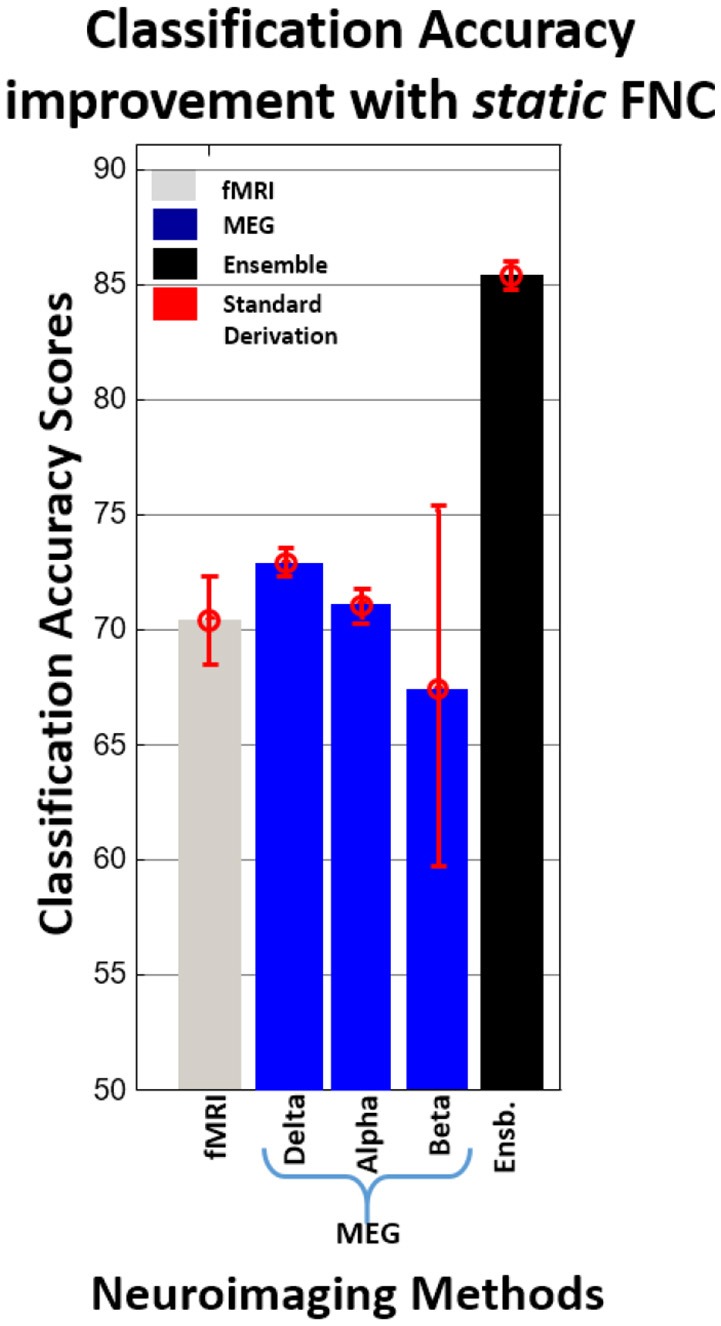
Mental disorders like schizophrenia are currently diagnosed by physicians/psychiatrists through clinical assessment and their evaluation of patient's self-reported experiences as the illness emerges. There is great interest in identifying biological markers of prognosis at the onset of illness, rather than relying on the evolution of symptoms across time. Functional network connectivity, which indicates a subject's overall level of "synchronicity" of activity between brain regions, demonstrates promise in providing individual subject predictive power. Many previous studies reported functional connectivity changes during resting-state using only functional magnetic resonance imaging (fMRI). Nevertheless, exclusive reliance on fMRI to generate such networks may limit the inference of the underlying dysfunctional connectivity, which is hypothesized to be a factor in patient symptoms, as fMRI measures connectivity via hemodynamics. Therefore, combination of connectivity assessments using fMRI and magnetoencephalography (MEG), which more directly measures neuronal activity, may provide improved classification of schizophrenia than either modality alone. Moreover, recent evidence indicates that metrics of dynamic connectivity may also be critical for understanding pathology in schizophrenia. In this work, we propose a new framework for extraction of important disease related features and classification of patients with schizophrenia based on using both fMRI and MEG to investigate functional network components in the resting state. Results of this study show that the integration of fMRI and MEG provides important information that captures fundamental characteristics of functional network connectivity in schizophrenia and is helpful for prediction of schizophrenia patient group membership. Combined fMRI/MEG methods, using static functional network connectivity analyses, improved classification accuracy relative to use of fMRI or MEG methods alone (by 15 and 12.45%, respectively), while combined fMRI/MEG methods using dynamic functional network connectivity analyses improved classification up to 5.12% relative to use of fMRI alone and up to 17.21% relative to use of MEG alone.
像精神分裂症这样的精神障碍目前由医生/精神科医生通过临床评估以及在疾病出现时对患者自我报告经历的评估来诊断。人们对在疾病发作时识别预后的生物学标志物非常感兴趣,而不是依赖症状随时间的演变。功能网络连通性表明大脑区域之间活动的“同步性”总体水平,在提供个体预测能力方面显示出前景。许多先前的研究仅使用功能磁共振成像(fMRI)报告静息状态下的功能连通性变化。然而,仅依靠fMRI来生成此类网络可能会限制对潜在功能失调连通性的推断,据推测这是患者症状的一个因素,因为fMRI通过血液动力学来测量连通性。因此,将使用fMRI的连通性评估与更直接测量神经元活动的脑磁图(MEG)相结合,可能比单独使用任何一种方式能更好地对精神分裂症进行分类。此外,最近的证据表明动态连通性指标对于理解精神分裂症的病理也可能至关重要。在这项工作中,我们提出了一个新框架,用于基于使用fMRI和MEG来研究静息状态下的功能网络成分,提取与疾病相关的重要特征并对精神分裂症患者进行分类。这项研究的结果表明,fMRI和MEG的整合提供了重要信息,捕捉了精神分裂症中功能网络连通性的基本特征,有助于预测精神分裂症患者群体归属。使用静态功能网络连通性分析的fMRI/MEG联合方法相对于单独使用fMRI或MEG方法提高了分类准确率(分别提高了15%和12.45%),而使用动态功能网络连通性分析的fMRI/MEG联合方法相对于单独使用fMRI提高了高达5.12%的分类准确率,相对于单独使用MEG提高了高达17.21%的分类准确率。