Liakopoulos Apostolos, Mavroidi Angeliki, Katsifas Efstathios A, Theodosiou Alexandros, Karagouni Amalia D, Miriagou Vivi, Petinaki Efthymia
Department of Microbiology, University Hospital of Larissa, Larissa, Greece.
BMC Infect Dis. 2013 Oct 29;13:505. doi: 10.1186/1471-2334-13-505.
Multidrug-resistant Pseudomonas aeruginosa is a serious challenge for antimicrobial therapy of nosocomial infections, as it possesses several mechanisms of antimicrobial resistance. In Central Greece, a sudden increase of infections caused by carbapenem-resistant P. aeruginosa was observed during 2011, indicating the need for further analysis.
Five-hundred and sixty-eight P. aeruginosa isolates were collected consecutively during an 8-month period in 2011 from inpatients treated in three hospitals in the Thessaly region (1,000,000 habitants) of Greece. Carbapenem-resistant P. aeruginosa (n = 284) were characterized by antimicrobial susceptibility testing and β-lactamase content, and the genetic relatedness of carbapenemase-producing isolates was assessed by BOX-PCR, multilocus sequence typing, and eBURST analysis. Mapping of the class I integrons of Verona integron-encoded metallo-β-lactamase (VIM)-carrying isolates was also performed, and clinical data of the VIM producers were reviewed.
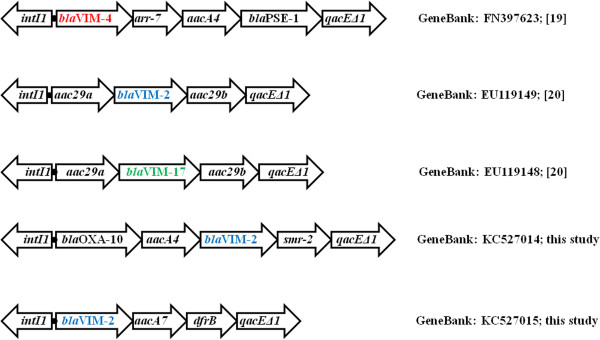
Eighty (14.1%) out of the 568 P. aeruginosa isolates recovered from clinical specimens were VIM producers. Multilocus sequence typing revealed high prevalence of the international clones ST111 and ST235 among blaVIM-2- and blaVIM-4-positive isolates, respectively. blaVIM-17 was identified in an isolate of a novel sequence type (ST1457). blaVIM gene cassettes were carried by five distinct class I integrons, including two novel ones.
Since the first report of VIM-producing P. aeruginosa in 2000, this microorganism still remains among the most prevalent multidrug resistant pathogens in Greece. The spread of VIM-producers belonging to the most common international clones (ST111 and ST235), the spread of integrons of divergent structures, and the emergence of novel integrons underscore their ongoing evolution.
多重耐药铜绿假单胞菌是医院感染抗菌治疗面临的严峻挑战,因为它具有多种抗菌耐药机制。在希腊中部,2011年观察到耐碳青霉烯类铜绿假单胞菌引起的感染突然增加,这表明需要进一步分析。
2011年,在8个月的时间里,连续从希腊色萨利地区(有100万居民)的三家医院接受治疗的住院患者中收集了568株铜绿假单胞菌分离株。通过抗菌药物敏感性试验和β-内酰胺酶含量对耐碳青霉烯类铜绿假单胞菌(n = 284)进行特征分析,并通过BOX-PCR、多位点序列分型和eBURST分析评估产碳青霉烯酶分离株的遗传相关性。还对携带维罗纳整合子编码金属β-内酰胺酶(VIM)的分离株的I类整合子进行了定位,并回顾了VIM产生菌的临床数据。
从临床标本中分离出的568株铜绿假单胞菌中,有80株(14.1%)是VIM产生菌。多位点序列分型显示,国际克隆ST111和ST235分别在blaVIM-2和blaVIM-4阳性分离株中高度流行。在一个新序列类型(ST1457)的分离株中鉴定出blaVIM-17。blaVIM基因盒由五个不同的I类整合子携带,包括两个新的整合子。
自2000年首次报道产VIM的铜绿假单胞菌以来,这种微生物仍然是希腊最常见的多重耐药病原体之一。属于最常见国际克隆(ST111和ST235)的VIM产生菌的传播、不同结构整合子的传播以及新整合子的出现突显了它们的持续进化。