Hospital Universitario 12 de Octubre, Madrid, Spain.
Emerg Infect Dis. 2012 Aug;18(8):1235-41. doi: 10.3201/eid1808.111234.
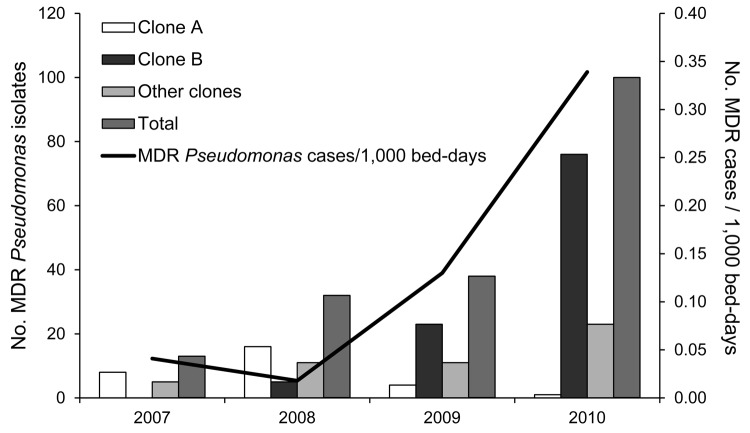
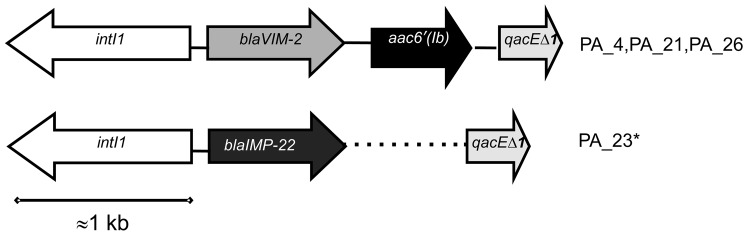
A total of 183 patients were colonized or infected with multidrug-resistant Pseudomonas aeruginosa isolates at a hospital in Spain during 2007-2010; prevalence increased over this period from 2.8% to 15.3%. To characterize these isolates, we performed molecular epidemiologic and drug resistance analysis. Genotyping showed that 104 (56.8%) isolates belonged to a single major clone (clone B), which was identified by multilocus sequence typing as sequence type (ST) 175. This clone was initially isolated from 5 patients in 2008, and then isolated from 23 patients in 2009 and 76 patients in 2010. PCR analysis of clone B isolates identified the bla(VIM-2) gene in all but 1 isolate, which harbored bla(IMP-22). ST175 isolates were susceptible to only amikacin (75%) and colistin (100%). Emergence of the ST175 clone represents a major health problem because it compromises therapy for treatment of P. aeruginosa nosocomial infections.
2007 年至 2010 年期间,西班牙一家医院共有 183 名患者定植或感染了多药耐药铜绿假单胞菌分离株;在此期间,其流行率从 2.8%上升至 15.3%。为了对这些分离株进行特征分析,我们进行了分子流行病学和耐药性分析。基因分型显示,104 株(56.8%)分离株属于单一主要克隆(克隆 B),通过多位点序列分型确定为序列型 175(ST175)。该克隆最初于 2008 年从 5 名患者中分离出来,然后于 2009 年从 23 名患者和 2010 年从 76 名患者中分离出来。对克隆 B 分离株的 PCR 分析发现,除了 1 株携带 bla(IMP-22)基因外,其余均携带 bla(VIM-2)基因。ST175 分离株仅对阿米卡星(75%)和黏菌素(100%)敏感。ST175 克隆的出现是一个主要的健康问题,因为它会影响治疗铜绿假单胞菌医院感染的疗效。