Suzuki Kenji
Department of Radiology, The University of Chicago, Chicago, IL 60637, USA.
IEICE Trans Inf Syst. 2013 Apr 1;E96-D(4):772-783. doi: 10.1587/transinf.e96.d.772.
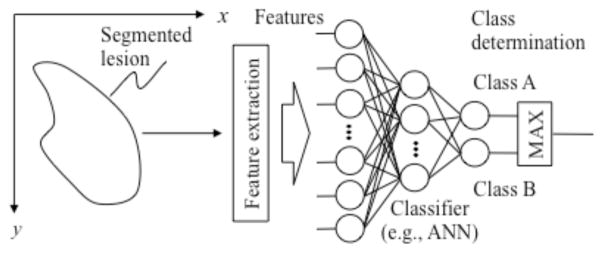
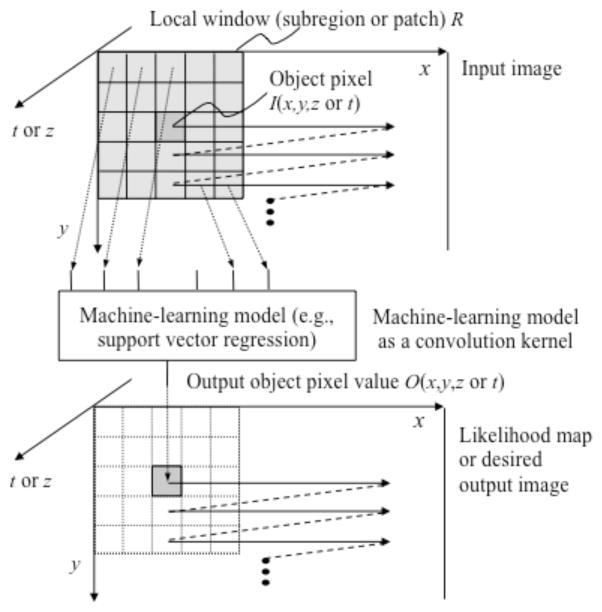
Computer-aided detection (CADe) and diagnosis (CAD) has been a rapidly growing, active area of research in medical imaging. Machine leaning (ML) plays an essential role in CAD, because objects such as lesions and organs may not be represented accurately by a simple equation; thus, medical pattern recognition essentially require "learning from examples." One of the most popular uses of ML is the classification of objects such as lesion candidates into certain classes (e.g., abnormal or normal, and lesions or non-lesions) based on input features (e.g., contrast and area) obtained from segmented lesion candidates. The task of ML is to determine "optimal" boundaries for separating classes in the multidimensional feature space which is formed by the input features. ML algorithms for classification include linear discriminant analysis (LDA), quadratic discriminant analysis (QDA), multilayer perceptrons, and support vector machines (SVM). Recently, pixel/voxel-based ML (PML) emerged in medical image processing/analysis, which uses pixel/voxel values in images directly, instead of features calculated from segmented lesions, as input information; thus, feature calculation or segmentation is not required. In this paper, ML techniques used in CAD schemes for detection and diagnosis of lung nodules in thoracic CT and for detection of polyps in CT colonography (CTC) are surveyed and reviewed.
计算机辅助检测(CADe)和诊断(CAD)一直是医学成像领域中快速发展且活跃的研究领域。机器学习(ML)在CAD中起着至关重要的作用,因为诸如病变和器官等对象可能无法通过简单的方程式准确表示;因此,医学模式识别本质上需要“从示例中学习”。ML最常见的用途之一是根据从分割的候选病变中获得的输入特征(例如对比度和面积),将诸如候选病变等对象分类到特定类别(例如,异常或正常,病变或非病变)。ML的任务是在由输入特征形成的多维特征空间中确定用于分离类别的“最佳”边界。用于分类的ML算法包括线性判别分析(LDA)、二次判别分析(QDA)、多层感知器和支持向量机(SVM)。最近,基于像素/体素的ML(PML)出现在医学图像处理/分析中,它直接使用图像中的像素/体素值,而不是从分割病变计算出的特征,作为输入信息;因此,不需要进行特征计算或分割。本文对用于胸部CT中肺结节检测和诊断以及CT结肠成像(CTC)中息肉检测的CAD方案中使用的ML技术进行了调查和综述。