Kiss Thomas, Güldner Andreas, Bluth Thomas, Uhlig Christopher, Spieth Peter Markus, Markstaller Klaus, Ullrich Roman, Jaber Samir, Santos Jose Alberto, Mancebo Jordi, Camporota Luigi, Beale Richard, Schettino Guilherme, Saddy Felipe, Vallverdú Immaculada, Wiedemann Bärbel, Koch Thea, Schultz Marcus Josephus, Pelosi Paolo, de Abreu Marcelo Gama
Department of Anesthesiology and Intensive Care Medicine, Pulmonary Engineering Group, University Hospital Dresden, Technische Universität Dresden, Dresden, Germany.
Trials. 2013 Oct 31;14:363. doi: 10.1186/1745-6215-14-363.
In pressure support ventilation (PSV), a non-variable level of pressure support is delivered by the ventilator when triggered by the patient. In contrast, variable PSV delivers a level of pressure support that varies in a random fashion, introducing more physiological variability to the respiratory pattern. Experimental studies show that variable PSV improves gas exchange, reduces lung inflammation and the mean pressure support, compared to non-variable PSV. Thus, it can theoretically shorten weaning from the mechanical ventilator.
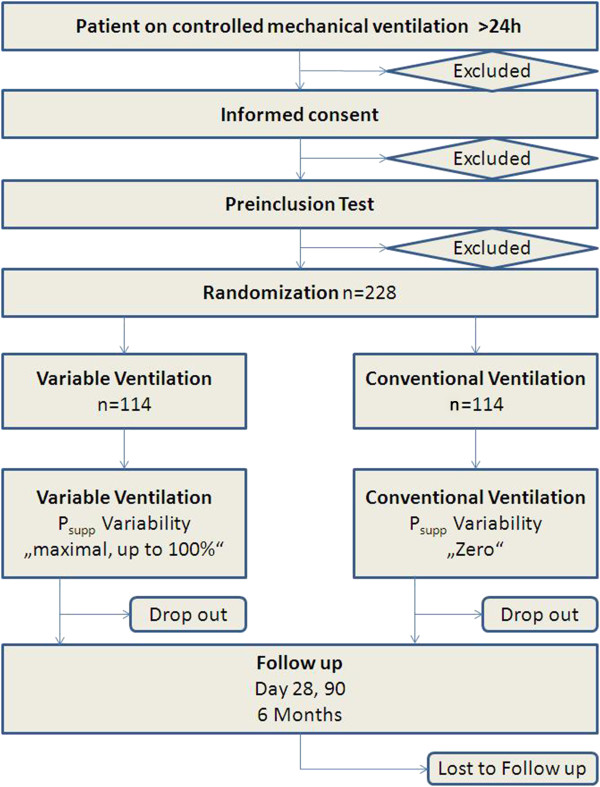
METHODS/DESIGN: The ViPS (variable pressure support) trial is an international investigator-initiated multicenter randomized controlled open trial comparing variable vs. non-variable PSV. Adult patients on controlled mechanical ventilation for more than 24 hours who are ready to be weaned are eligible for the study. The randomization sequence is blocked per center and performed using a web-based platform. Patients are randomly assigned to one of the two groups: variable PSV or non-variable PSV. In non-variable PSV, breath-by-breath pressure support is kept constant and targeted to achieve a tidal volume of 6 to 8 ml/kg. In variable PSV, the mean pressure support level over a specific time period is targeted at the same mean tidal volume as non-variable PSV, but individual levels vary randomly breath-by-breath. The primary endpoint of the trial is the time to successful weaning, defined as the time from randomization to successful extubation.
ViPS is the first randomized controlled trial investigating whether variable, compared to non-variable PSV, shortens the duration of weaning from mechanical ventilation in a mixed population of critically ill patients. This trial aims to determine the role of variable PSV in the intensive care unit.
clinicaltrials.gov NCT01769053.
在压力支持通气(PSV)中,当患者触发时,呼吸机提供固定水平的压力支持。相比之下,可变PSV提供的压力支持水平呈随机变化,给呼吸模式引入更多生理变异性。实验研究表明,与固定PSV相比,可变PSV可改善气体交换、减轻肺部炎症并降低平均压力支持。因此,理论上它可以缩短机械通气撤机时间。
方法/设计:可变压力支持(ViPS)试验是一项由国际研究者发起的多中心随机对照开放试验,比较可变与固定PSV。接受控制机械通气超过24小时且准备撤机的成年患者符合研究条件。随机序列按中心进行分组,并使用基于网络的平台进行操作。患者被随机分配到两组之一:可变PSV组或固定PSV组。在固定PSV中,逐次呼吸的压力支持保持恒定,目标是实现6至8 ml/kg的潮气量。在可变PSV中,特定时间段内的平均压力支持水平目标与固定PSV相同的平均潮气量,但个体水平逐次呼吸随机变化。试验的主要终点是成功撤机时间,定义为从随机分组到成功拔管的时间。
ViPS是第一项随机对照试验,研究在危重症患者的混合人群中,与固定PSV相比,可变PSV是否能缩短机械通气撤机时间。该试验旨在确定可变PSV在重症监护病房中的作用。
clinicaltrials.gov NCT01769053。