Department of Environmental Health, Rollins School of Public Health, Emory University, Atlanta, Georgia, USA.
Environ Health Perspect. 2014 Jan;122(1):10-6. doi: 10.1289/ehp.1306670. Epub 2013 Nov 6.
Climate change is anticipated to influence heat-related mortality in the future. However, estimates of excess mortality attributable to future heat waves are subject to large uncertainties and have not been projected under the latest greenhouse gas emission scenarios.
We estimated future heat wave mortality in the eastern United States (approximately 1,700 counties) under two Representative Concentration Pathways (RCPs) and investigated sources of uncertainty.
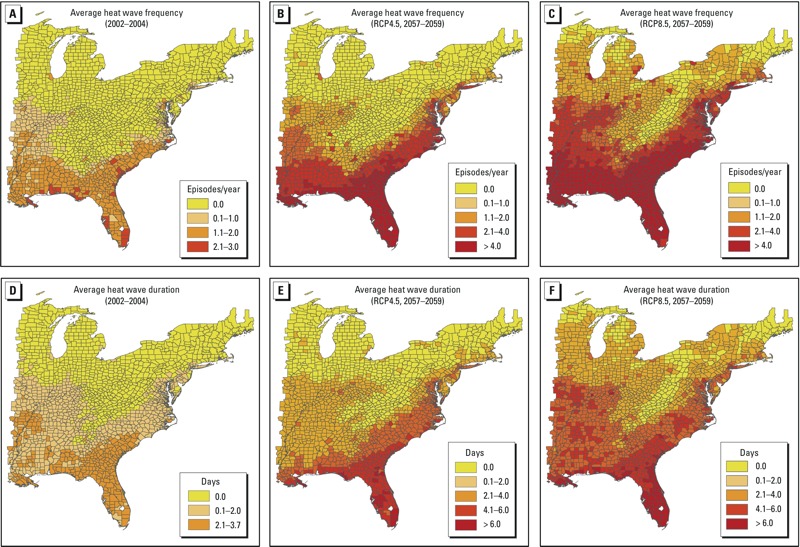
Using dynamically downscaled hourly temperature projections for 2057-2059, we projected heat wave days that were defined using four heat wave metrics and estimated the excess mortality attributable to them. We apportioned the sources of uncertainty in excess mortality estimates using a variance-decomposition method.
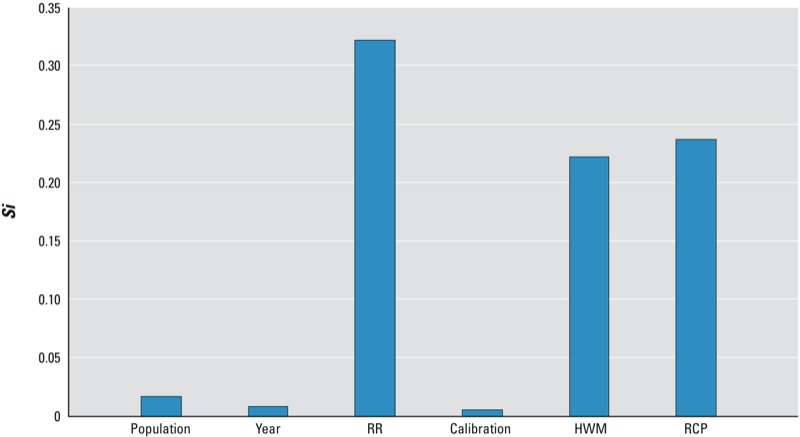
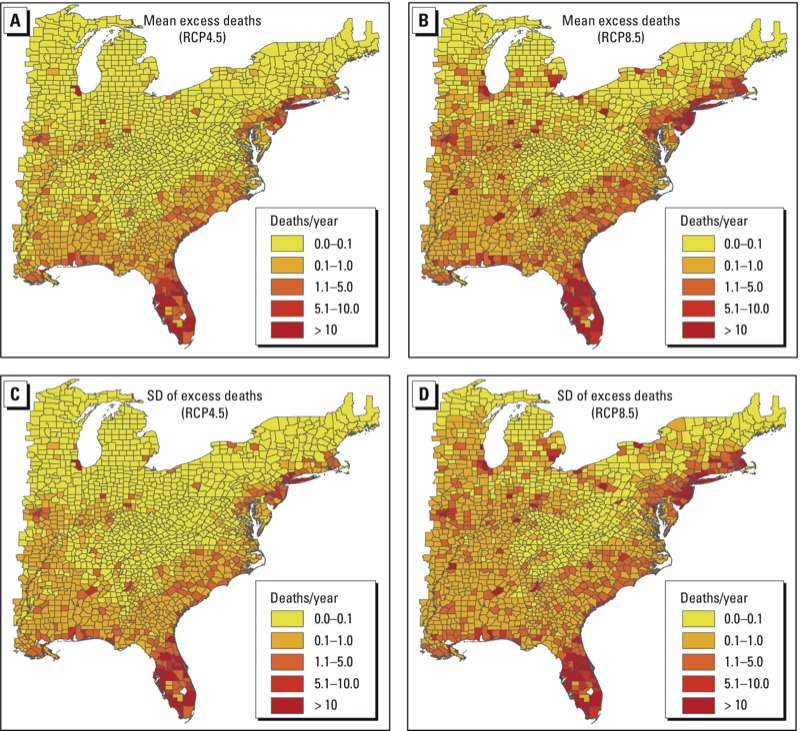
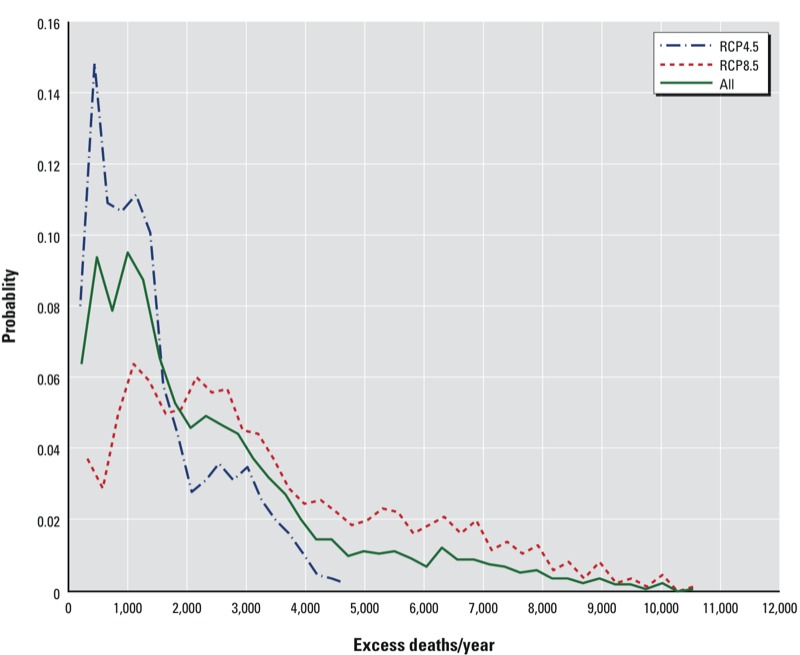
Estimates suggest that excess mortality attributable to heat waves in the eastern United States would result in 200-7,807 deaths/year (mean 2,379 deaths/year) in 2057-2059. Average excess mortality projections under RCP4.5 and RCP8.5 scenarios were 1,403 and 3,556 deaths/year, respectively. Excess mortality would be relatively high in the southern states and eastern coastal areas (excluding Maine). The major sources of uncertainty were the relative risk estimates for mortality on heat wave versus non-heat wave days, the RCP scenarios, and the heat wave definitions.
Mortality risks from future heat waves may be an order of magnitude higher than the mortality risks reported in 2002-2004, with thousands of heat wave-related deaths per year in the study area projected under the RCP8.5 scenario. Substantial spatial variability in county-level heat mortality estimates suggests that effective mitigation and adaptation measures should be developed based on spatially resolved data.
预计气候变化将影响未来与热相关的死亡率。然而,归因于未来热浪的超额死亡人数的估计存在很大的不确定性,并且尚未根据最新的温室气体排放情景进行预测。
我们根据两种代表性浓度途径(RCP)估计了美国东部(约 1700 个县)未来热浪的死亡人数,并研究了不确定性的来源。
使用 2057-2059 年逐小时温度的动态降尺度预测,我们预测了使用四个热浪指标定义的热浪日,并估计了归因于这些热浪日的超额死亡人数。我们使用方差分解方法分配超额死亡人数估计的不确定性来源。
估计表明,美国东部热浪归因于热浪的超额死亡人数将导致 2057-2059 年每年 200-7807 人死亡(平均每年 2379 人死亡)。RCP4.5 和 RCP8.5 情景下的平均超额死亡人数预测分别为每年 1403 人和 3556 人。南部各州和东海岸地区(缅因州除外)的超额死亡率相对较高。不确定性的主要来源是热浪日与非热浪日死亡率的相对风险估计、RCP 情景和热浪定义。
未来热浪的死亡风险可能比 2002-2004 年报告的死亡风险高一个数量级,在 RCP8.5 情景下,研究区域每年预计有数千人死于热浪相关死亡。县级热浪死亡率估计的显著空间变异性表明,应根据空间分辨率数据制定有效的缓解和适应措施。