Li Yin-Jun, Li Xin-Lou, Liang Song, Fang Li-Qun, Cao Wu-Chun
State Key Laboratory of Pathogens and Biosecurity, Beijing Institute of Microbiology and Epidemiology, 20 Dong-Da Street, Fengtai District, Beijing 100071, People's Republic of China.
BMC Infect Dis. 2013 Nov 16;13:547. doi: 10.1186/1471-2334-13-547.
Human brucellosis incidence in China has been increasing dramatically since 1999. However, epidemiological features and potential factors underlying the re-emergence of the disease remain less understood.
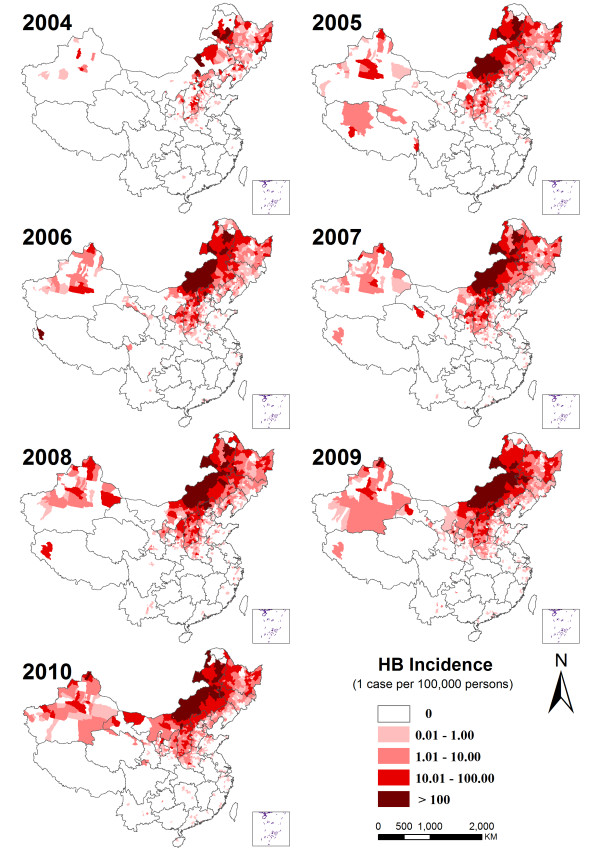
Data on human and animal brucellosis cases at the county scale were collected for the year 2004 to 2010. Also collected were environmental and socioeconomic variables. Epidemiological features including spatial and temporal patterns of the disease were characterized, and the potential factors related to the spatial heterogeneity and the temporal trend of were analysed using Poisson regression analysis, Granger causality analysis, and autoregressive distributed lag (ADL) models, respectively.
The epidemic showed a significantly higher spatial correlation with the number of sheep and goats than swine and cattle. The disease was most prevalent in grassland areas with elevation between 800-1,600 meters. The ADL models revealed that local epidemics were correlated with comparatively lower temperatures and less sunshine in winter and spring, with a 1-7 month lag before the epidemic peak in May.
Our findings indicate that human brucellosis tended to occur most commonly in grasslands at moderate elevation where sheep and goats were the predominant livestock, and in years with cooler winter and spring or less sunshine.
自1999年以来,中国人间布鲁氏菌病发病率急剧上升。然而,该疾病再次出现的流行病学特征和潜在因素仍鲜为人知。
收集了2004年至2010年县级层面的人间和动物布鲁氏菌病病例数据。还收集了环境和社会经济变量。对该疾病的时空模式等流行病学特征进行了描述,并分别使用泊松回归分析、格兰杰因果分析和自回归分布滞后(ADL)模型分析了与空间异质性和时间趋势相关的潜在因素。
该疫情与绵羊和山羊数量的空间相关性显著高于猪和牛。该病在海拔800 - 1600米的草原地区最为流行。ADL模型显示,局部疫情与冬春季节相对较低的温度和较少的日照相关,在5月疫情高峰前有1 - 7个月的滞后。
我们的研究结果表明,人间布鲁氏菌病往往最常发生在海拔适中、以绵羊和山羊为主要牲畜的草原地区,以及冬春较凉爽或日照较少的年份。