Research Center for Charged Particle Therapy, National Institute of Radiological Sciences, Chiba, Japan ; Department of Radiology, Kanagawa Children's Medical Center, Yokohama, Japan ; Research Center for Child Mental Development, Chiba University Graduate School of Medicine, Chiba, Japan.
PLoS One. 2013 Nov 28;8(11):e82746. doi: 10.1371/journal.pone.0082746. eCollection 2013.
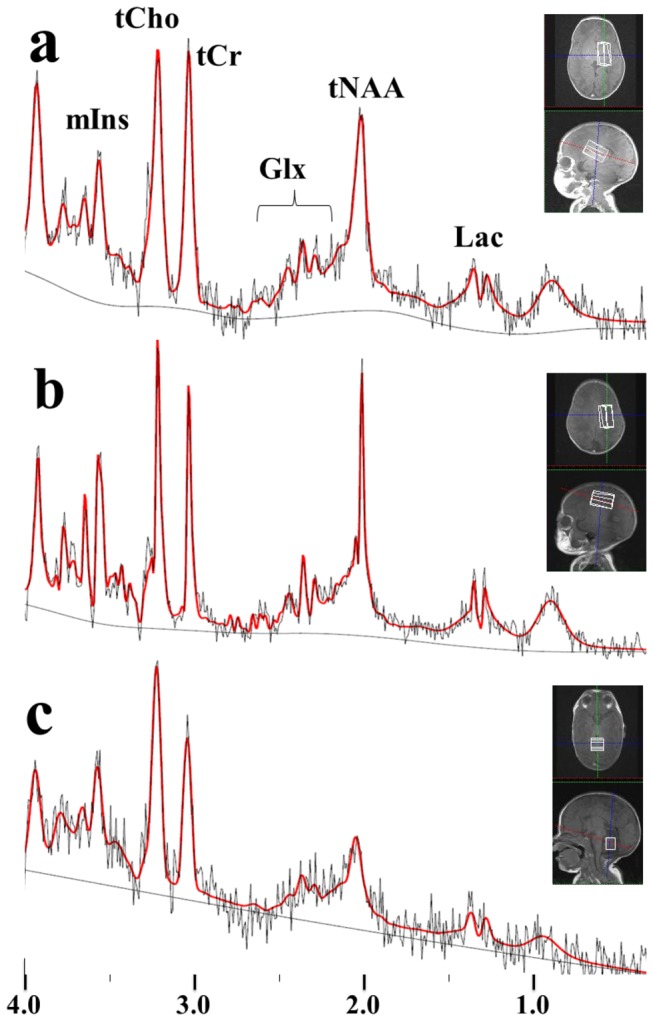
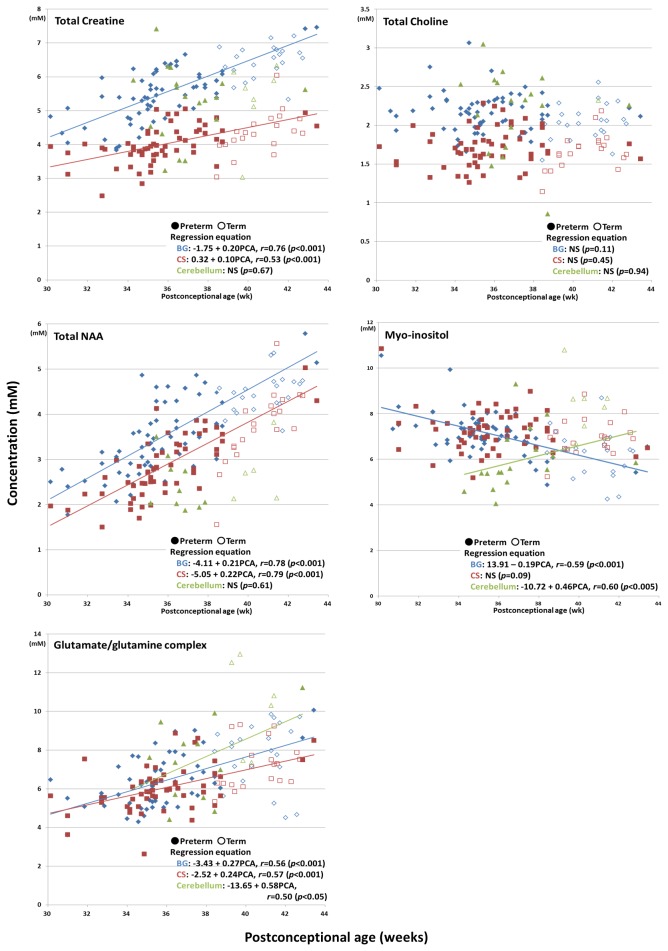
Brain metabolite concentrations change dynamically throughout development, especially during early childhood. The purpose of this study was to investigate the brain metabolite concentrations of neonates (postconceptional age (PCA): 30 to 43 weeks) using single-voxel magnetic resonance spectroscopy (MRS) and to discuss the relationships between the changes in the concentrations of such metabolites and brain development during the neonatal period. A total of 83 neonatal subjects were included using the following criteria: the neonates had to be free of radiological abnormalities, organic illness, and neurological symptoms; the MR spectra had to have signal-to-noise ratios ≥ 4; and the estimated metabolite concentrations had to display Cramér-Rao lower bounds of ≤ 30%. MRS data (echo time/repetition time, 30/5000 ms; 3T) were acquired from the basal ganglia (BG), centrum semiovale (CS), and the cerebellum. The concentrations of five metabolites were measured: creatine, choline, N-acetylaspartate, myo-inositol, and glutamate/glutamine complex (Glx). One hundred and eighty-four MR spectra were obtained (83 BG, 77 CS, and 24 cerebellum spectra). Creatine, N-acetylaspartate, and Glx displayed increases in their concentrations with PCA. Choline was not correlated with PCA in any region. As for myo-inositol, its concentration decreased with PCA in the BG, whereas it increased with PCA in the cerebellum. Quantitative brain metabolite concentrations and their changes during the neonatal period were assessed. Although the observed changes were partly similar to those detected in previous reports, our results are with more subjects (n = 83), and higher magnetic field (3T). The metabolite concentrations examined in this study and their changes are clinically useful indices of neonatal brain development.
脑代谢物浓度在整个发育过程中动态变化,尤其是在儿童早期。本研究旨在使用单体素磁共振波谱(MRS)研究新生儿(孕龄(PCA):30 至 43 周)的脑代谢物浓度,并探讨这些代谢物浓度变化与新生儿期脑发育的关系。根据以下标准纳入了 83 名新生儿受试者:新生儿必须无放射学异常、器质性疾病和神经症状;MR 谱的信噪比必须≥4;且估计的代谢物浓度必须显示出 Cramér-Rao 下限≤30%。MRS 数据(回波时间/重复时间,30/5000 ms;3T)来自基底节(BG)、半卵圆中心(CS)和小脑。测量了 5 种代谢物的浓度:肌酸、胆碱、N-乙酰天冬氨酸、肌醇和谷氨酸/谷氨酰胺复合物(Glx)。共获得 184 个 MR 谱(83 个 BG、77 个 CS 和 24 个小脑谱)。在 PCA 过程中,肌酸、N-乙酰天冬氨酸和 Glx 的浓度增加。胆碱在任何区域均与 PCA 无关。至于肌醇,其在 BG 中的浓度随 PCA 而降低,而在小脑中的浓度随 PCA 而增加。评估了新生儿期的定量脑代谢物浓度及其变化。尽管观察到的变化部分与以前的报告中检测到的变化相似,但我们的结果有更多的受试者(n=83)和更高的磁场(3T)。本研究中检查的代谢物浓度及其变化是新生儿脑发育的临床有用指标。