International Crops Research Institute for the Semi-Arid Tropics (ICRISAT), Hyderabad, India,
Theor Appl Genet. 2014 Feb;127(2):445-62. doi: 10.1007/s00122-013-2230-6. Epub 2013 Dec 11.
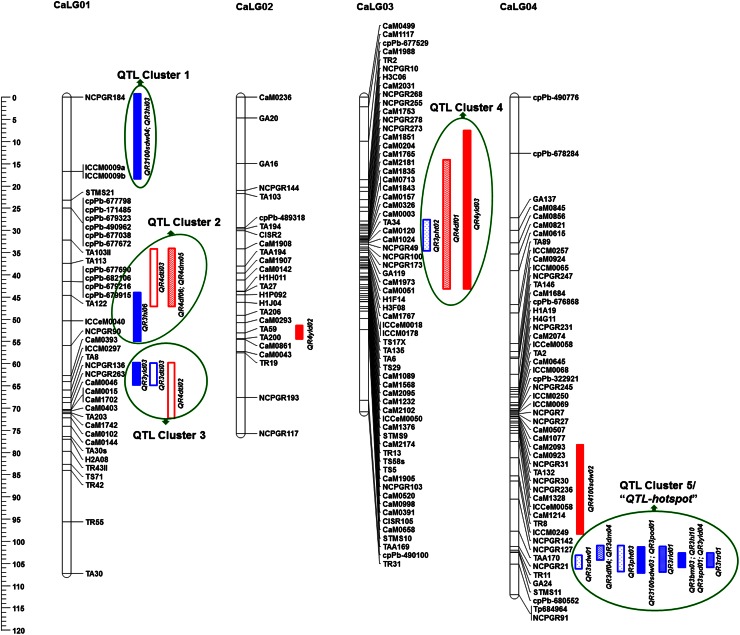
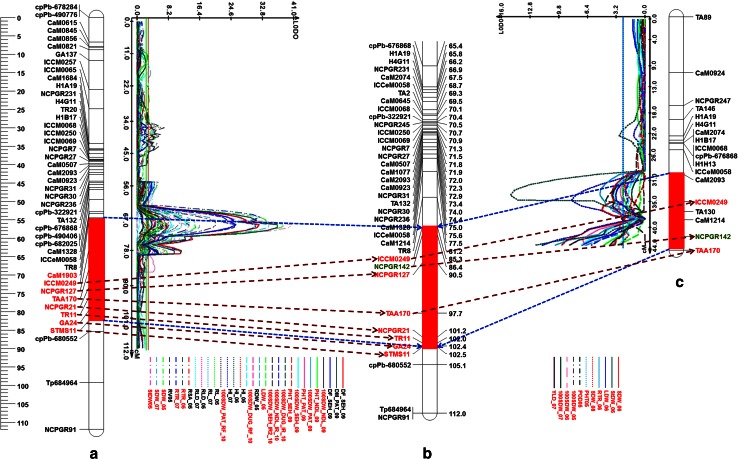
Analysis of phenotypic data for 20 drought tolerance traits in 1-7 seasons at 1-5 locations together with genetic mapping data for two mapping populations provided 9 QTL clusters of which one present on CaLG04 has a high potential to enhance drought tolerance in chickpea improvement. Chickpea (Cicer arietinum L.) is the second most important grain legume cultivated by resource poor farmers in the arid and semi-arid regions of the world. Drought is one of the major constraints leading up to 50% production losses in chickpea. In order to dissect the complex nature of drought tolerance and to use genomics tools for enhancing yield of chickpea under drought conditions, two mapping populations-ICCRIL03 (ICC 4958 × ICC 1882) and ICCRIL04 (ICC 283 × ICC 8261) segregating for drought tolerance-related root traits were phenotyped for a total of 20 drought component traits in 1-7 seasons at 1-5 locations in India. Individual genetic maps comprising 241 loci and 168 loci for ICCRIL03 and ICCRIL04, respectively, and a consensus genetic map comprising 352 loci were constructed ( http://cmap.icrisat.ac.in/cmap/sm/cp/varshney/). Analysis of extensive genotypic and precise phenotypic data revealed 45 robust main-effect QTLs (M-QTLs) explaining up to 58.20% phenotypic variation and 973 epistatic QTLs (E-QTLs) explaining up to 92.19% phenotypic variation for several target traits. Nine QTL clusters containing QTLs for several drought tolerance traits have been identified that can be targeted for molecular breeding. Among these clusters, one cluster harboring 48% robust M-QTLs for 12 traits and explaining about 58.20% phenotypic variation present on CaLG04 has been referred as "QTL-hotspot". This genomic region contains seven SSR markers (ICCM0249, NCPGR127, TAA170, NCPGR21, TR11, GA24 and STMS11). Introgression of this region into elite cultivars is expected to enhance drought tolerance in chickpea.
对来自两个作图群体的 20 个 1-7 季 1-5 个地点的耐旱性状表型数据和遗传作图数据进行分析,鉴定到 9 个 QTL 簇,其中一个位于 CaLG04 的 QTL 簇具有提高鹰嘴豆耐旱性的巨大潜力。鹰嘴豆(Cicer arietinum L.)是全世界资源匮乏的农民种植的第二大重要豆类作物。干旱是导致鹰嘴豆减产 50%的主要限制因素之一。为了剖析耐旱性的复杂特性,并利用基因组学工具提高干旱条件下鹰嘴豆的产量,对两个作图群体 ICCRIL03(ICC 4958×ICC 1882)和 ICCRIL04(ICC 283×ICC 8261)进行了表型分析,这两个群体在印度 1-5 个地点的 1-7 个季节中总共对 20 个与耐旱性相关的根系性状进行了表型鉴定。分别为 ICCRIL03 和 ICCRIL04 构建了包含 241 个和 168 个位点的个体遗传图谱,以及包含 352 个位点的共识遗传图谱(http://cmap.icrisat.ac.in/cmap/sm/cp/varshney/)。对广泛的基因型和精确的表型数据进行分析,鉴定到 45 个解释高达 58.20%表型变异的主效 QTL(M-QTL)和 973 个解释高达 92.19%表型变异的上位性 QTL(E-QTL)。鉴定到 9 个包含多个耐旱性性状 QTL 的 QTL 簇,可作为分子育种的目标。其中一个簇含有 12 个耐旱性性状的 48%稳健的 M-QTL,位于 CaLG04 上,解释高达 58.20%的表型变异,被称为“QTL 热点”。该基因组区域包含 7 个 SSR 标记(ICCM0249、NCPGR127、TAA170、NCPGR21、TR11、GA24 和 STMS11)。将该区域导入到优良品种中,有望提高鹰嘴豆的耐旱性。