Bekele Wesinew Adugna, Tessema Tesfaye Sisay, Melaku Simenew Keskes
College of Veterinary Medicine and Agriculture, Addis Ababa University, P,O, Box 34, Debre Zeit, Ethiopia.
Acta Vet Scand. 2013 Dec 17;55(1):89. doi: 10.1186/1751-0147-55-89.
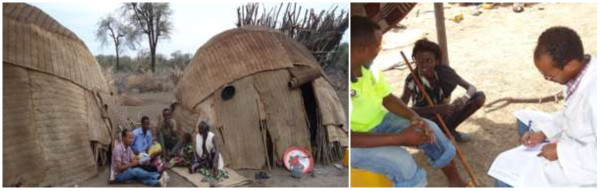
A cross-sectional study was carried out in four districts of the Afar region in Ethiopia to determine the prevalence of brucellosis in camels, and to identify risky practices that would facilitate the transmission of zoonoses to humans. This study involved testing 461 camels and interviewing 120 livestock owners. The modified Rose Bengal plate test (mRBPT) and complement fixation test (CFT) were used as screening and confirmatory tests, respectively. SPSS 16 was used to analyze the overall prevalence and potential risk factors for seropositivity, using a multivariable logistic regression analysis.
In the camel herds tested, 5.4% had antibodies against Brucella species, and the district level seroprevalence ranged from 11.7% to 15.5% in camels. The logistic regression model for camels in a herd size > 20 animals (OR = 2.8; 95% CI: 1.16-6.62) and greater than four years of age (OR = 4.9; 95% CI: 1.45-16.82) showed a higher risk of infection when compared to small herds and those ≤ 4 years old. The questionnaire survey revealed that most respondents did not know about the transmission of zoonotic diseases, and that their practices could potentially facilitate the transmission of zoonotic pathogens.
The results of this study revealed that camel brucellosis is prevalent in the study areas. Therefore, there is a need for implementing control measures and increasing public awareness in the prevention methods of brucellosis.
在埃塞俄比亚阿法尔地区的四个区开展了一项横断面研究,以确定骆驼布鲁氏菌病的患病率,并确定可能促进人畜共患病传播给人类的危险行为。该研究对461头骆驼进行了检测,并对120名牲畜所有者进行了访谈。改良的玫瑰红平板试验(mRBPT)和补体结合试验(CFT)分别用作筛查和确诊试验。使用SPSS 16通过多变量逻辑回归分析来分析总体患病率和血清阳性的潜在危险因素。
在所检测的骆驼群中,5.4%的骆驼具有抗布鲁氏菌属的抗体,各区骆驼的血清阳性率在11.7%至15.5%之间。对于畜群规模大于20头(比值比[OR]=2.8;95%置信区间[CI]:1.16-6.62)且年龄大于4岁(OR=4.9;95%CI:1.45-16.82)的骆驼,与小畜群及年龄小于等于4岁的骆驼相比,其感染风险更高。问卷调查显示,大多数受访者不了解人畜共患病的传播情况,且他们的行为可能会促进人畜共患病原体的传播。
本研究结果显示,骆驼布鲁氏菌病在研究地区普遍存在。因此,有必要实施控制措施并提高公众对布鲁氏菌病预防方法的认识。