Department of Neurobiology, Weizmann Institute of Science Rehovot, Israel.
The Leslie and Susan Gonda (Goldschmied) Multidisciplinary Brain Research Center, Bar-Ilan University Ramat Gan, Israel.
Front Psychol. 2013 Dec 3;4:912. doi: 10.3389/fpsyg.2013.00912. eCollection 2013.
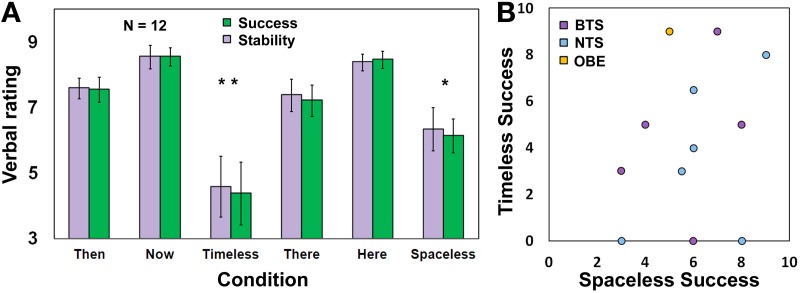
Meditation practice can lead to what have been referred to as "altered states of consciousness."One of the phenomenological characteristics of these states is a joint alteration in the sense of time, space, and body. Here, we set out to study the unique experiences of alteration in the sense of time and space by collaborating with a select group of 12 long-term mindfulness meditation (MM) practitioners in a neurophenomenological setup, utilizing first-person data to guide the neural analyses. We hypothesized that the underlying neural activity accompanying alterations in the sense of time and space would be related to alterations in bodily processing. The participants were asked to volitionally bring about distinct states of "Timelessness" (outside time) and "Spacelessness" (outside space) while their brain activity was recorded by MEG. In order to rule out the involvement of attention, memory, or imagination, we used control states of "Then" (past) and "There" (another place). MEG sensors evidencing alterations in power values were identified, and the brain regions underlying these changes were estimated via spatial filtering (beamforming). Particularly, we searched for similar neural activity hypothesized to underlie both the state of "Timelessness" and "Spacelessness." The results were mostly confined to the theta band, and showed that: (1) the "Then"/"There" overlap yielded activity in regions related to autobiographic memory and imagery (right posterior parietal lobule (PPL), right precentral/middle frontal gyrus (MFG), bilateral precuneus); (2) "Timelessness"/"Spacelessness" conditions overlapped in a different network, related to alterations in the sense of the body (posterior cingulate, right temporoparietal junction (TPJ), cerebellum); and (3) phenomenologically-guided neural analyses enabled us to dissociate different levels of alterations in the sense of the body. This study illustrates the utility of employing experienced contemplative practitioners within a neurophenomenological setup for scientifically characterizing a self-induced altered sense of time, space and body, as well as the importance of theta activity in relation with these altered states.
冥想练习可能会导致所谓的“意识改变状态”。这些状态的现象学特征之一是时间、空间和身体感觉的联合改变。在这里,我们与一组 12 名长期正念冥想(MM)从业者合作,在神经现象学设置中,利用第一人称数据来指导神经分析,旨在研究时间和空间感觉改变的独特体验。我们假设,伴随时间和空间感觉改变的潜在神经活动与身体处理的改变有关。要求参与者在大脑活动由 MEG 记录的同时,自愿进入“无时间感”(无时间)和“无空间感”(无空间)的状态。为了排除注意力、记忆或想象力的参与,我们使用了“那时”(过去)和“那里”(另一个地方)的控制状态。确定了证明功率值改变的 MEG 传感器,并通过空间滤波(波束形成)估计了这些变化背后的大脑区域。特别是,我们搜索了假设为“无时间感”和“无空间感”状态提供基础的类似神经活动。结果主要局限于θ波段,表明:(1)“那时”/“那里”的重叠在与自传体记忆和意象相关的区域产生了活动(右后顶叶小叶(PPL),右中央/额前回(MFG),双侧楔前叶);(2)“无时间感”/“无空间感”条件在一个不同的网络中重叠,与身体感觉的改变有关(后扣带、右颞顶联合(TPJ)、小脑);(3)现象学指导的神经分析使我们能够区分身体感觉改变的不同水平。这项研究说明了在神经现象学设置中雇用经验丰富的冥想从业者的效用,以便科学地描述自我诱导的改变的时间、空间和身体感觉,以及与这些改变状态相关的θ活动的重要性。