Wright Nicholas D, Symmonds Mkael, Morris Laurel S, Dolan Raymond J
Wellcome Trust Centre for Neuroimaging, Institute of Neurology, University College, London, United Kingdom.
Wellcome Trust Centre for Neuroimaging, Institute of Neurology, University College, London, United Kingdom ; Nuffield Department of Clinical Neurosciences, University of Oxford, Oxford, United Kingdom.
PLoS One. 2013 Dec 20;8(12):e83454. doi: 10.1371/journal.pone.0083454. eCollection 2013.
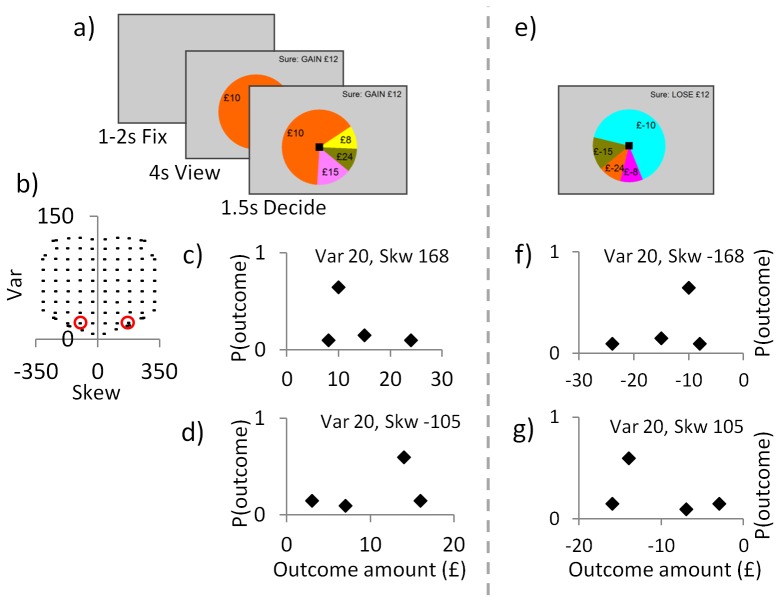
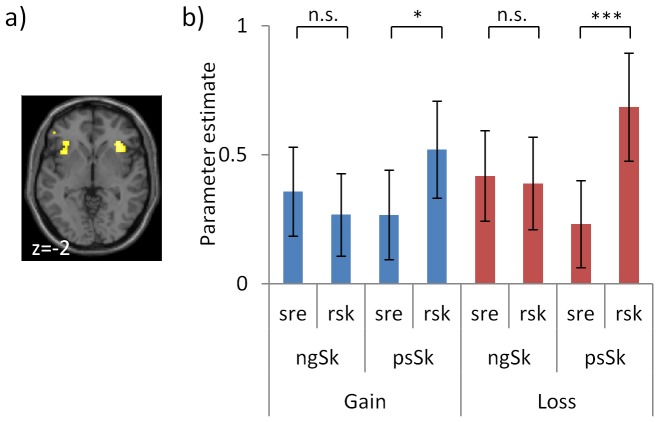
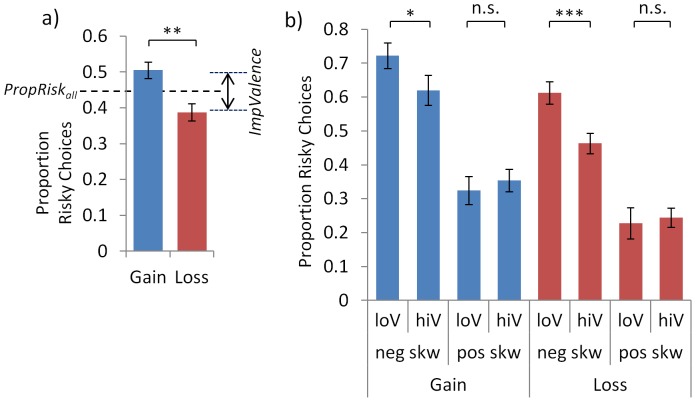
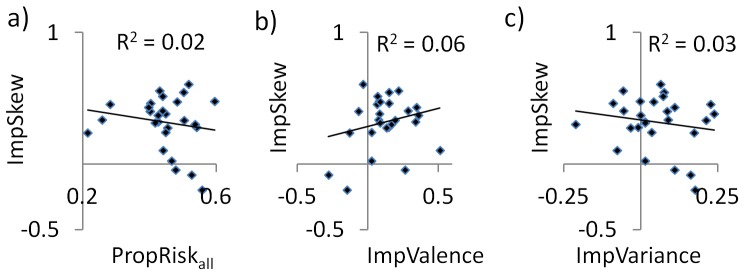
Asymmetry in distributions of potential outcomes (i.e. skewness), and whether those potential outcomes reflect gains or losses (i.e. their valence), both exert a powerful influence on value-based choice. How valence affects the impact of skewness on choice is unknown. Here by orthogonally manipulating the skewness and valence of economic stimuli we show that both have an influence on choice. We show that the influence of skewness on choice is independent of valence, both across and within subjects. fMRI data revealed skew-related activity in bilateral anterior insula and dorsomedial prefrontal cortex, which shows no interaction with valence. Further, the expression of skew-related activity depends on an individual's preference for skewness, and this was again independent of valence-related preference. Our findings highlight the importance of skewness in choice and show that its influence, both behaviourally and neurally, is distinct from an influence of valence.
潜在结果分布的不对称性(即偏度)以及这些潜在结果反映的是收益还是损失(即它们的效价),都会对基于价值的选择产生强大影响。效价如何影响偏度对选择的影响尚不清楚。在这里,我们通过正交操纵经济刺激的偏度和效价,表明两者都对选择有影响。我们表明,偏度对选择的影响在个体间和个体内均独立于效价。功能磁共振成像数据显示,双侧前岛叶和背内侧前额叶皮质存在与偏度相关的活动,且该活动与效价无相互作用。此外,与偏度相关的活动表达取决于个体对偏度的偏好,并且这再次独立于与效价相关的偏好。我们的研究结果突出了偏度在选择中的重要性,并表明其在行为和神经层面的影响与效价的影响不同。