Centre for Clinical Diagnostics, Royal Brisbane and Women's Hospital, University of Queensland Centre for Clinical Research, Building 71/918, Herston, Queensland 4029, Australia.
J Transl Med. 2014 Jan 6;12:4. doi: 10.1186/1479-5876-12-4.
The role of exosomes in the pathogenesis and metastatic spread of cancer remains to be fully elucidated. Recent studies support the hypothesis that the release of exosomes from cells modifies local extracellular conditions to promote cell growth and neovascularisation. In addition, exosomes may modify the phenotype of parent and/or target cell. For example, sequestration of signaling mediators into exosomes may reduce their intracellular bioavailability to the parent cell thereby altering cell phenotype and metastatic potential. The fusion of released exosomes with target cell and delivery may also modify cell function and activity. In this study, to further elucidate the role of exosomes in ovarian cancer, the release of exosomes from two ovarian cancer cell lines of different invasive capacity and their miRNA content of exosomes were compared. The hypothesis to be tested was that ovarian cancer cell invasiveness is associated with altered release of exosomes and discordant exosomal sequestration of miRNA.
High (SKOV-3) and low (OVCAR-3) invasive ovarian cancer cell lines were used to characterize their exosome release. SKOV-3 and OVCAR-3 cells were cultured (DMEM, 20% exosome-free FBS) under an atmosphere of 8% O2 for 24 hours. Cell-conditioned media were collected and exosomes were isolated by differential and buoyant density centrifugation and characterised by Western blot (CD63 and CD9). Exosomal microRNA (let-7a-f and miR-200a-c) content was established by real-time PCR.
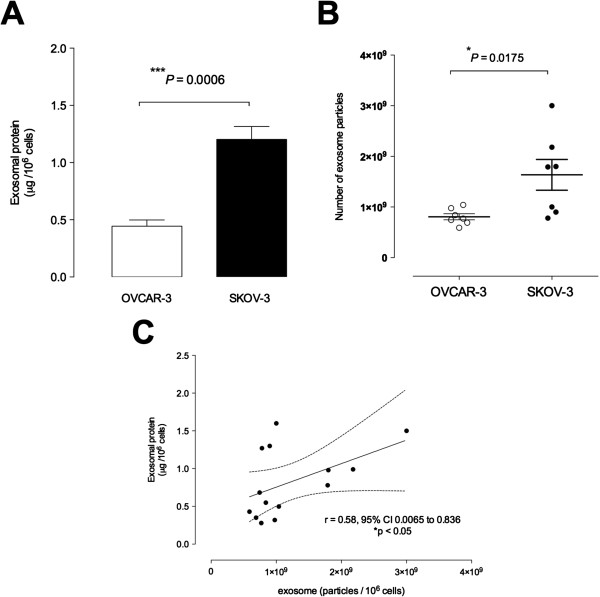
Exosomes were identified with by the presence of typical cup-shaped spherical vesicle and the expression of exosome markers: CD63, CD9. SKOV-3 cells released 2.7-fold more exosomes (1.22 ± 0.11 μg/106 cells) compared to OVCAR-3 (0.44 ± 0.05 μg/106 cells). The let-7 family miRNA transcripts were identified in both ovarian cancer cell lines and their exosomes. The let-7 family transcripts were more abundant in OVCAR-3 cell than SKOV-3 cells. In contrast, let-7 family transcripts were more abundant in exosomes from SKOV-3 than OVCAR-3. miR-200 family transcripts were only identified in OVCAR-3 cells and their exosomes.
The data obtained in this study are consistent with the hypothesis that the releases of exosomes varies significantly between ovarian cancer cell lines and correlates with their invasive potential.
外泌体在癌症的发病机制和转移扩散中的作用仍有待充分阐明。最近的研究支持这样一种假设,即细胞释放的外泌体改变局部细胞外环境,促进细胞生长和新生血管形成。此外,外泌体还可以改变亲本和/或靶细胞的表型。例如,将信号介质隔离到外泌体中可能会降低其在亲本细胞中的细胞内生物利用度,从而改变细胞表型和转移潜能。释放的外泌体与靶细胞融合和传递也可能改变细胞功能和活性。在这项研究中,为了进一步阐明外泌体在卵巢癌中的作用,我们比较了两种侵袭能力不同的卵巢癌细胞系释放的外泌体及其外泌体中的 miRNA 含量。要检验的假设是卵巢癌细胞的侵袭能力与外泌体释放的改变以及 miRNA 的外泌体隔离不一致有关。
使用高(SKOV-3)和低(OVCAR-3)侵袭性卵巢癌细胞系来表征它们的外泌体释放。将 SKOV-3 和 OVCAR-3 细胞在 8%氧气的环境下用含有 20%无外泌体胎牛血清的 DMEM 培养基培养 24 小时。收集细胞条件培养基,并通过差速和浮力密度离心分离外泌体,并通过 Western blot(CD63 和 CD9)进行鉴定。通过实时 PCR 确定外泌体 microRNA(let-7a-f 和 miR-200a-c)含量。
通过存在典型的杯形球形囊泡和外泌体标记物(CD63、CD9)鉴定出外泌体。与 OVCAR-3(0.44±0.05μg/106 细胞)相比,SKOV-3 细胞释放的外泌体多 2.7 倍(1.22±0.11μg/106 细胞)。卵巢癌细胞系及其外泌体中均鉴定出 let-7 家族 miRNA 转录物。与 SKOV-3 细胞相比,OVCAR-3 细胞中的 let-7 家族转录物更为丰富。相比之下,SKOV-3 细胞中外泌体中的 let-7 家族转录物更为丰富。miR-200 家族转录物仅在 OVCAR-3 细胞及其外泌体中被鉴定。
本研究获得的数据与这样一种假设一致,即外泌体的释放在卵巢癌细胞系之间差异显著,与它们的侵袭能力相关。