MENRVA Group, School of Engineering Science, Faculty of Applied Science, Simon Fraser University, 8888 University Drive, Burnaby, BC V5A 1S6, Canada.
J Neuroeng Rehabil. 2014 Jan 8;11:2. doi: 10.1186/1743-0003-11-2.
Body motion data registered by wearable sensors can provide objective feedback to patients on the effectiveness of the rehabilitation interventions they undergo. Such a feedback may motivate patients to keep increasing the amount of exercise they perform, thus facilitating their recovery during physical rehabilitation therapy. In this work, we propose a novel wearable and affordable system which can predict different postures of the upper-extremities by classifying force myographic (FMG) signals of the forearm in real-time.
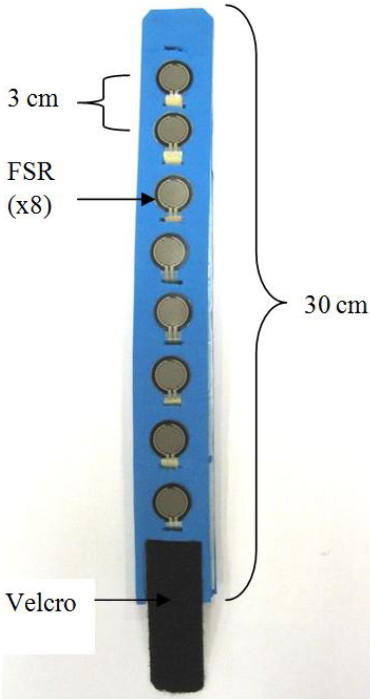
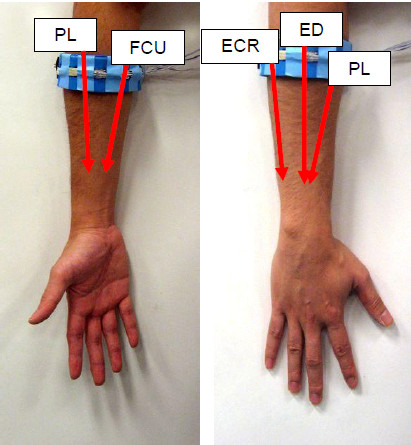
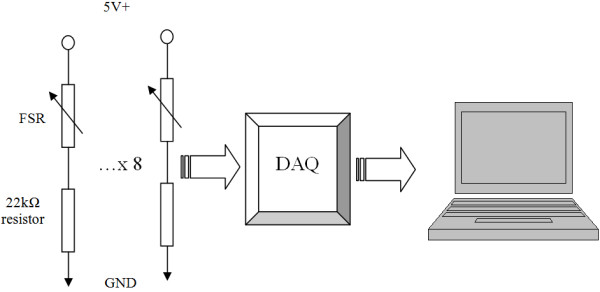
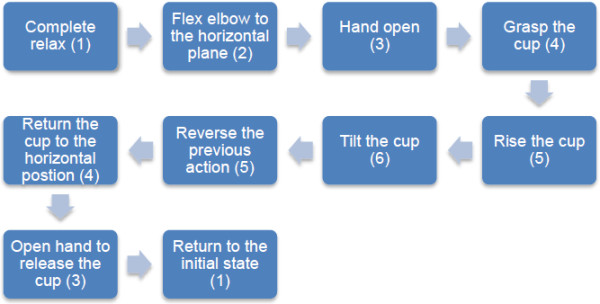
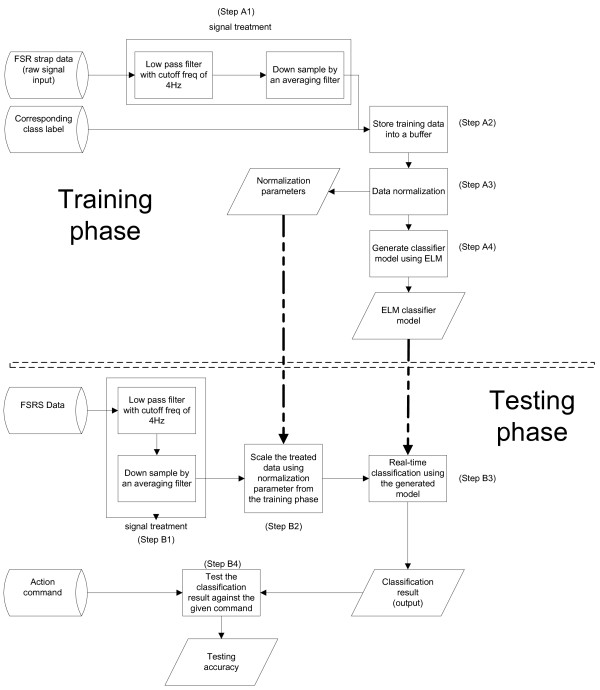
An easy to use force sensor resistor (FSR) strap to extract the upper-extremities FMG signals was prototyped. The FSR strap was designed to be placed on the proximal portion of the forearm and capture the activities of the main muscle groups with eight force input channels. The non-kernel based extreme learning machine (ELM) classifier with sigmoid based function was implemented for real-time classification due to its fast learning characteristics. A test protocol was designed to classify in real-time six upper-extremities postures that are needed to successfully complete a drinking task, which is a functional exercise often used in constraint-induced movement therapy. Six healthy volunteers participated in the test. Each participant repeated the drinking task three times. FMG data and classification results were recorded for analysis.
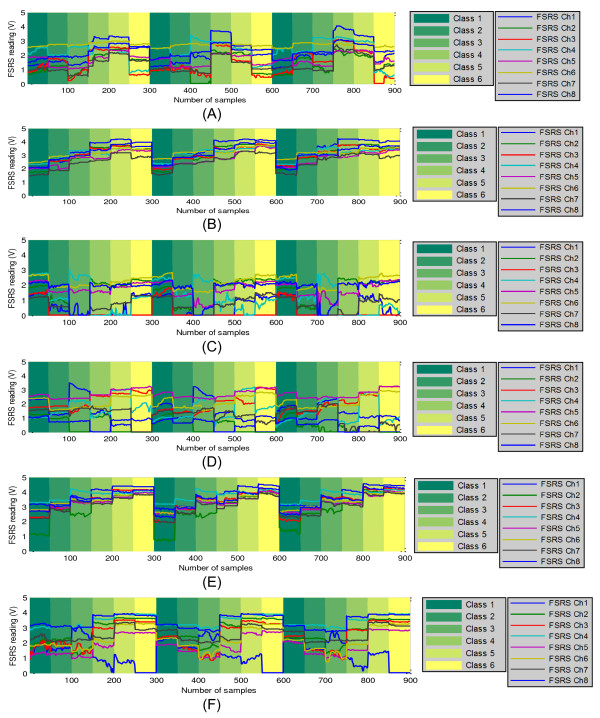
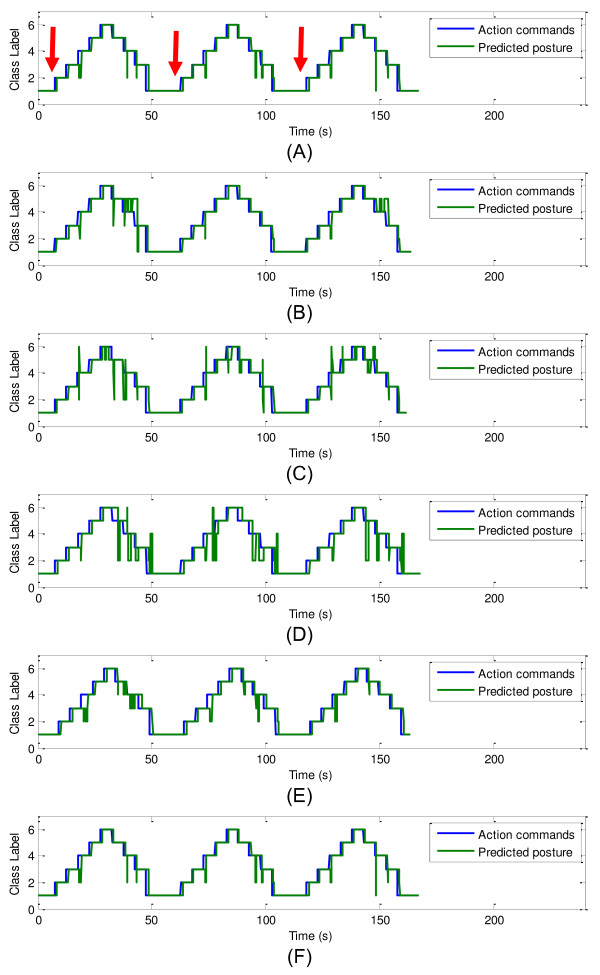
The obtained results confirmed that the FMG data captured from the FSR strap produced distinct patterns for the selected upper-extremities postures of the drinking task. With the use of the non-kernel based ELM, the postures associated to the drinking task were predicted in real-time with an average overall accuracy of 92.33% and standard deviation of 3.19%.
This study showed that the proposed wearable FSR strap was able to detect eight FMG signals from the forearm. In addition, the implemented ELM algorithm was able to correctly classify in real-time six postures associated to the drinking task. The obtained results therefore point out that the proposed system has potential for providing instant feedback during functional rehabilitation exercises.
可穿戴传感器记录的身体运动数据可以为患者提供有关其接受的康复干预措施效果的客观反馈。这种反馈可以激励患者不断增加锻炼量,从而促进他们在物理康复治疗期间的恢复。在这项工作中,我们提出了一种新颖的可穿戴且经济实惠的系统,该系统可以通过实时分类前臂的力肌电图(FMG)信号来预测上肢的不同姿势。
我们原型设计了一个易于使用的力传感器电阻器(FSR)带,以提取上肢 FMG 信号。FSR 带设计用于放置在前臂的近端,并通过八个力输入通道捕获主要肌肉群的活动。由于其快速学习的特点,我们实现了基于非核的极限学习机(ELM)分类器和基于 sigmoid 的函数进行实时分类。设计了一个测试协议,用于实时分类完成饮水任务所需的六种上肢姿势,这是一种常用于强制性运动疗法的功能性运动。六名健康志愿者参加了测试。每位参与者重复三次饮水任务。记录 FMG 数据和分类结果进行分析。
获得的结果证实,从 FSR 带捕获的 FMG 数据产生了与饮水任务所选上肢姿势明显不同的模式。使用基于非核的 ELM,与饮水任务相关的姿势可以以 92.33%的平均整体准确性和 3.19%的标准差实时预测。
本研究表明,所提出的可穿戴 FSR 带能够从前臂检测到八个 FMG 信号。此外,实现的 ELM 算法能够实时正确地分类与饮水任务相关的六个姿势。因此,所获得的结果表明,所提出的系统具有在功能性康复运动期间提供即时反馈的潜力。