Voogt Carmen, Kuntsche Emmanuel, Kleinjan Marloes, Poelen Evelien, Engels Rutger
Behavioural Science Institute, Radboud University Nijmegen, Nijmegen, Netherlands.
J Med Internet Res. 2014 Jan 8;16(1):e5. doi: 10.2196/jmir.2817.
Web-based brief alcohol interventions are effective in reducing alcohol use among students when measured at limited follow-up time points. To date, no studies have tested Web-based brief alcohol intervention effectiveness over time by using a large number of measurements.
Testing whether the What Do You Drink (WDYD) Web-based brief alcohol intervention can sustain a reduction in alcohol use among heavy-drinking students aged 18-24 years at 1-, 3-, and 6-month follow-up intervals.
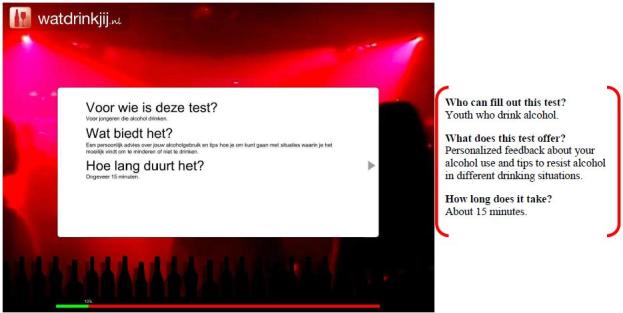
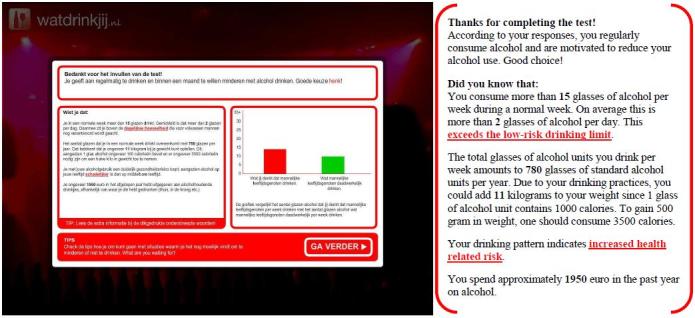
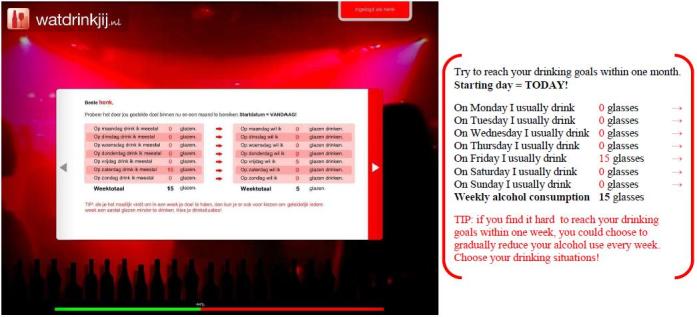
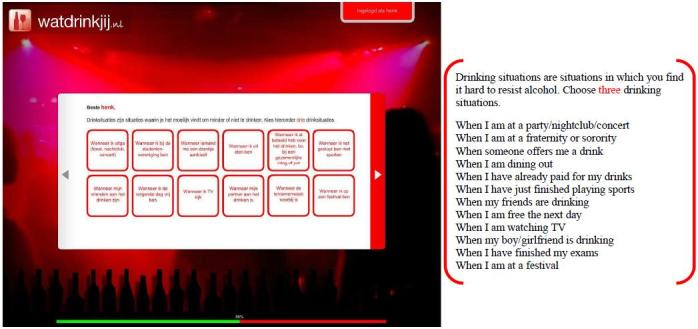
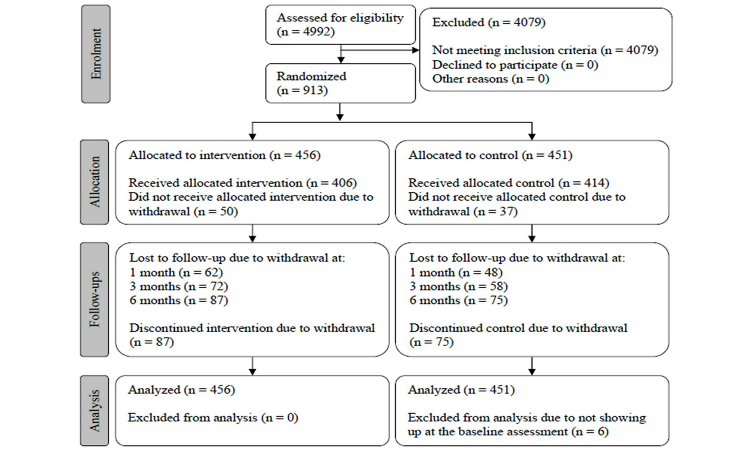
A purely Web-based, 2-arm, parallel-group randomized controlled trial applying an ecological momentary assessment approach with 30 weekly measurements was conducted in the Netherlands (2010-2011). Participants were recruited offline and online. A total of 907 participants were randomized into the experimental condition (n=456) including the single-session and fully automated WDYD intervention, or into the control condition (n=451) including assessment only. Weekly alcohol consumption and frequency of binge drinking were the self-assessed outcome measures.
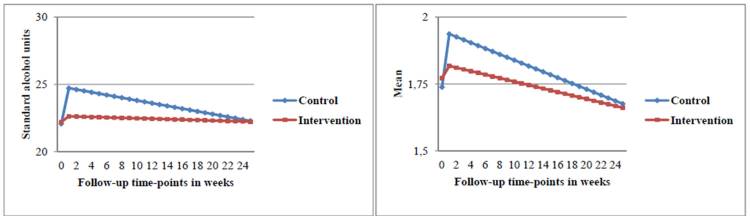
Attrition rates of the 907 participants were 110 (12.1%), 130 (14.3%), and 162 (17.9%) at 1-, 3-, and 6-month follow-up intervals, respectively. Latent growth curve analyses according to the intention-to-treat principle revealed that participants in the experimental condition had significantly lower weekly alcohol consumption compared to participants in the control condition that was sustained at 3-month follow-up (intercept=-2.60, P<.001; slope=0.16, P=.08). Additional linear regression analyses indicated that this intercept difference resulted from significantly higher levels of alcohol units per week for participants in the control condition compared to those in the experimental condition at 1-month (beta=-2.56, SE 0.74, Cohen's d=0.20, P=.001), 3-month (beta=-1.76, SE 0.60, Cohen's d=0.13, P=.003), and 6-month (beta=-1.21, SE 0.58, Cohen's d=0.09, P=.04) follow-up intervals. Latent growth curve analyses further indicated that participants in the experimental condition had a significantly lower frequency of binge drinking compared to participants in the control condition that was sustained at 6-month follow-up (intercept=-0.14, P=.01; slope=0.004, P=.19). This intercept difference resulted from higher levels in this outcome for participants in the control condition relative to participants in the experimental condition at 1-month (beta=-1.15, SE 0.06, Cohen's d=0.16, P=.01), 3-month (beta=-0.12, SE 0.05, Cohen's d=0.09, P=.01), and 6-month (beta=-0.09, SE 0.05, Cohen's d=0.03, P=.045) follow-up intervals.
The WDYD intervention was shown to be effective in preventing an increase in weekly alcohol consumption and frequency of binge drinking directly after the intervention. This effect was sustained 3 and 6 months after the intervention.
Netherlands Trial Register NTR2665; http://www.trialregister.nl/trialreg/admin/rctview.asp?TC=2665 (Archived by WebCite at http://webcitation.org/6LuQVn12M).
基于网络的简短酒精干预措施在有限的随访时间点进行测量时,对于减少学生饮酒是有效的。迄今为止,尚无研究通过大量测量来测试基于网络的简短酒精干预措施随时间的效果。
测试“你喝什么(WDYD)”基于网络的简短酒精干预措施能否在1个月、3个月和6个月的随访间隔期内,持续减少18 - 24岁重度饮酒学生的酒精摄入量。
在荷兰(2010 - 2011年)进行了一项纯基于网络的双臂平行组随机对照试验,采用生态瞬时评估方法,每周进行30次测量。通过线下和线上方式招募参与者。总共907名参与者被随机分为实验组(n = 456)和对照组(n = 451);实验组包括单节次且全自动的WDYD干预措施,对照组仅包括评估。每周酒精摄入量和暴饮频率是自我评估的结果指标。
在1个月、3个月和6个月的随访间隔期,907名参与者的失访率分别为110人(12.1%)、130人(14.3%)和162人(17.9%)。根据意向性分析原则进行的潜在增长曲线分析显示,与对照组参与者相比,实验组参与者的每周酒精摄入量显著更低,且在3个月随访期仍保持这一差异(截距 = -2.60,P <.001;斜率 = 0.16,P =.08)。额外的线性回归分析表明,这种截距差异是由于对照组参与者在1个月(β = -2.56,标准误0.74,科恩d值 = 0.20,P =.001)、3个月(β = -1.76,标准误0.60,科恩d值 = 0.13,P =.003)和6个月(β = -1.21,标准误0.58,科恩d值 = 0.09,P =.04)随访间隔期的每周酒精单位摄入量显著高于实验组参与者。潜在增长曲线分析进一步表明,与对照组参与者相比,实验组参与者的暴饮频率显著更低,且在6个月随访期仍保持这一差异(截距 = -0.14,P =.01;斜率 = 0.004,P =.19)。这种截距差异是由于对照组参与者在1个月(β = -1.15,标准误0.06,科恩d值 = 0.16,P =.01)、3个月(β = -0.12,标准误0.05,科恩d值 = 0.09,P =.01)和6个月(β = -0.09,标准误0.05,科恩d值 = 0.03,P =.045)随访间隔期的这一结果水平高于实验组参与者。
WDYD干预措施在干预后能有效防止每周酒精摄入量和暴饮频率增加。这种效果在干预后3个月和6个月仍持续存在。
荷兰试验注册库NTR2665;http://www.trialregister.nl/trialreg/admin/rctview.asp?TC=2665(由WebCite存档于http://webcitation.org/6LuQVn12M)