Lindahl Elisabeth, Sattorov Nosirjon, Boqvist Sofia, Sattori Izzatullo, Magnusson Ulf
Division of Reproduction, Department of Clinical Sciences, Swedish University of Agricultural Sciences, P.O. Box 7054, 750 07, Uppsala, Sweden.
Trop Anim Health Prod. 2014 Mar;46(3):563-9. doi: 10.1007/s11250-013-0534-9. Epub 2014 Jan 12.
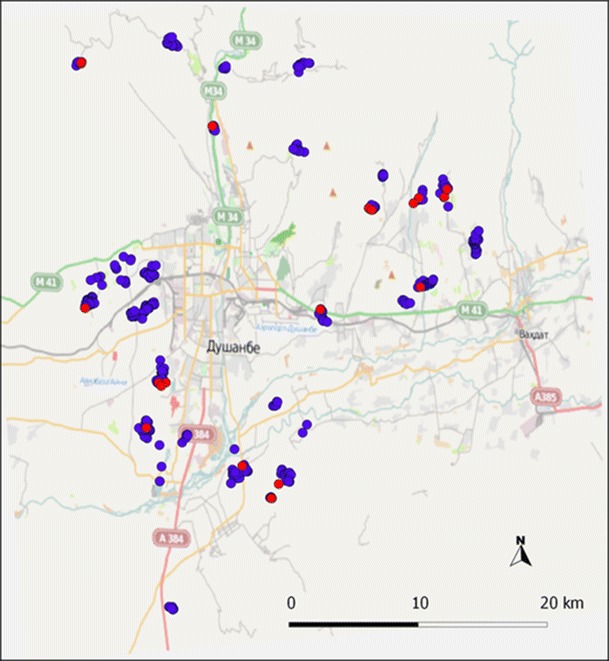
In this cross-sectional study, we assessed and mapped the seroprevalence of brucellosis in small-scale dairy farming in an urban and peri-urban area of Tajikistan and investigated factors associated with seropositivity. As urban and peri-urban farming is both an opportunity to improve the livelihood for small-scale farmers and a potential public health hazard, studies are warranted to reveal possible peculiarities in the epidemiology of brucellosis in this type of dairy farming. In total, 904 cows of breeding age belonging to 443 herds in 32 villages were serologically tested with indirect enzyme-linked immunosorbent assay (ELISA) and positive samples confirmed with competitive ELISA. Two logistic regression models were used to investigate an association between seropositivity and risk factors at herd and individual level. The herd and individual seroprevalences were 4.1 and 2.0 %, respectively. Herds with a history of abortions were found to be associated with seropositivity [odds ratio (OR) = 5.3; 95 % confidence interval (CI), 1.3-21.3]. Large herds with more than eight cattle were more likely to be seropositive compared to smaller herds with one to two cattle (OR = 13.9; 95 % CI, 1.6-119). The number of calves produced per cow (indicating age) was found to be associated with seropositivity. Younger cows with one to two produced calves were less likely to be seropositive compared to older cows with more than six produced calves (OR = 0.24; 95 % CI, 0.06-1.0). Neither introduction of new cattle to the herd nor communal grazing was associated with seropositivity. This study shows that infection with Brucella (1) is present in small-scale urban and peri-urban dairy farming in Tajikistan and (2) has significant negative effects on reproductive performance in this farming system and (3) that some previously known risk factors for seropositivity in rural farming system were absent here.
在这项横断面研究中,我们评估并绘制了塔吉克斯坦城市及周边地区小规模奶牛养殖中布鲁氏菌病的血清阳性率,并调查了与血清阳性相关的因素。由于城市及周边养殖既是小规模养殖户改善生计的机会,也是潜在的公共卫生隐患,因此有必要开展研究以揭示此类奶牛养殖中布鲁氏菌病流行病学可能存在的特殊性。总共对32个村庄443个牛群中904头育龄奶牛进行了间接酶联免疫吸附测定(ELISA)血清学检测,并用竞争ELISA法对阳性样本进行了确认。使用两个逻辑回归模型研究血清阳性与畜群和个体水平风险因素之间的关联。畜群和个体血清阳性率分别为4.1%和2.0%。发现有流产史的畜群与血清阳性有关[比值比(OR)=5.3;95%置信区间(CI),1.3 - 21.3]。与拥有1至2头牛的较小畜群相比,拥有8头以上奶牛的大型畜群血清阳性的可能性更大(OR = 13.9;95% CI,1.6 - 119)。发现每头奶牛产犊数量(表明年龄)与血清阳性有关。与产犊6头以上的老龄奶牛相比,产犊1至2头的年轻奶牛血清阳性的可能性较小(OR = 0.24;95% CI,0.06 - 1.0)。向畜群引入新牛和公共放牧均与血清阳性无关。本研究表明,布鲁氏菌感染(1)存在于塔吉克斯坦城市及周边小规模奶牛养殖中,(2)对该养殖系统的繁殖性能有显著负面影响,(3)农村养殖系统中一些先前已知的血清阳性风险因素在此处并不存在。