Netherlands Organisation for Applied Scientific Research, TNO Work and Employment, Hoofddorp, The Netherlands.
Saf Health Work. 2013 Dec;4(4):187-96. doi: 10.1016/j.shaw.2013.10.001. Epub 2013 Oct 19.
Health, safety, and well-being (HSW) at work represent important values in themselves. It seems, however, that other values can contribute to HSW. This is to some extent reflected in the scientific literature in the attention paid to values like trust or justice. However, an overview of what values are important for HSW was not available. Our central research question was: what organizational values are supportive of health, safety, and well-being at work?
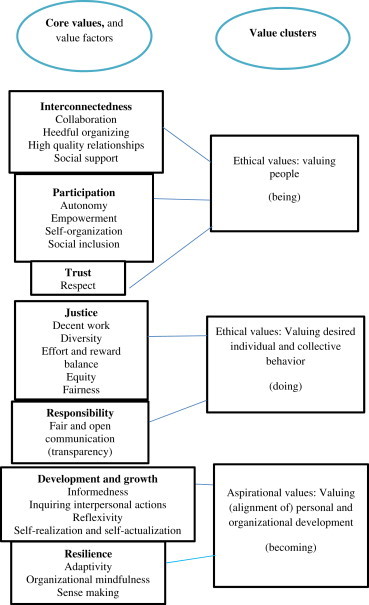
The literature was explored via the snowball approach to identify values and value-laden factors that support HSW. Twenty-nine factors were identified as relevant, including synonyms. In the next step, these were clustered around seven core values. Finally, these core values were structured into three main clusters.
The first value cluster is characterized by a positive attitude toward people and their "being"; it comprises the core values of interconnectedness, participation, and trust. The second value cluster is relevant for the organizational and individual "doing", for actions planned or undertaken, and comprises justice and responsibility. The third value cluster is relevant for "becoming" and is characterized by the alignment of personal and organizational development; it comprises the values of growth and resilience.
The three clusters of core values identified can be regarded as "basic value assumptions" that underlie both organizational culture and prevention culture. The core values identified form a natural and perhaps necessary aspect of a prevention culture, complementary to the focus on rational and informed behavior when dealing with HSW risks.
工作中的健康、安全和福利(HSW)本身就是重要的价值观。然而,其他价值观似乎也有助于 HSW。这在一定程度上反映在关注信任或正义等价值观的科学文献中。然而,对于哪些价值观对 HSW 很重要,并没有一个概述。我们的核心研究问题是:哪些组织价值观对工作中的健康、安全和福利有支持作用?
通过滚雪球的方法探索文献,以确定支持 HSW 的价值观和价值观因素。确定了 29 个相关因素,包括同义词。在下一步中,这些因素围绕着七个核心价值观进行了聚类。最后,这些核心价值观被分为三个主要集群。
第一个价值集群的特点是对人和他们的“存在”持积极态度;它包括相互联系、参与和信任的核心价值观。第二个价值集群与组织和个人的“行动”有关,与计划或采取的行动有关,包括公正和责任。第三个价值集群与“成为”有关,其特点是个人和组织发展的一致性;它包括成长和弹性的价值观。
确定的三个核心价值集群可以被视为“基本价值假设”,这些假设是组织文化和预防文化的基础。确定的核心价值观形成了预防文化的自然且必要的方面,与处理 HSW 风险时对理性和明智行为的关注相辅相成。