Huang Grace L, Anderson Timothy D, Clubb Robert T
Department of Chemistry and Biochemistry; University of California-Los Angeles; Los Angeles, CA USA; UCLA-DOE Institute of Genomics and Proteomics; University of California-Los Angeles; Los Angeles, CA USA.
Department of Chemistry and Biochemistry; University of California-Los Angeles; Los Angeles, CA USA; UCLA-DOE Institute of Genomics and Proteomics; University of California-Los Angeles; Los Angeles, CA USA; Molecular Biology Institute; University of California-Los Angeles; Los Angeles, CA USA.
Bioengineered. 2014 Mar-Apr;5(2):96-106. doi: 10.4161/bioe.27461. Epub 2013 Dec 18.
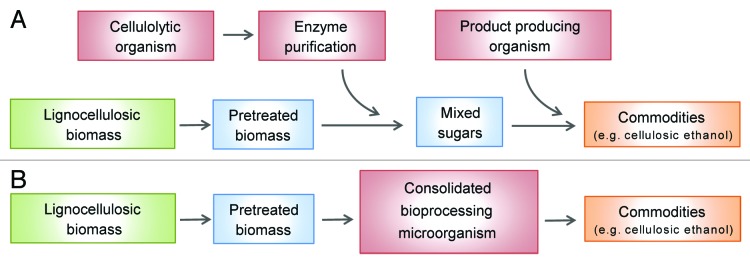
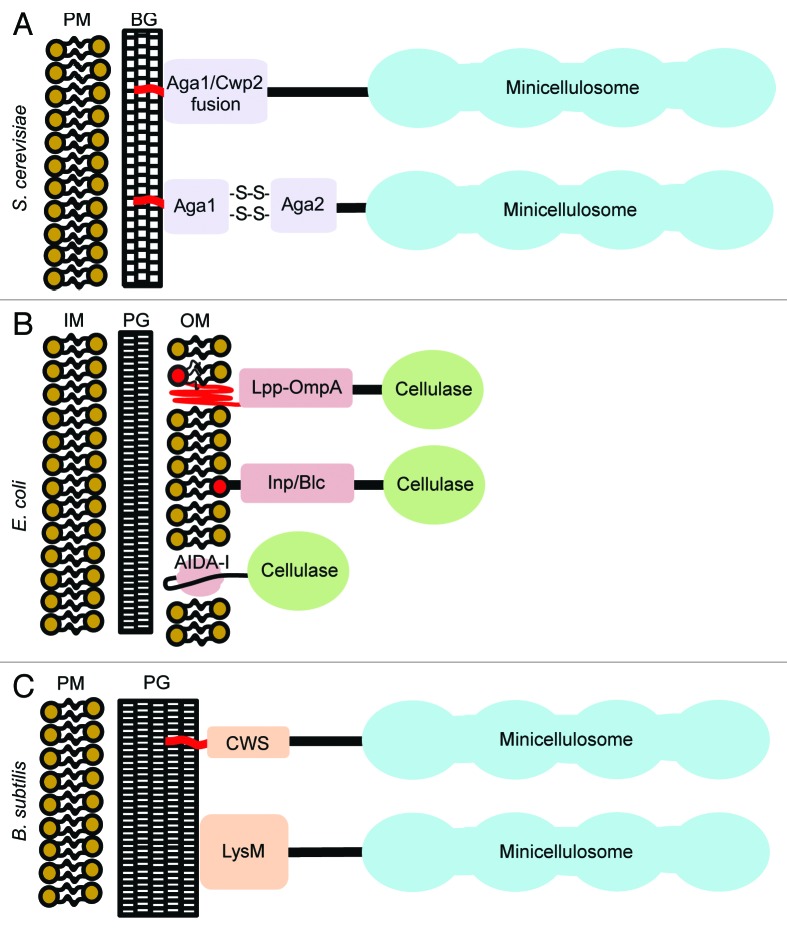
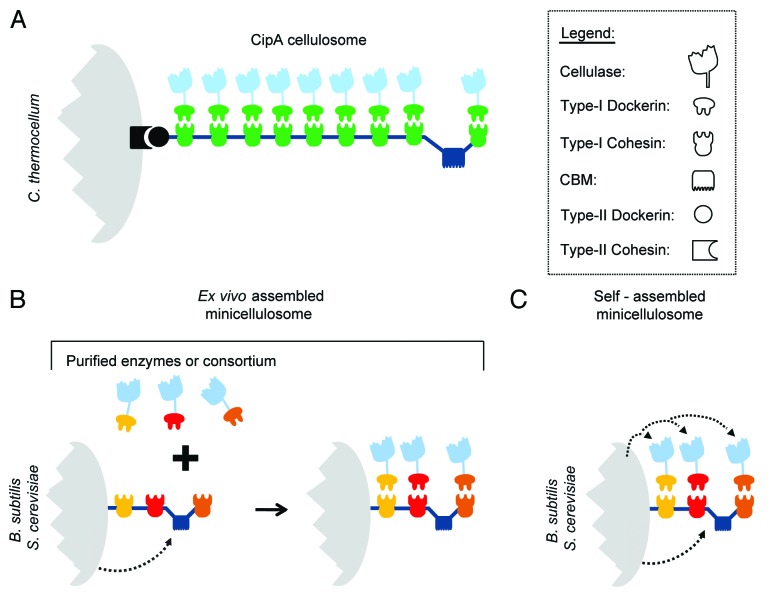
Renewable lignocellulosic plant biomass is a promising feedstock from which to produce biofuels, chemicals, and materials. One approach to cost-effectively exploit this resource is to use consolidating bioprocessing (CBP) microbes that directly convert lignocellulose into valuable end products. Because many promising CBP-enabling microbes are non-cellulolytic, recent work has sought to engineer them to display multi-cellulase containing minicellulosomes that hydrolyze biomass more efficiently than isolated enzymes. In this review, we discuss progress in engineering the surfaces of the model microorganisms: Bacillus subtilis, Escherichia coli, and Saccharomyces cerevisiae. We compare the distinct approaches used to display cellulases and minicellulosomes, as well as their surface enzyme densities and cellulolytic activities. Thus far, minicellulosomes have only been grafted onto the surfaces of B. subtilis and S. cerevisiae, suggesting that the absence of an outer membrane in fungi and Gram-positive bacteria may make their surfaces better suited for displaying the elaborate multi-enzyme complexes needed to efficiently degrade lignocellulose.
可再生木质纤维素植物生物质是一种很有前景的原料,可用于生产生物燃料、化学品和材料。一种经济高效地利用这种资源的方法是使用整合生物加工(CBP)微生物,这些微生物可直接将木质纤维素转化为有价值的最终产品。由于许多有前景的CBP微生物是非纤维素分解菌,最近的研究致力于对它们进行工程改造,使其展示含有多种纤维素酶的小型纤维素体,这种小型纤维素体比分离的酶更有效地水解生物质。在这篇综述中,我们讨论了对模式微生物枯草芽孢杆菌、大肠杆菌和酿酒酵母进行表面工程改造的进展。我们比较了用于展示纤维素酶和小型纤维素体的不同方法,以及它们的表面酶密度和纤维素分解活性。到目前为止,小型纤维素体仅被嫁接到枯草芽孢杆菌和酿酒酵母的表面,这表明真菌和革兰氏阳性细菌缺乏外膜可能使它们的表面更适合展示有效降解木质纤维素所需的复杂多酶复合物。