Arija Victoria, Fargas Francesc, March Gemma, Abajo Susana, Basora Josep, Canals Josefa, Ribot Blanca, Aparicio Estefania, Serrat Nuria, Hernández-Martínez Carmen, Aranda Núria
Unitat de Suport a la Recerca Tarragona-Reus, Institut d'Investigació en Atenció Primària Jordi Gol, Tarragona, Spain.
BMC Pregnancy Childbirth. 2014 Jan 18;14:33. doi: 10.1186/1471-2393-14-33.
Currently, there is no consensus regarding iron supplementation dose that is most beneficial for maternal and offspring health during gestation. Recommended iron supplementation dose does not preempt anemia in around 20% of the pregnancies, nor the risk of hemoconcentration in 15%. This deficit, or excess, of iron prejudices the mother-child wellbeing. Therefore the aims of the study are to determine the highest level of effectiveness of iron supplementation adapted to hemoglobin (Hb) levels in early pregnancy, which would be optimum for mother-child health.
Randomized Clinical Trial (RCT) triple-blindedSetting: 10 Primary Care Centers from Catalunya (Spain)Study subjects: 878 non-anemic pregnant women at early gestation stage, and their subsequent newborns
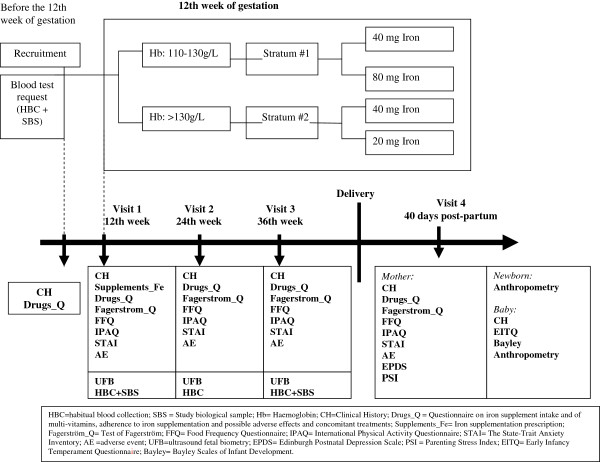
The study is structured as a RCT with 2 strata, depending on the Hb levels before week 12 of gestation. Stratum #1: If Hb from 110 to 130 g/L, randomly assigned at week 12 to receive iron supplement of 40 or 80 mg/d. Stratum #2: If Hb >130 g/L, randomly assigned at week 12 to receive iron supplement of 40 or 20 mg/d.
In the mother: socio-economic data, clinical history, food item frequency, lifestyle and emotional state, and adherence to iron supplement prescription. Biochemical measurements include: Hb, serum ferritin, C reactive protein, cortisol, and alterations in the HFE gene (C282Y, H63D). In children: ultrasound fetal biometry, anthropometric measurements, and temperament development.Statistical analyses, using the SPSS program for Windows, will include bivariate and multivariate analyses adjusted for variables associated with the relationship under study.
Should conclusive outcomes be reached, the study would indicate the optimal iron supplementation dose required to promote maternal and infant health. These results would contribute towards developing guidelines for good clinical practice.
目前,对于孕期补充何种剂量的铁对母体和子代健康最为有益,尚无定论。推荐的铁补充剂量并不能预防约20%的妊娠贫血,也无法预防15%的血液浓缩风险。铁的这种不足或过量都会损害母婴健康。因此,本研究的目的是确定根据孕早期血红蛋白(Hb)水平调整的铁补充剂的最高有效水平,这对母婴健康最为适宜。
随机临床试验(RCT),三盲
来自加泰罗尼亚(西班牙)的10个初级保健中心
878名孕早期非贫血孕妇及其新生儿
根据妊娠第12周前的Hb水平,本研究分为2个层次的随机对照试验。第1层:如果Hb为110至130 g/L,在第12周随机分配接受40或80 mg/d的铁补充剂。第2层:如果Hb>130 g/L,在第12周随机分配接受40或20 mg/d的铁补充剂。
母亲方面:社会经济数据、临床病史、食物频率、生活方式和情绪状态,以及铁补充剂处方的依从性。生化测量包括:Hb、血清铁蛋白、C反应蛋白、皮质醇以及HFE基因(C282Y、H63D)的改变。儿童方面:超声胎儿生物测量、人体测量和气质发育。使用Windows版SPSS程序进行统计分析,包括双变量和多变量分析,并对与研究关系相关的变量进行调整。
如果得出确凿的结果,该研究将表明促进母婴健康所需的最佳铁补充剂量。这些结果将有助于制定良好临床实践指南。