Meier Sebastian, Jensen Pernille R, Karlsson Magnus, Lerche Mathilde H
Carlsberg Laboratory, Gamle Carlsberg Vej 10, 1799 Copenhagen V, Denmark.
Sensors (Basel). 2014 Jan 16;14(1):1576-97. doi: 10.3390/s140101576.
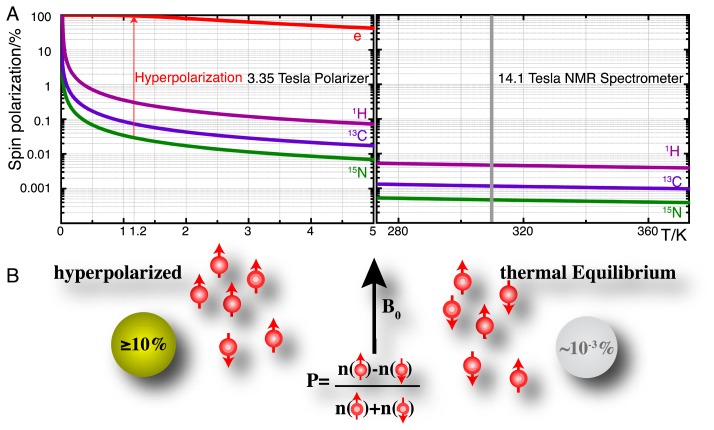
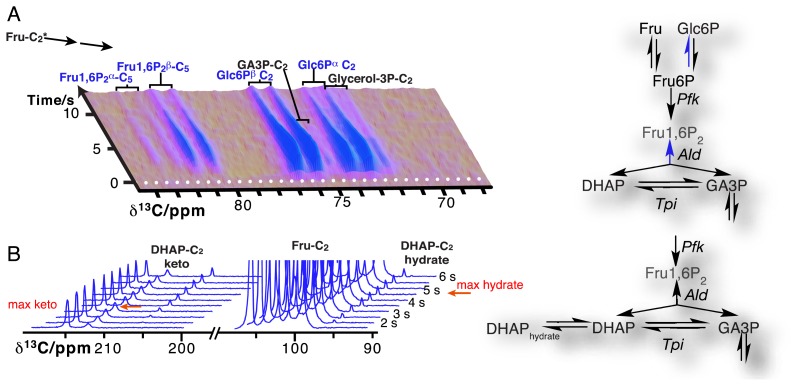
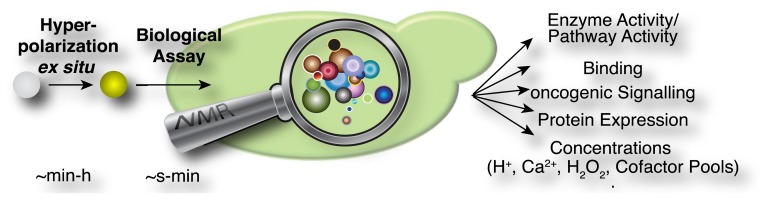
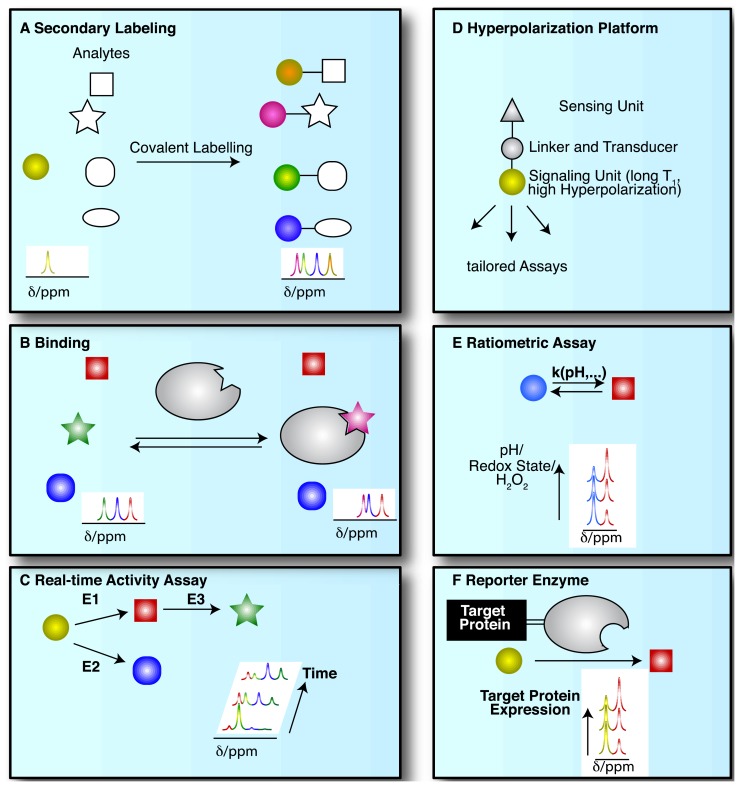
During the last decade, the development of nuclear spin polarization enhanced (hyperpolarized) molecular probes has opened up new opportunities for studying the inner workings of living cells in real time. The hyperpolarized probes are produced ex situ, introduced into biological systems and detected with high sensitivity and contrast against background signals using high resolution NMR spectroscopy. A variety of natural, derivatized and designed hyperpolarized probes has emerged for diverse biological studies including assays of intracellular reaction progression, pathway kinetics, probe uptake and export, pH, redox state, reactive oxygen species, ion concentrations, drug efficacy or oncogenic signaling. These probes are readily used directly under natural conditions in biofluids and are often directly developed and optimized for cellular assays, thus leaving little doubt about their specificity and utility under biologically relevant conditions. Hyperpolarized molecular probes for biological NMR spectroscopy enable the unbiased detection of complex processes by virtue of the high spectral resolution, structural specificity and quantifiability of NMR signals. Here, we provide a survey of strategies used for the selection, design and use of hyperpolarized NMR probes in biological assays, and describe current limitations and developments.
在过去十年中,核自旋极化增强(超极化)分子探针的发展为实时研究活细胞的内部运作开辟了新机遇。超极化探针在体外制备,引入生物系统,并使用高分辨率核磁共振波谱以高灵敏度和相对于背景信号的高对比度进行检测。各种各样的天然、衍生化和设计的超极化探针已出现,用于各种生物学研究,包括细胞内反应进程、途径动力学、探针摄取和输出、pH值、氧化还原状态、活性氧、离子浓度、药物疗效或致癌信号的测定。这些探针可在生物流体的自然条件下直接轻松使用,并且通常直接针对细胞测定进行开发和优化,因此在生物学相关条件下其特异性和实用性几乎毋庸置疑。用于生物核磁共振波谱的超极化分子探针凭借核磁共振信号的高光谱分辨率、结构特异性和可量化性,能够对复杂过程进行无偏差检测。在此,我们综述了在生物学测定中用于超极化核磁共振探针的选择、设计和使用的策略,并描述了当前的局限性和进展。