Hunt Kate, Gray Cindy M, Maclean Alice, Smillie Susan, Bunn Christopher, Wyke Sally
MRC/CSO Social and Public Health Sciences Unit, University of Glasgow, 4 Lilybank Gardens, Glasgow G12 8RZ, UK.
BMC Public Health. 2014 Jan 21;14:50. doi: 10.1186/1471-2458-14-50.
The prevalence of obesity in men in the UK is amongst the highest in Europe but men are less likely than women to use existing weight loss programmes. Developing weight management programmes which are appealing and acceptable to men is a public health priority. Football Fans in Training (FFIT), a men-only weight management programme delivered to groups of men at top professional football clubs, encourages men to lose weight by working with, not against, cultural ideals of masculinity. To inform further development of interventions in football club settings, the current study explored who is attracted to FFIT and why overweight/obese men choose to take part.
A mixed-methods study analysing baseline data on 747 men aged 35-65 years with BMI ≥ 28 kg/m2 who were participants in a randomised controlled trial of FFIT, and data from 13 focus group discussions with 63 men who had attended the programme.
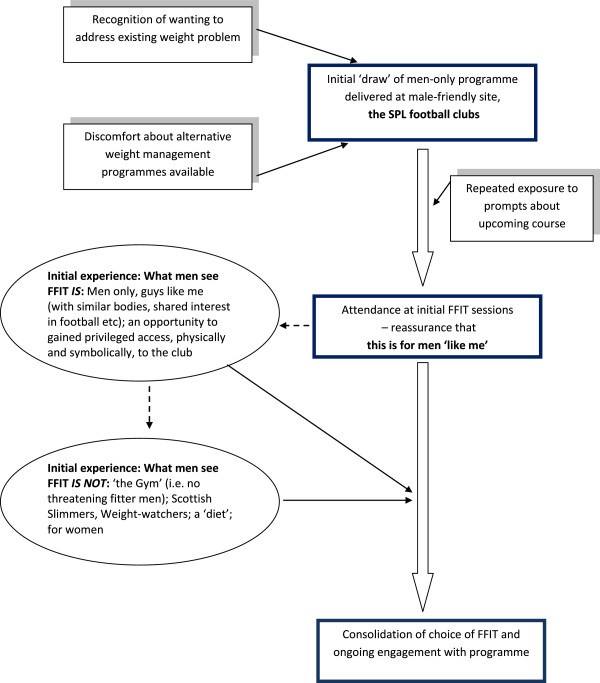
Objectively-measured mean body mass index was 35.3 kg/m2 (sd 4.9). Overall over 90% of participants were at very high or extremely high risk of future ill-health. Around three-quarters of participants in all age groups were at 'very high' risk of type 2 diabetes, hypertension and cardiovascular disease (72%, 73% and 80% of men aged 35-44, 45-54 and 55-64 years respectively). A further 21%, 16% and 13% were at 'extremely high' risk. Qualitative data revealed that the powerful 'draw' of the football club attracted men otherwise reluctant to attend existing weight management programmes. The location and style of delivery of early FFIT sessions fostered team spirit; men appreciated being with others 'like them' and the opportunity to undertake weight management in circumstances that enhanced physical and symbolic proximity to something they valued highly, the football club.
The delivery of a weight management intervention via professional football clubs attracted men at high risk of ill-health. The setting enabled men to join a weight management programme in circumstances that felt 'right' rather than threatening to themselves as men. FFIT is an example of how to facilitate health promotion activities in a way that is consistent with, rather than challenging to, common ideals of masculinity.
英国男性肥胖率在欧洲位居前列,但男性参与现有减肥项目的可能性低于女性。开发对男性有吸引力且可接受的体重管理项目是一项公共卫生重点工作。“球迷训练计划”(FFIT)是一项仅针对男性的体重管理项目,在顶级职业足球俱乐部向男性群体开展,鼓励男性通过顺应而非违背男性气质的文化理想来减肥。为指导足球俱乐部环境中干预措施的进一步发展,本研究探讨了哪些人被FFIT吸引以及超重/肥胖男性选择参与的原因。
一项混合方法研究,分析了747名年龄在35 - 65岁、BMI≥28kg/m²的男性的基线数据,这些男性参与了FFIT的随机对照试验,同时分析了与63名参加过该项目的男性进行的13次焦点小组讨论的数据。
客观测量的平均体重指数为35.3kg/m²(标准差4.9)。总体而言,超过90%的参与者未来健康状况处于极高或极其高风险。所有年龄组中约四分之三的参与者患2型糖尿病、高血压和心血管疾病的风险为“极高”(35 - 44岁、45 - 54岁和55 - 64岁男性分别为72%、73%和80%)。另有21%、16%和13%处于“极其高”风险。定性数据显示,足球俱乐部强大的“吸引力”吸引了原本不愿参加现有体重管理项目的男性。早期FFIT课程的地点和开展方式培养了团队精神;男性喜欢与“和自己一样”的人在一起,并且有机会在增强与他们高度重视的事物(足球俱乐部)的身体和象征意义上的亲近感的环境中进行体重管理。
通过职业足球俱乐部开展体重管理干预措施吸引了健康状况高风险的男性。这种环境使男性能够在感觉“合适”而非对自身男性身份构成威胁的情况下加入体重管理项目。FFIT是一个如何以符合而非挑战男性常见理想的方式促进健康促进活动的例子。